 By Naman Gundaniya
AI in 2030: Five Bets I'm Making as an AI Engineer
My five bets for AI in 2030: agents will handle multi-day work on their own, intelligence will be cheap but energy and checking will not, most business software will have agents inside, jobs will reshuffle rather than vanish, and the web will serve agents as much as people. Each bet rests on a measured trend, and each could be wrong.
This post closes my series on where AI and work are heading. Forecasts are cheap, so I have tried to make these specific enough to be checked in 2030. For each bet I give the evidence I am leaning on, what would prove me wrong, and what I am doing about it. Everything labelled as a bet is my opinion. Everything with a link is someone else's data.
Bet 1: AI agents will finish multi-day work on their own
By 2030 I expect agents to complete tasks that take a skilled person several days, without a human steering each step. This is the bet with the best data behind it.
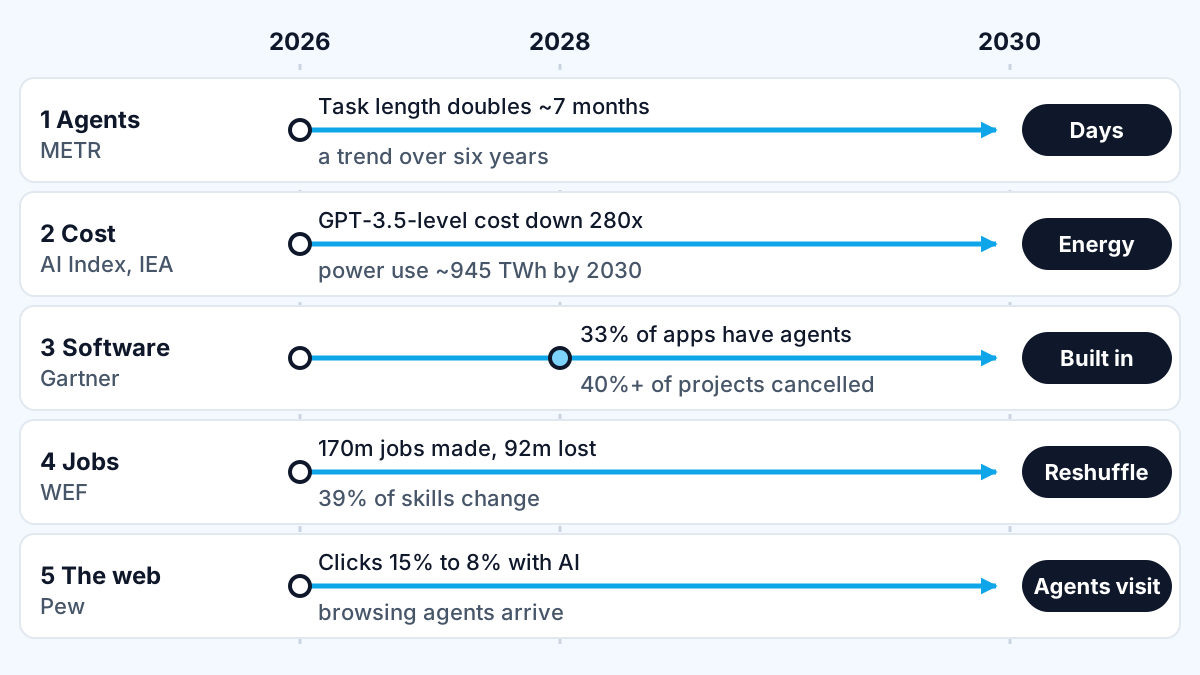
METR, an AI evaluation group, measures the length of tasks, timed by how long human experts take, that frontier models can complete with 50% reliability. That "time horizon" has doubled roughly every 7 months for six years, and METR notes that if the trend holds to the end of the decade, frontier systems "will be capable of autonomously carrying out month-long projects." METR is careful about the caveats: results depend on the tasks chosen, and the trend could change.
I am betting on days rather than a month because reliability lags capability. A 50% success rate is a research milestone, not something a client can deploy. What would prove me wrong: the doubling stalls for two years or more. How I am preparing: I already give agents a way to check their own work, and I write specs and acceptance tests before I let one run. Long tasks fail on vague goals, not on typing speed.
Bet 2: Intelligence will be cheap, energy and checking will not
By 2030 the price of a given level of AI capability will be a rounding error, and the real costs will be electricity and human review. The first half is already visible: Stanford's AI Index found the cost of running a system at GPT-3.5's level fell more than 280-fold between November 2022 and October 2024, while hardware costs fell about 30% a year and energy efficiency improved about 40% a year.
The other half is physical. The International Energy Agency projects global data centre electricity demand will more than double by 2030 to around 945 terawatt-hours, with demand from AI-optimised data centres growing more than fourfold. Cheap tokens, consumed in vast numbers, still add up to a power bill the size of a country.
What would prove me wrong: prices for frontier capability stay flat for several years. How I am preparing: I design client systems so the model can be swapped, cache what can be cached and match the model to the task, the same habits I describe in how to reduce LLM costs. Cheap intelligence rewards teams that can change suppliers in a day.
Bet 3: Most business software will ship with agents inside, and most early agent projects will fail
By 2030 an agent will be a normal feature of business software, like search or notifications, and the failures of the first wave will be forgotten. Gartner predicts that by 2028, 33% of enterprise software applications will include agentic AI, up from under 1% in 2024, and that at least 15% of day-to-day work decisions will be made autonomously.
The same analysts also expect more than 40% of agentic AI projects to be cancelled by the end of 2027, citing rising costs, unclear business value and weak risk controls, and estimate that only about 130 of the thousands of vendors selling "agentic" products are the real thing. I think both forecasts are right. The projects that survive will be narrow, measurable and owned by someone.
What would prove me wrong: agents stay a chat window bolted onto the side of products rather than doing work inside them. How I am preparing: I scope agent work to one process with a number attached, and I build approval steps in from day one. The memory and permission questions matter more than the model choice.
Bet 4: Jobs will reshuffle, not disappear
By 2030 more jobs will have changed than vanished, and the people who struggle most will be those entering the workforce. The World Economic Forum's Future of Jobs Report 2025, based on a survey of more than 1,000 employers representing over 14 million workers, projects 170 million jobs created and 92 million displaced by 2030, a net gain of 78 million. It also expects 39% of workers' existing skills to be transformed or outdated by then, with AI and big data the fastest-growing skills.
Net numbers hide a lot of individual pain, and the people displaced are rarely the ones who get the new roles. My view on software, specifically, is in will AI replace software engineers: the tasks change faster than the job titles.
What would prove me wrong: large, sustained falls in employment across AI-exposed occupations, not only at entry level. How I am preparing: I keep moving towards the parts of the work AI does badly, which are understanding the problem, deciding and owning the outcome.
Bet 5: Websites will serve agents as much as people
By 2030 a large share of the "visits" to a business's website will be AI systems reading it on someone's behalf, either to answer a question or to complete a task. The first half is measured: Pew found Google users clicked a result on 8% of visits when an AI summary appeared, against 15% without one. The second half is arriving through browsers that click for you, which I covered in agentic browsers.
What would prove me wrong: AI answers and browsing agents stay a niche used by early adopters. How I am preparing: I build sites with clean structure, real data and clear actions, and I treat an API or MCP server as part of the website for businesses whose customers will send agents.
The five bets at a glance
| Bet | Evidence today | What would change my mind |
|---|---|---|
| Agents finish multi-day work | Time horizon doubling about every 7 months (METR) | Two years without the trend continuing |
| Intelligence cheap, energy and checking not | 280-fold cost fall (AI Index); data centre demand to about 945 TWh (IEA) | Frontier prices flat for years |
| Agents inside most business software | 33% of enterprise apps by 2028 (Gartner) | Agents stay a chat sidebar |
| Jobs reshuffle, not vanish | 170m created, 92m displaced by 2030 (WEF) | Broad, sustained job losses in exposed roles |
| Websites serve agents | Clicks fall from 15% to 8% with AI summaries (Pew) | AI answers stay niche |
Work with me
I build AI agents and full-stack products for teams that want to be ready for where this is going, not where it was. See AI agent development and full-stack development, or browse my work and book a scoping call.
Frequently asked
What will AI be like in 2030?
Nobody knows precisely, but measured trends point to agents that can work on their own for days, much cheaper AI per task, and AI built into most business software. METR has found the length of tasks AI can complete doubling about every 7 months, and Gartner expects a third of enterprise apps to include agentic AI by 2028.
Will AI take most jobs by 2030?
The best available forecast says no: the World Economic Forum projects 170 million jobs created and 92 million displaced by 2030, a net gain of 78 million. It also expects 39% of workers' skills to change, so most people will do different work rather than no work.
How much energy will AI use by 2030?
The International Energy Agency projects global data centre electricity demand will more than double to around 945 terawatt-hours by 2030, with demand from AI-optimised data centres growing more than fourfold. Energy is likely to become one of the main limits on how fast AI grows.
How should I prepare for AI in 2030?
Learn to direct and check AI work rather than compete with it on routine tasks. In practice that means writing clear specs, verifying output, understanding the business problem and owning results. Those skills get more valuable as agents take on longer tasks.
Sources
- doubled roughly every 7 months for six years (metr.org)
- fell more than 280-fold between November 2022 and October 2024 (hai.stanford.edu)
- more than double by 2030 to around 945 terawatt-hours (publicpower.org)
- biztechreports.com
- more than 1,000 employers representing over 14 million workers (peoplematters.in)
- 8% of visits when an AI summary appeared, against 15% without one (pewresearch.org)
Related services
Building something like this?
Naman Gundaniya takes on full-stack and AI projects fixed quote after a free 30-minute scoping call, replies within 24 hours.
Get in touch