 By Naman Gundaniya
AI Lead Generation That Doesn't Feel Like Spam
AI lead generation works when you use AI for research and judgement rather than volume: define a narrow ideal customer, let a research agent gather verifiable facts about each prospect, score fit, and draft a short message a person reviews and sends. Keep volumes low, authenticate your domain and honour opt-outs. Mass AI emails mostly damage deliverability.
The easiest thing to do with AI in sales is also the worst: generate thousands of "personalised" emails and send them all. It looks productive for a week. Then reply rates fall, spam complaints rise, and the domain your real customers rely on starts landing in junk folders.
The better use is the opposite. AI is very good at the slow part of prospecting, reading a company's website, recent news and job posts to decide whether they are a fit and what to say. Used that way, it lets one person do careful outreach to more of the right people, not careless outreach to everyone.
What does AI actually do well in lead generation?
AI does three things well in lead generation: research, fit scoring and first drafts. It does badly when asked to decide who to contact at scale without rules, or to invent rapport it does not have.
| Task | Good use of AI | Poor use of AI |
|---|---|---|
| Finding prospects | Filtering a list you are allowed to use against clear criteria | Scraping sites and platforms that forbid it |
| Research | Summarising a company's site, news and hiring, with sources | Guessing facts when nothing is found |
| Fit scoring | Scoring against a written ideal customer profile, with reasons | Scoring on vague "intent" with no explanation |
| Drafting | A short, specific first draft for a person to edit | Fully automated sends with no review |
| Follow-up | Reminding a person when a reply needs attention | Endless automated sequences to non-responders |
| Replies | Classifying replies (interested, not now, unsubscribe) | Arguing with people who said no |
The pattern is the same as most good automation: AI handles the reading and sorting, a person handles judgement and anything that speaks for the business.
What does a quality-first AI lead generation workflow look like?
A quality-first workflow is short and has a human gate before anything is sent. This is the shape I build for clients.
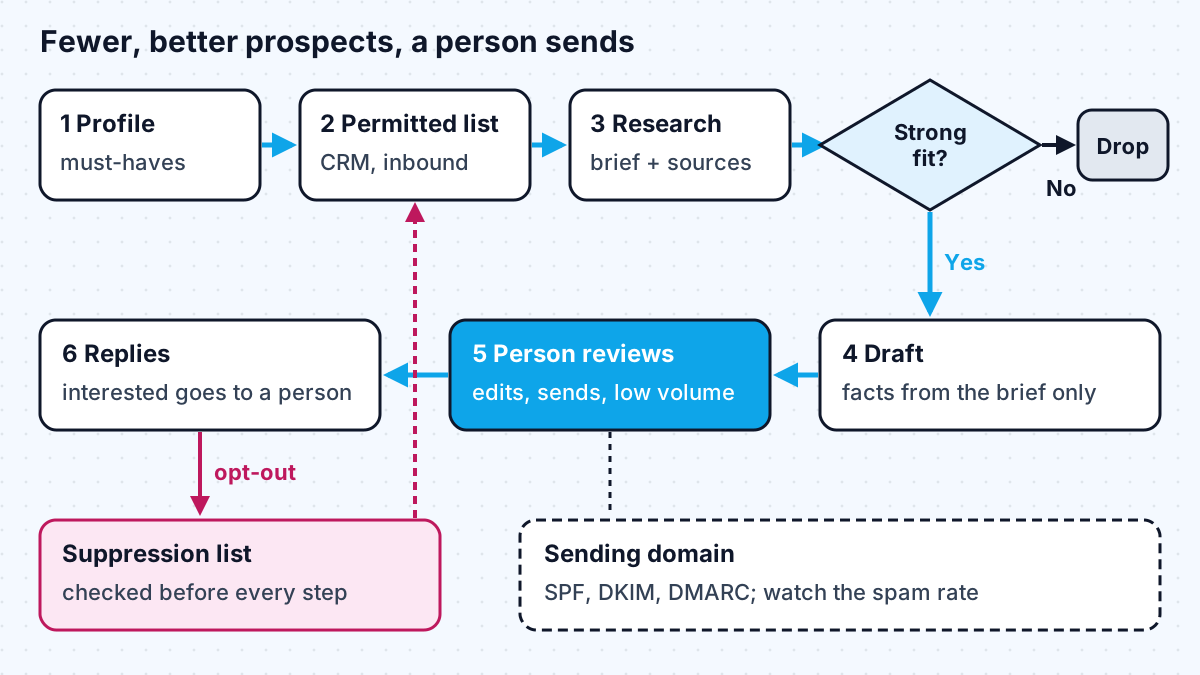
- Write the ideal customer profile. Industry, size, region, the problem you solve, and deal-breakers. If you cannot write it down, AI cannot apply it.
- Build the list from permitted sources. Your CRM, past inbound leads, event attendee lists you are allowed to use, partners, and data providers whose licence covers outreach. Be careful with platforms: LinkedIn's help page on prohibited software says it does not permit third-party "crawlers" or bots, and lists using automated methods to "send or redirect messages" among prohibited uses.
- Research each prospect. An agent reads the company's public website, recent news and job listings, and writes a short brief: what they do, any relevant change, why you might help, with a link for each fact.
- Score fit and drop the weak ones. The agent scores against the profile and explains the score. Anything below the bar is dropped or parked. This step is where most of the value is: fewer, better prospects.
- Draft a short message. Three or four sentences that reference one verifiable fact from the brief and one specific way you could help. No flattery, no fake familiarity.
- A person reviews and sends. They check the facts, fix the tone and send from a properly authenticated domain, at a pace they can follow up on personally.
- Handle replies and opt-outs. Classify replies, route interested ones to a person, and add any opt-out to a suppression list that every earlier step checks.
I listed lead research briefs as one of the quick wins in AI automation ideas for agencies; this is the same idea taken further.
Where are the limits of AI personalisation?
AI personalisation stops being useful the moment it invents something or becomes uncomfortably personal. The rule I use: mention only what a thoughtful person could have found in two minutes on the company's own public pages, and cite it in the brief so a reviewer can check it.
Things to avoid:
- Invented facts. Models will fill gaps with plausible guesses. If the research found nothing specific, the draft should say less, not make something up. Require a source link for every fact in the brief.
- Fake familiarity. "Loved your recent post" when nobody read it. Recipients can tell.
- Personal details. Family, location, personal social media. Business context only.
- Template tells. Opening with the company name in a sentence that could apply to anyone. Specific beats clever.
- Too much. One relevant point is enough. Three paragraphs of research reads like surveillance.
It helps to give the research agent a fixed output format, so reviewers know exactly where to look. The brief I use has five parts:
- Company in one sentence, in plain words, from their own site.
- Relevant change, such as a new product, funding, hiring for a role you support, or an expansion, each with a link and date.
- Fit score and reasons, checked against each must-have and deal-breaker in the profile.
- Suggested angle, one specific way you could help, tied to the relevant change.
- Unknowns, what the agent could not confirm, stated plainly so nobody fills the gap with a guess.
The "unknowns" line matters more than it looks. It gives the model an honest place to put uncertainty, instead of turning it into a confident sentence in the draft.
Keeping a person in the loop is what makes these rules stick. I covered the general pattern in human-in-the-loop AI agents.
Why does mass AI outreach hurt deliverability?
Mass outreach hurts deliverability because mailbox providers measure how recipients react, and unwanted mail raises complaint rates that follow your domain. Google's email sender guidelines require all senders to set up SPF or DKIM and to keep the spam rate reported in Postmaster Tools below 0.3%. Senders of more than 5,000 messages a day to Gmail must also set up SPF, DKIM and DMARC, and marketing messages must support one-click unsubscribe. Google's monitoring guidance recommends staying below 0.1%.
What that means in practice:
- Authenticate everything. SPF, DKIM and DMARC on any domain that sends outreach, set up before the first send.
- Consider a separate domain for outreach, so a mistake does not affect invoices and support email on your main domain. It still has to be clearly yours.
- Keep volumes human. If a person reviews every message, volume stays naturally low, and that is the point.
- Stop when people say stop. Fewer, better messages earn fewer complaints.
There are legal rules too, and they differ by country. In the US, the FTC's CAN-SPAM compliance guide says "the law makes no exception for business-to-business email", and requires accurate headers, non-deceptive subject lines, a valid physical postal address and opt-outs honoured "within 10 business days", with penalties of up to $53,088 per violating email. The UK, EU and other regions have their own rules on electronic marketing and personal data, which are often stricter; check them with your adviser before you start.
How do you measure whether it is working?
Measure replies and conversations, not emails sent. A good AI lead generation setup sends fewer emails than before and gets more useful replies from them.
- Positive reply rate: interested replies divided by messages sent.
- Meetings booked from outreach.
- Spam complaint rate in Postmaster Tools, kept well under Google's limit.
- Research accuracy: how often a reviewer has to correct a fact in a brief.
- Time per prospect for the person reviewing, which shows whether the research is saving effort.
If you are building a business case for the build, my post on AI automation ROI shows how to turn time saved and conversion changes into a number.
Work with me
I build research agents and outreach workflows with a human review step, a suppression list and proper domain setup from the start. See AI agent development and workflow automation, browse my work, and book a scoping call.
Frequently asked
How can AI be used for lead generation?
AI can research prospects from public sources, score them against your ideal customer profile, draft short personalised messages, and classify replies. It works best when a person reviews and sends each message, because the value is in better targeting, not higher volume.
Does AI cold email outreach hurt deliverability?
It can, if it is used to send high volumes. Mailbox providers watch complaint rates; Google requires senders to keep the spam rate in Postmaster Tools below 0.3% and recommends staying below 0.1%. Low, reviewed volumes from an authenticated domain protect deliverability.
Is AI-personalised cold email legal?
It depends on the country. In the US, CAN-SPAM covers business-to-business email and requires accurate headers, honest subject lines, a postal address and opt-outs honoured within 10 business days. The UK and EU have their own, often stricter, rules on electronic marketing and personal data, so check them before sending.
Can I use AI tools to automate LinkedIn outreach?
Be careful. LinkedIn's help centre says it does not permit third-party crawlers or bots, and lists using automated methods to send messages among prohibited uses, with a risk of account restriction. Use AI for research and drafting, and send messages yourself.
What should an AI prospect research brief include?
It should include what the company does, any relevant recent change such as new funding, hiring or a product launch, why your service might fit, and a source link for each fact. If the research finds nothing specific, the brief should say so rather than guess.
Sources
Related services
Building something like this?
Naman Gundaniya takes on full-stack and AI projects fixed quote after a free 30-minute scoping call, replies within 24 hours.
Get in touch