 By Naman Gundaniya
Generative Engine Optimization: Ranking Inside AI Answers
Generative engine optimization (GEO) is the practice of making your pages easy for AI answer engines to find, understand and quote. In practice it means letting their crawlers in, serving the content as plain HTML, putting a direct answer at the top of each section, and backing claims with sources and statistics, which is what research found raises citation rates most.
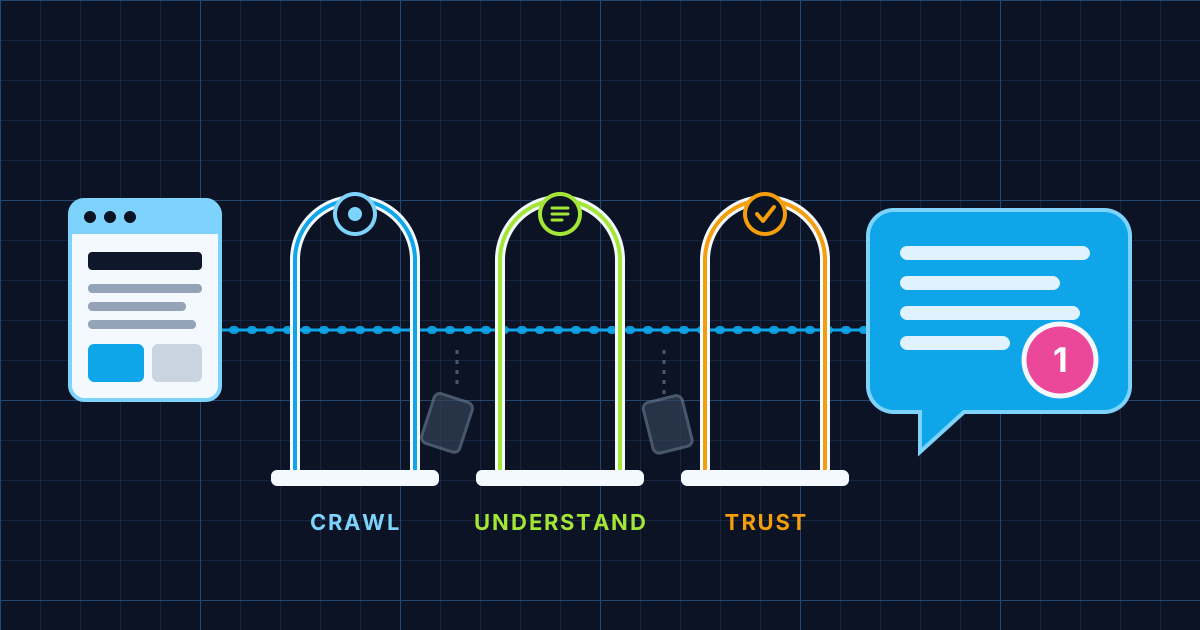
Search is no longer only ten blue links. People ask ChatGPT, Perplexity or Google's AI Mode a question and read a written answer with a few citations. If your page is one of those citations, you get the click and the credibility. If it is not, you may not exist for that reader. This post explains how those engines pick pages and what I do on this site to be pickable, including where the evidence is thin.
What is generative engine optimization?
GEO is SEO's sibling for answer engines: the goal is to be cited inside a generated answer rather than to rank as a link. The term comes from a 2023 paper by researchers at Princeton and elsewhere, accepted at KDD 2024, which built a benchmark of queries and tested how page edits changed a source's visibility in generated answers. They found GEO methods could raise visibility by up to 40%.
GEO does not replace SEO. Most answer engines retrieve pages from a search index first and then write an answer from what they retrieved, the same retrieve-then-generate pattern behind RAG and agentic RAG. If your page is not indexed, nothing else on this list matters.
| Classic SEO | GEO | |
|---|---|---|
| Goal | Rank a link on a results page | Be quoted or cited in a written answer |
| Unit that wins | The whole page | A passage, a sentence, a number |
| Main signals | Relevance, links, page experience | Retrievability, a clear answer, evidence |
| Crawlers to allow | Googlebot, Bingbot | Those plus OAI-SearchBot, PerplexityBot and similar |
| How you measure | Rankings, clicks | Citations and referral traffic from AI tools |
How do ChatGPT, Perplexity and Google pick which pages to cite?
Each engine retrieves candidate pages with its own crawler or index, then the model writes an answer and attaches the pages it drew on. The details differ, but every engine publishes the first gate: whether its crawler may read you.
- ChatGPT search uses OAI-SearchBot. OpenAI states that sites opted out of OAI-SearchBot will not be shown in ChatGPT search answers. GPTBot is a separate crawler for model training, so you can block training and still allow search.
- Perplexity uses PerplexityBot, which is designed to surface and link websites in Perplexity search results and is not used for training foundation models.
- Google AI Overviews and AI Mode use the normal Google index. Google says there are no additional requirements or special optimisations needed: a page must be indexed and eligible to show with a snippet.
After retrieval, the choice is the model's, and nobody outside these companies knows the exact rules. What we do have is controlled research on what makes a source more likely to be used, and that is where the practical advice comes from.
What actually moves citations: the evidence
The strongest evidence is still the original GEO paper, and its findings are specific. The methods that worked best were adding quotations, adding statistics and citing sources, which gave a relative improvement of 30-40% on its main visibility metric. Making text more fluent and easier to read also helped, by 15-30%.
Two results are worth remembering:
- Keyword stuffing did not help. It scored below the unedited baseline in the paper's tests, and on Perplexity it performed about 10% worse than the baseline.
- Smaller sites gained most. For a source ranked fifth in the retrieved results, citing sources raised visibility by 115.1%, while top-ranked sources tended to lose visibility from the same edits.
That second result is the hopeful one for a small site like mine. You do not need to be the biggest page on the topic. You need to be the most quotable one among the pages retrieved.
A caution: the paper tested a benchmark and Perplexity in 2023 and 2024, and engines change. I treat its findings as direction, not as a formula.
How I apply GEO on this site
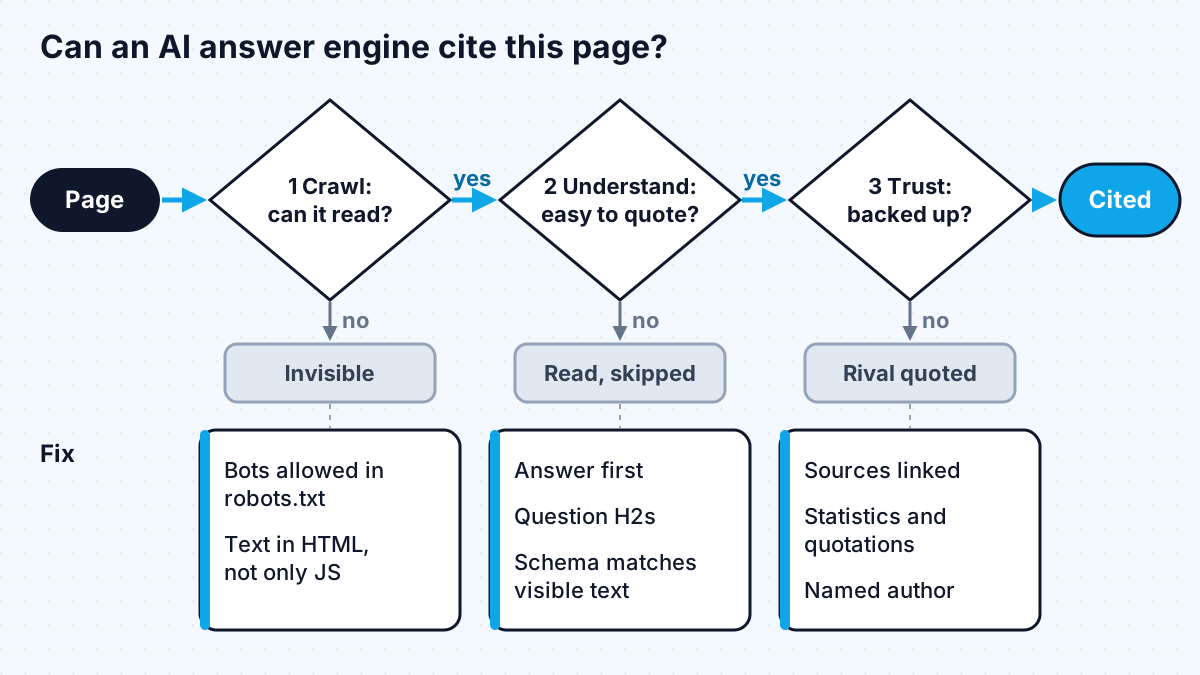
This site is my test bed, so here is what it actually does. Every item maps to one of the three gates.
Crawl
- The pages are server-rendered by Next.js, so the full text is in the HTML. If text only appears after JavaScript runs, a crawler that does not execute scripts sees an empty page.
- The robots file explicitly allows OAI-SearchBot, ChatGPT-User, PerplexityBot, ClaudeBot and the Google and Bing crawlers, and blocks only the API routes.
Understand
- Every post opens with a bold, 40 to 70 word answer to its title, written to be quotable on its own.
- Every H2 is phrased as the question it answers, and the first sentence under it is a self-contained answer.
- Each post has BlogPosting and FAQPage structured data, and every FAQ in the markup is also visible on the page. Google asks that structured data match the visible text, and that it is not a special requirement for AI features.
Trust
- Every statistic links inline to the page I read it on, which is also what the GEO paper rewards.
- Posts carry a named author with a real profile and case studies, rather than an anonymous byline.
One honest caveat: when I last checked, in late 2026, this site was not yet appearing for its target queries at all. GEO works on top of indexing and authority, and those take time and verified search console accounts. Good structure makes a page citable. It does not make it known.
Does llms.txt help with AI search?
Probably not much for search today, though it is cheap to add. llms.txt is a proposal from Jeremy Howard, first published in September 2024, for a Markdown file at the root of a site that tells AI agents what the site is and links to its most useful pages. The only required element is an H1 with the site's name.
Google has been direct that you do not need AI text files or new machine-readable files to appear in its AI features. This site has an llms.txt anyway, generated from the same data as the pages, because it costs nothing to maintain and helps agents that do read it. I would not spend more than an hour on it.
A GEO checklist you can run this week
- Check robots.txt for each engine you care about: OAI-SearchBot, PerplexityBot, Googlebot, Bingbot. Decide separately whether to allow training crawlers such as GPTBot.
- View source, not the rendered page. If your main content is not in the raw HTML, fix rendering first.
- Rewrite your top pages' openings so the first two sentences answer the question directly.
- Turn H2s into questions people actually ask, with the answer in the first sentence beneath each one.
- Add evidence: a statistic with its source, a quotation from a primary document, or your own data.
- Add structured data that matches the page, such as FAQPage and Article, and validate it.
- Measure referral traffic from chatgpt.com, perplexity.ai and similar in your analytics, and test your key questions in each engine every month.
If your site is a web app rather than a content site, the same rules apply to its public pages. Adding AI features to the product is a separate job, covered in how to add AI to an existing app.
Work with me
I build fast, server-rendered Next.js sites and AI features with this structure built in, from answer-first content to matching structured data. See full-stack development and AI integration, or look through my work and book a scoping call.
Frequently asked
What is the difference between GEO and SEO?
SEO aims to rank a page as a link in search results, while GEO aims to have a page quoted or cited inside an AI-generated answer. They overlap heavily, because most answer engines retrieve from a search index first. GEO adds emphasis on answer-first writing, evidence such as statistics and sources, and allowing AI search crawlers.
How do I get my website cited by ChatGPT?
Allow OAI-SearchBot in your robots.txt, because OpenAI says sites that block it will not appear in ChatGPT search answers. Then make sure the content is in the HTML, open each section with a direct answer and support claims with sources and statistics. There is no way to guarantee a citation.
Do I need special schema markup for Google AI Overviews?
No. Google says there is no special structured data needed for AI Overviews or AI Mode, and no additional requirements beyond being indexed and eligible to show with a snippet. Standard structured data still helps, as long as it matches the visible text on the page.
Does keyword stuffing work for AI search?
No. In the original GEO research, keyword stuffing scored below the unedited baseline, and on Perplexity it performed about 10% worse. Adding statistics, quotations and cited sources performed best.
Sources
- accepted at KDD 2024 (arxiv.org)
- developers.openai.com
- designed to surface and link websites in Perplexity search results (docs.perplexity.ai)
- no additional requirements or special optimisations needed (developers.google.com)
- a relative improvement of 30-40% on its main visibility metric (arxiv.org)
- proposal from Jeremy Howard, first published in September 2024 (llmstxt.org)
Related services
Building something like this?
Naman Gundaniya takes on full-stack and AI projects fixed quote after a free 30-minute scoping call, replies within 24 hours.
Get in touch