 By Naman Gundaniya
AI Search Is Eating Google: What Changes for Websites
AI search reduces clicks to websites when the answer fits in a summary. Pew Research found Google users clicked a result on 8% of visits when an AI summary appeared, against 15% without one, and Ahrefs measured a 58% lower click rate for the top result. Pages that offer something a summary cannot, such as tools, original data or a transaction, still earn the visit.
The headline is deliberately provocative. Google is not dying: it is becoming an AI answer engine itself, alongside ChatGPT and Perplexity. What is being eaten is the old deal, where a search engine showed ten links and sent you a visitor in return for your content. This post looks at what the data says about that deal, which kinds of pages it hurts, and what I would change on a website now.
How much traffic are AI answers taking from websites?
The best independent studies show a large drop in clicks when an AI answer appears, while Google says its total clicks are stable. Both can be true: fewer clicks per AI-answered search, more searches overall.
| Source | What it measured | Finding |
|---|---|---|
| Pew Research Center | 68,879 Google searches by 900 US adults, March 2025 | Clicked a traditional result on 8% of visits with an AI summary, 15% without |
| Pew Research Center | Same data | About 1% of visits with a summary included a click on a link inside it; 26% ended the browsing session, against 16% without |
| Ahrefs | 300,000 keywords, December 2023 against December 2025 | AI Overviews correlate with a 58% lower click-through rate for the top-ranking page |
| Its own search data, 2025 | Total organic click volume "relatively stable year-over-year", with "average click quality" up |
Ahrefs is careful to call its result a correlation, and Google's claim is about totals across all of Search, not about any one site. In practice the effect lands unevenly. Sites that lived on informational queries feel it most.
Which searches end without a click?
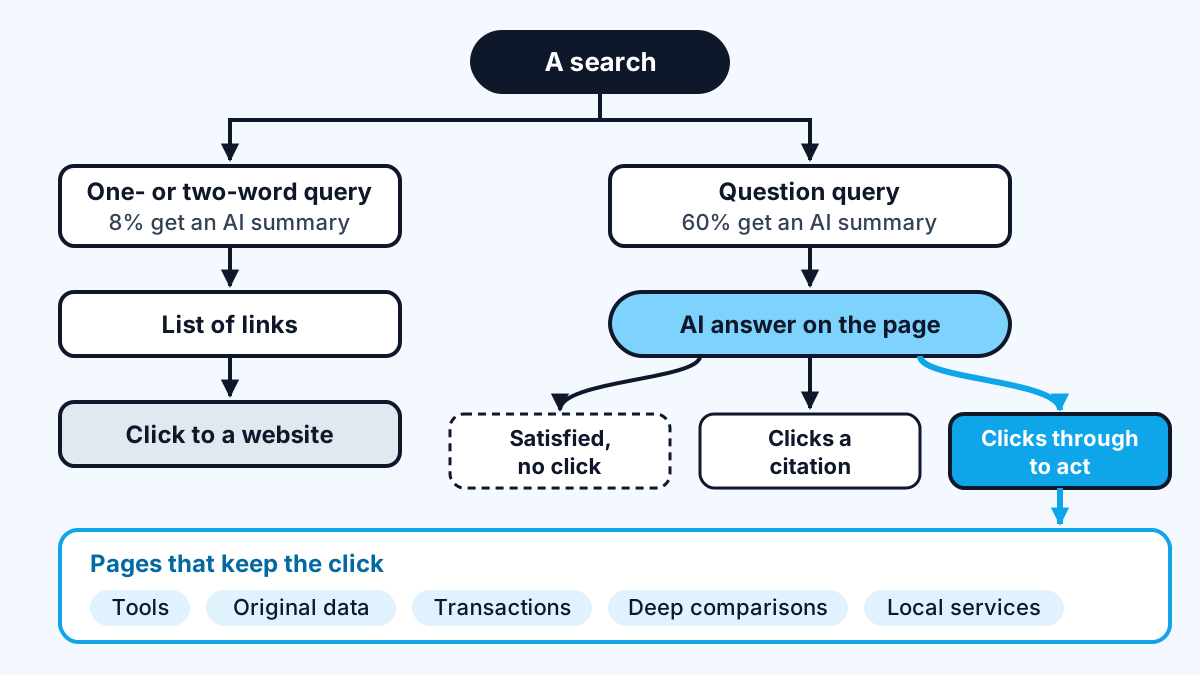
Searches phrased as questions are the most likely to get an AI answer, and those are exactly the searches that used to send informational traffic. Pew found that 60% of queries starting with who, what, when or why produced an AI summary, against just 8% of one- or two-word searches. For queries of 10 words or more, the figure was 53%.
That pattern tells you where the risk is. A short navigational search, such as a brand name, still shows links. A long, conversational question, such as "how long does it take to build a chatbot for a small business", is likely to be answered on the page.
How do AI search engines choose their sources?
AI search engines retrieve pages from an index, write an answer from them and cite a handful. For Google, the entry ticket is unchanged: it states there are "no additional requirements to appear in AI Overviews or AI Mode", only that a page is indexed and eligible to show a snippet. Google also explains that these features may use "query fan-out", issuing several related searches across subtopics to build one answer, which lets them cite a wider set of pages than a classic results page.
The sources that win are not evenly spread. In Pew's data, Wikipedia, YouTube and Reddit were the most-linked sites in both AI summaries and standard results, and government sites made up 6% of summary sources against 2% of standard results. Reference material, community discussion and official sources are favoured.
I covered the mechanics of getting cited, including crawler access and how to structure a page, in generative engine optimization. This post is about the business side: what happens to the visit.
Which pages still get clicks from AI search?
Pages still earn clicks when the reader has to do something the answer cannot do for them. This is my view from building and auditing sites, not a measured ranking, but it follows from the data above:
- Tools and calculators. An AI can explain a pricing model; it cannot run your quote builder with the reader's numbers.
- Original data. If you publish the survey, benchmark or dataset, AI answers cite you, and readers who need the detail click.
- Transactions. Booking, buying, signing up and contacting still happen on your site.
- Deep comparisons and case studies. A summary gives the verdict. People making an expensive decision want the evidence.
- Local and service pages. "Who can do this for me" questions end with a choice of provider, and the provider's page is where trust is earned.
The pages most at risk are the thin explainers written to catch a question and show ads around the answer. If an AI can answer the question in two sentences, it will.
What should you change on your website?
You should stop measuring success only by visits and start making pages that are worth citing and worth clicking. My checklist for client sites:
- Check you are retrievable. Indexed, crawlable, served as HTML, not blocked from the AI crawlers you want to be cited by.
- Answer first, then go deeper. Put a direct answer at the top of each page, then give the depth, data and examples that a summary cannot carry.
- Publish something only you have. Your own numbers, process, case studies or tools. These are what get cited and what earn the click.
- Turn informational pages into next steps. Every explainer should lead to a calculator, a demo, a contact form or a related decision page.
- Measure the right thing. Google reports AI Overviews and AI Mode traffic inside the normal Search Console performance report under the Web search type, so it will not appear separately. Track conversions, branded searches and referrals from AI tools alongside clicks.
- Decide what you will not give away. Google's
nosnippet,data-nosnippetandmax-snippetcontrols limit what appears from your pages, at the cost of visibility. Use them only on content whose value depends on the visit.
Some businesses go one step further and put an AI assistant on their own site, so visitors who arrive with a question get an answer grounded in their content; my website chatbot build guide covers that build. I cover how to bolt that kind of feature onto a site you already run in adding AI to an existing app.
Is AI search really eating Google?
Not in the sense of replacing it: Google is one of the biggest AI answer engines, and it says AI features are driving more queries. What is shrinking is the share of searches that end on someone else's website. My view is that this trend will continue, because answering on the page is better for the searcher, and both Google and its competitors are built around that now.
For a website owner, the practical conclusion is simple. Traffic from questions is becoming a byproduct, not a business model. Being the source the answer cites, and the place the reader goes to act, is the job now.
Work with me
I build fast, well-structured websites and AI features that make a site worth citing and worth visiting. See full-stack development and AI integration, or browse my work and book a scoping call.
Frequently asked
Do AI Overviews reduce website traffic?
Yes, for the searches where they appear. Pew Research found people clicked a traditional result on 8% of Google visits with an AI summary, compared with 15% without, and Ahrefs measured a 58% lower click-through rate for the top-ranking page. Google says total clicks across Search have stayed relatively stable.
What is a zero-click search?
A zero-click search is one where the person gets what they need on the results page and does not visit any website. AI summaries increase these: in Pew's data, 26% of visits to pages with an AI summary ended the browsing session, against 16% of pages without one.
Is SEO still worth it with AI search?
Yes, because AI search engines retrieve from the same indexes. Google says a page must be indexed and eligible for a snippet to appear in AI Overviews, with no extra requirements. What changes is the goal: being cited and earning the visits that need your site, not ranking for every question.
Which websites are most affected by AI search?
Sites that depend on informational, question-style queries are most affected, because 60% of searches starting with who, what, when or why triggered an AI summary in Pew's study. Sites built around tools, transactions, original data or local services are less exposed.
Sources
Related services
Building something like this?
Naman Gundaniya takes on full-stack and AI projects fixed quote after a free 30-minute scoping call, replies within 24 hours.
Get in touch