 By Naman Gundaniya
Will AI Replace Software Engineers? A Builder's Honest Answer
No, not as a job, but it is already replacing a large share of the tasks inside the job. The US government still projects software developer employment to grow 10% over the decade, while pure "computer programmer" roles are projected to shrink. The work that remains is deciding what to build, checking what AI writes, and owning the result.
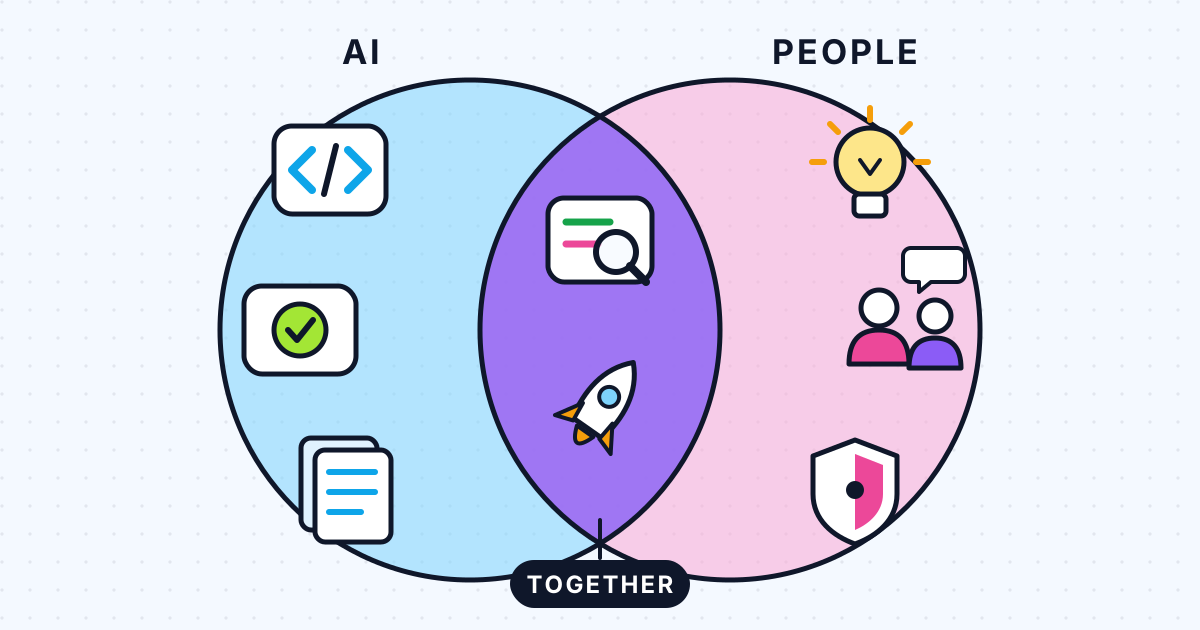
I build AI products for a living, and I use coding agents for a large part of my own work. So I have a stake in both sides of this question: I want the tools to be good, and I want there to be work for engineers. Here is what the data says, and where I think it points.
Why "will AI replace programmers?" is the wrong question
Jobs are bundles of tasks, and AI takes over tasks long before it can take over a bundle. A software engineer's week includes understanding a vague request, deciding what not to build, writing code, reviewing other people's code, debugging production, talking to users and keeping a system running for years. Some of those tasks are now mostly automated. Others have barely changed.
Anthropic's analysis of real coding conversations shows how lopsided this is. When developers used its coding agent, Claude Code, 79% of conversations were classed as automation, where the AI performs the task directly, against 49% on the general Claude.ai chat. The same report found that the most common work was building user interfaces and web apps, and suggested developers whose jobs centre on simple apps "might shift toward higher-level design and user experience work."
That is the pattern I see too: the typing has moved to the machine. The job has not.
What the hiring data actually says
The headline numbers do not support "engineers are finished", but they do show a real shift inside the profession.
| Source | What it found | What it means |
|---|---|---|
| US Bureau of Labor Statistics | Software developers, QA analysts and testers projected to grow 10% from 2025 to 2035, about 106,100 openings a year | Demand for people who design and build software keeps growing |
| US Bureau of Labor Statistics | Computer programmers projected to decline 7% over the same decade, as firms use AI to automate repetitive programming | Roles defined only by writing code to a spec are shrinking |
| Stanford Digital Economy Lab | Employment for 22 to 25 year olds in highly AI-exposed occupations is about 19% below where it would otherwise be; experienced workers show no comparable gap | The pressure lands on entry-level hiring first |
Two details matter. First, the BLS says software developer demand is strong partly because of the continued expansion of software development for AI: AI creates software work as well as removing it. Second, the Stanford team found the adjustment works mainly through reduced hiring of young workers, not through layoffs, and they are careful to call their results descriptive patterns rather than proof that AI caused them. An earlier note from the same lab says the drop for young software developers in particular has several causes, some of them not AI.
If you want the wider picture across every job family, I covered it in AI jobs in 2028. This post stays on engineering.
Which engineering tasks AI already does well
AI is strongest where the task is well specified and the result can be checked quickly. In my own work and in the survey data, that means:
- Code in a familiar area. In Stack Overflow's 2026 survey, 69.3% of developers use AI to generate code in an area they know, the most common use.
- Debugging and refactoring, used by 63.8% of respondents in the same survey.
- Writing tests, used by 58.1%.
- Boilerplate and glue: forms, API clients, data mapping, migrations, scripts.
- First drafts of UI from a description or a design.
Notice that every item has a fast feedback loop. A test passes or fails. A page renders or it does not. That is exactly where agents can loop on their own.
Which tasks still need an engineer
The tasks that stay human are the ones where the hard part is judgement, context or accountability rather than typing. In my view these are the core of the job now:
- Deciding what to build. Turning "can we add AI to this?" into a scoped feature with a definition of done.
- Design under constraints. Choosing what data the system can touch, where it can fail safely and what it costs to run.
- Reviewing and verifying. AI writes plausible code quickly. Someone has to know whether it is correct, secure and maintainable.
- Owning production. Incidents, migrations, compliance and the five-year life of a system.
- Working with people. Clients, users, product managers and other teams do not hand over clean specifications.
Developers seem to agree that checking is the human part: the same survey found 48% trust AI output when they can easily validate it. The engineers who can do that validating well are the ones who stay needed.
My honest answer, as someone who builds with AI daily
This section is my view, not a forecast from a dataset. I think the number of people paid mainly to turn clear specifications into code will keep falling, which is what the BLS programmer projection already says. I think the number of people paid to own outcomes, meaning a working product in front of real users, will keep growing, because AI makes it cheaper to build software and so more software gets built.
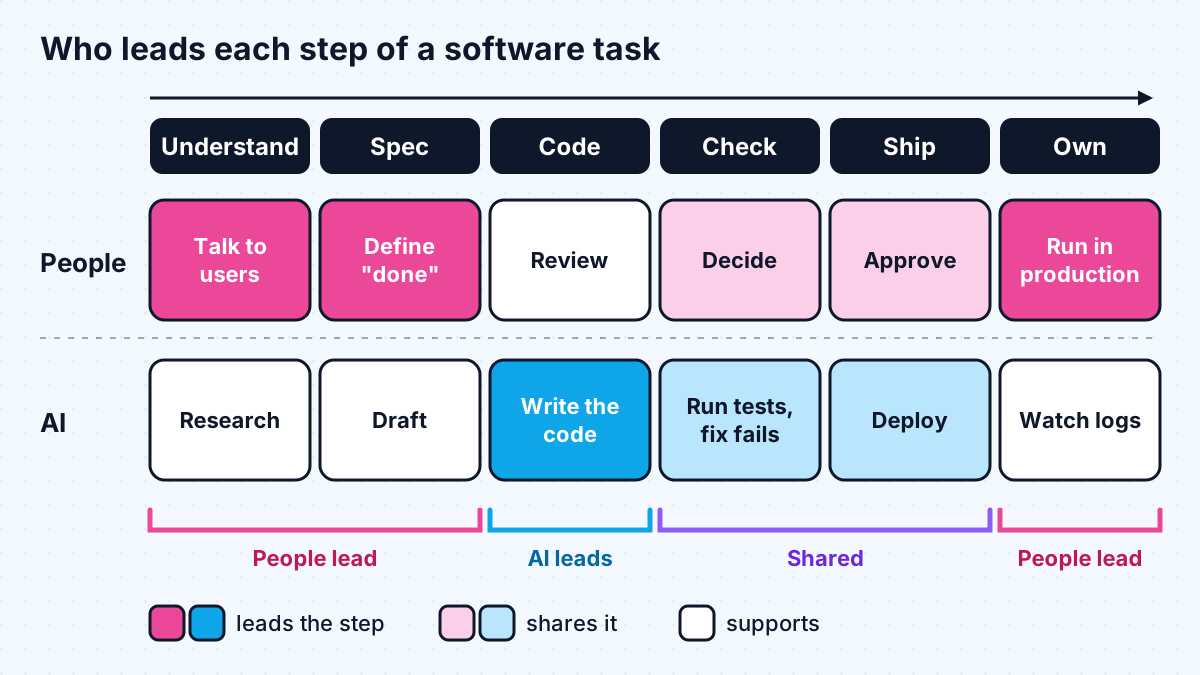
On client projects I now spend far more of my time on the two ends of the diagram above than in the middle. I write specs, connect systems, set up checks and review agent output. The agent writes much of the code. That is not a smaller job. It is a different mix, and it rewards engineers who understand the whole system, which is much of what an AI full stack developer does.
Where I am genuinely worried is the entry level. If the tasks juniors used to learn on are automated, the industry has to find another way to train the seniors it will need. I will come back to that in a separate post for junior developers.
How to stay needed as a software engineer
You stay needed by moving towards the work AI does badly and getting very good at directing the work it does well. Practically:
- Get closer to the problem. Talk to users, write specs and learn the business you build for.
- Learn to verify. Read code critically, write tests first and understand security basics. This is the skill every agent workflow depends on.
- Use the tools seriously. Engineers who know how to give an agent context and checks get more done. My AI productivity stack shows the setup I use.
- Learn to build AI features. The fastest-growing demand is for people who can put models into real products. How to become an AI engineer covers that path.
- Own something end to end. A shipped product with users teaches the judgement that hiring managers cannot get from an agent.
Work with me
I build AI and full-stack products with coding agents in the loop, and I help teams set up the specs, checks and review habits that make that work. See full-stack development and AI agent development, or browse my work and book a scoping call.
Frequently asked
Will AI replace programmers completely?
No current data points to complete replacement. The US Bureau of Labor Statistics projects software developer jobs to grow 10% from 2025 to 2035, while narrower computer programmer roles are projected to fall 7%. AI is replacing tasks such as writing routine code, not the whole job of building and owning software.
Which software engineering jobs are most at risk from AI?
Roles defined mainly by writing code to someone else's specification are most exposed, along with entry-level positions that used to absorb that routine work. Stanford researchers found employment for 22 to 25 year olds in highly AI-exposed occupations is about 19% below its expected level, while experienced workers show no comparable gap.
Is software engineering still a good career?
In my view, yes, if you aim at the parts of the job AI does badly: understanding problems, designing systems, verifying output and owning production. The work is changing towards directing and checking AI, and engineers who can build AI features are in demand. Expect a harder entry point than a few years ago.
How much code does AI write today?
There is no reliable industry-wide percentage, and I would distrust anyone who quotes one confidently. What the data does show is wide adoption: in Stack Overflow's 2026 survey, 69.3% of developers use AI to generate code in areas they know, and Anthropic found 79% of Claude Code conversations were automation rather than assistance.
Sources
Related services
Building something like this?
Naman Gundaniya takes on full-stack and AI projects fixed quote after a free 30-minute scoping call, replies within 24 hours.
Get in touch