 By Naman Gundaniya
How Juniors Can Stay Hireable When AI Writes the Code
Junior developers stay hireable by being good at what AI does badly: understanding a problem, debugging code they did not write, verifying output and shipping something real. Entry-level hiring has fallen sharply, mainly through fewer new hires, so the bar is higher. Use AI to learn faster, not to skip the learning, and show proof of work.
If you are early in your career, the headlines are not kind. I am not going to pretend the market is easy. But I also build software with AI agents every day, and I can see which skills they replace and which they make more valuable. This post is the plan I would follow if I were starting again now.
Is it harder to get a junior developer job because of AI?
Yes, it is harder, and AI is part of the reason, though not the only one. Stanford's Digital Economy Lab found that employment for 22 to 25 year olds in highly AI-exposed occupations is about 19% below where it would otherwise be, while experienced workers show no comparable gap. The researchers say the adjustment works mainly through reduced hiring of young workers rather than layoffs, and they call their findings descriptive patterns, not proof of cause. An earlier note from the same lab says the drop for young software developers in particular has several causes, some of them not AI.
Hiring data from the largest tech companies points the same way. SignalFire's 2026 talent report estimates that new-graduate and entry-level hiring is down roughly 65% at the biggest tech firms compared with 2019, and about 76% at early-stage startups.
The longer-term picture is less bleak. The US Bureau of Labor Statistics still projects software developer employment to grow 10% from 2025 to 2035. Demand for people who build software is not going away. The entry point has narrowed. I covered the wider question in will AI replace software engineers?.
What AI changes about the junior role
The tasks juniors used to learn on are the tasks AI now does fastest. Small bug fixes, boilerplate, simple UI components and test scaffolding were how many of us got our first year of practice. A coding agent can do a first draft of all of them in minutes.
That changes what a junior is hired for. Teams do not need someone to type routine code. They need someone who can take a loosely defined task, get an agent or themselves to a working result, prove it works and explain the trade-offs. In my view that is closer to what a mid-level engineer did a few years ago, which is why the bar feels higher.
| Exposed to AI | What employers still pay juniors for |
|---|---|
| Writing boilerplate and CRUD screens | Understanding the problem and asking the right questions |
| Small, well-specified bug fixes | Debugging code you did not write, including AI's |
| Writing tests to a template | Deciding what to test and spotting what is missing |
| Translating a spec into code | Turning a vague request into a clear spec |
| Looking up syntax and APIs | Reading documentation and judging whether an answer is right |
SignalFire's report also shows where hiring is moving: the share of AI and machine learning engineers at the big tech firms is up 39% since ChatGPT launched, and forward-deployed engineers are up 30%, while the front-end engineer share is down about 25%. Roles that combine building with understanding a customer's problem are growing.
The skill trap: AI can stop you learning
The biggest risk for juniors is not that AI takes the job. It is that leaning on AI too early stops you learning the skills the job needs. Anthropic ran a randomised trial with 52 mostly junior engineers learning a new Python library. The group using AI scored 50% on a follow-up quiz against 67% for those who coded by hand, and the largest gap was on debugging questions. The AI group was only about two minutes faster, a difference that was not statistically significant.
The detail that matters most: how people used AI made the difference. Those who mainly delegated code generation and debugging averaged under 40%. Those who also asked conceptual questions and used AI to understand, not just to produce, scored 65% or higher.
So my rule for juniors is simple. Use AI as a tutor first and a typist second. Ask it why, not just what. Write the first version of anything new yourself, then compare it with what the AI would have done.
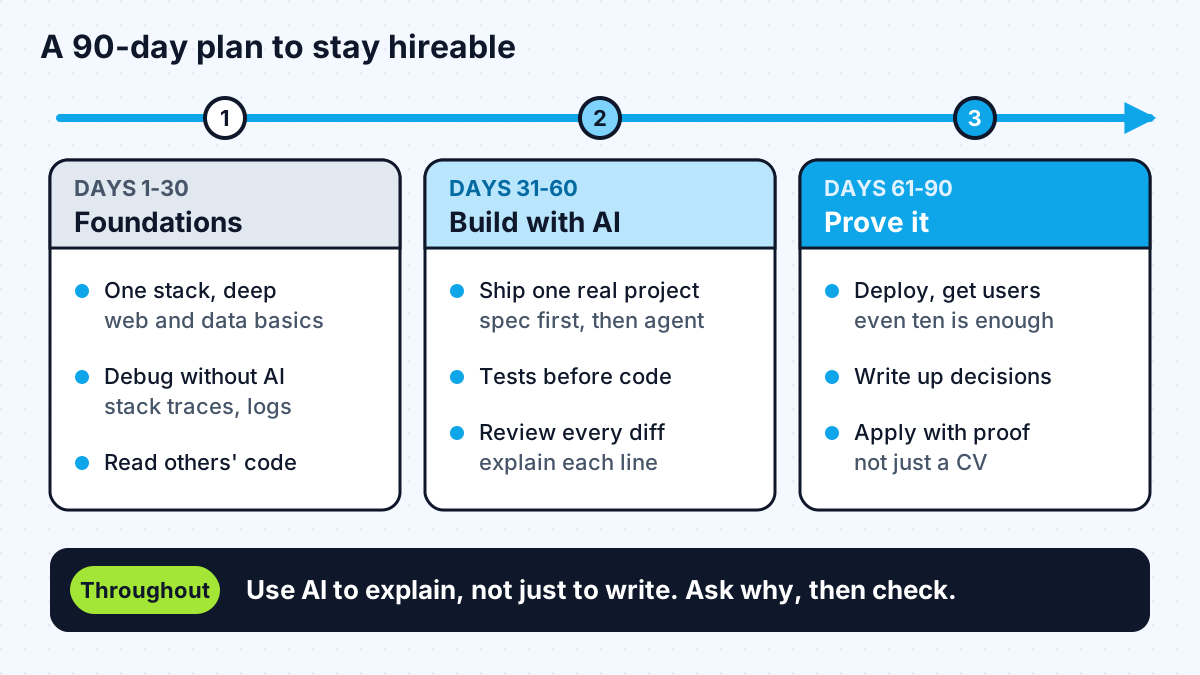
A 90-day plan to stay hireable
This plan assumes you already know the basics of one language. Adjust the pace, but keep the order: fundamentals before speed.
Days 1-30: foundations that AI cannot fake for you
- Pick one stack and go deep. For web work I would choose TypeScript, React and Node, because it is the stack I use for most of my client work and it is widely used for AI products.
- Learn how the web actually works: HTTP, databases, authentication, caching.
- Debug without AI for a month. Use the debugger, read stack traces, add logging. This is the skill the Anthropic study found most damaged by over-reliance.
- Read code you did not write: open-source projects, a library you use.
Days 31-60: build something real with AI in the loop
- Ship one project end to end with a coding agent, but write a short spec first and define what "done" means.
- Write tests before you ask the agent to implement, so it has a target and you have a check. My AI productivity stack shows how I set this up.
- Review every diff as if a colleague wrote it. If you cannot explain a line, ask the AI to explain it, then check the docs. The "almost right" problem lists the near-misses to look for.
- Add one AI feature, such as search, summarisation or a chat assistant, because companies want people who can build them. How to become an AI engineer covers the skills.
Days 61-90: prove it
- Deploy it and get real users, even ten. Fix what they report.
- Write up the decisions: what you built, what you chose not to build, what broke and how you found it.
- Apply with the proof of work, not just a CV. SignalFire's report puts it plainly: the most reliable path is demonstrating proof of work before anyone gives you permission.
What hiring managers want to see from juniors now
In my view, the strongest junior applications now show judgement, not volume. When I look at a junior's work, I look for:
- One shipped project with users, a README that explains decisions and honest notes on what does not work yet.
- Evidence of debugging: an issue you tracked down, a pull request to someone else's project, a post-mortem.
- Sensible use of AI: you used it, you can say where it helped and where it was wrong, and you checked its output.
- Communication: clear writing in issues, commit messages and the write-up. Much of directing AI, and working with a team, is writing.
Teams are also changing how they work. As more of the doing is handed to agents, the people who stand out are the ones who check output well and know when not to delegate. I wrote about that shift in what work looks like when every employee has an AI agent.
Work with me
I build AI and full-stack products with coding agents in the loop, using the same habits this plan teaches: clear specs, tests first and careful review. For project work, see full-stack development and AI integration, or browse my work.
Frequently asked
Are junior developer jobs disappearing because of AI?
They are shrinking but not disappearing. SignalFire estimates entry-level hiring at the largest tech firms is down roughly 65% from 2019, and Stanford researchers found employment for 22 to 25 year olds in AI-exposed jobs is about 19% below expected. The US government still projects overall software developer jobs to grow 10% by 2035.
Should junior developers use AI coding tools?
Yes, but use them to learn, not to skip learning. Anthropic's study of mostly junior engineers found those who used AI only to generate code scored under 40% on a follow-up quiz, while those who also asked conceptual questions scored 65% or higher. Write new things yourself first, then use AI to compare, explain and speed up.
What skills should a junior developer learn in the AI era?
Focus on debugging, reading unfamiliar code, testing, web and database fundamentals, and turning vague requests into clear specs. Add the ability to build and verify an AI feature. These are the parts of the job AI does badly or needs a person to check.
Is it still worth learning to code?
In my view, yes. Coding is how you learn to reason about systems, check AI output and build products, and demand for people who build software is still projected to grow. What has changed is that typing code is no longer the valuable part on its own.
Sources
Related services
Building something like this?
Naman Gundaniya takes on full-stack and AI projects fixed quote after a free 30-minute scoping call, replies within 24 hours.
Get in touch