 By Naman Gundaniya
What Work Looks Like When Every Employee Has an AI Agent
When every employee has an AI agent, the job moves from doing tasks to directing and checking them. People spend less time producing first drafts, moving data and chasing status, and more time deciding what good looks like, reviewing agent output and handling exceptions. Surveys already show the shift, and they show it depends more on how the organisation works than on the tool.
This is a forward-looking piece, so I want to be clear about what is data and what is my view. The data comes from large workplace surveys and from usage studies of AI tools. The scenario is my reading of that data, informed by building agent systems for clients. I have already written about which jobs grow and shrink and what agents do to SaaS, so this post stays on the working day itself.
How close are we to every employee having an AI agent?
Closer in some companies than others, and the gap is mostly organisational. Microsoft's 2026 Work Trend Index, a survey of 20,000 knowledge workers who use AI across ten countries, reported that active agents in Microsoft 365 grew 15 times year over year, and 18 times in large enterprises.
The year before, the same research series found that 82% of leaders were confident they would use "digital labor" to expand workforce capacity within 12 to 18 months, and 81% expected agents to be moderately or extensively part of their AI strategy in that window.
Usage studies show the same direction. Anthropic found that "directive" conversations, where a person hands over a whole task rather than collaborating step by step, rose from 27% to 39% of Claude.ai conversations in under a year, and that 77% of business API traffic showed automation patterns. People are delegating more, not just asking more questions.
What changes in each role?
Every role gains a layer of delegation, and the human part of the role becomes setting the goal, checking the work and owning the outcome. Microsoft has a name for this person: an "agent boss", someone who builds, delegates to and manages agents. In its 2025 survey, 36% of leaders expected managing agents to be part of their job within five years.
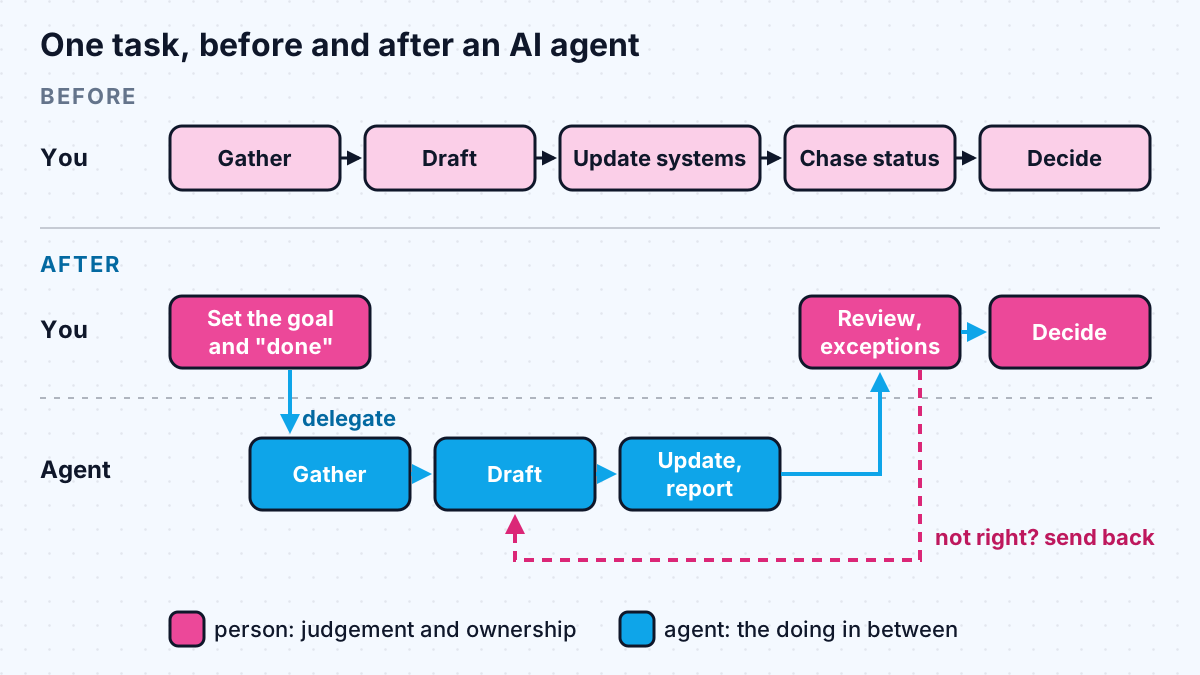
Here is how I expect that to look across a few roles. This table is my scenario, not survey data.
| Role | What the agent takes on | What the person spends more time on |
|---|---|---|
| Sales | Account research, call notes, CRM updates, follow-up drafts | Conversations, judgement on deals, relationships |
| Operations | Data entry, reconciliations, routing requests, status reports | Exceptions, process design, supplier issues |
| Customer support | First replies, lookups, ticket summaries | Hard cases, policy calls, feedback to product |
| Engineering | First drafts of code, tests, refactors | Specs, reviews, architecture, production |
| Management | Status roll-ups, meeting notes, reporting | Priorities, coaching, deciding who and what does the work |
The skill that rises everywhere is judging output. When Microsoft asked AI users which human skills are growing in importance, the top two were quality control of AI output at 50% and critical thinking at 46%. The same survey found 86% treat AI output as a starting point, not a final answer. That is the right instinct, and it is also the new workload; I cover how to make that checking systematic in the "almost right" problem.
What happens to meetings, status updates and management?
Status work shrinks, decision work stays, and managers become the people who design how humans and agents split the work. A large share of meetings and messages exist to move information between people: what is done, what is blocked, what changed. Agents with access to the right systems can gather and summarise that continuously. Microsoft's 2025 report measured how much of that noise exists, finding employees are interrupted about every two minutes during the core workday.
In my view, three things follow:
- Fewer status meetings, sharper decision meetings. If an agent can report progress, the meeting is for the decisions the report raises.
- Written goals matter more. An agent can only work towards what someone wrote down. Teams that are vague in writing will feel it first.
- Managers set the split. Microsoft's report proposes a "human-agent ratio", asking how many agents a role needs and how many people are needed to guide them. Somebody has to own that question, and it lands on managers.
Managers also set the tone. In a separate Microsoft study of 1,800 workers, when managers modelled AI use, employees reported a 17-point lift in the value they got from AI and a 30-point lift in trust in agentic AI.
Why the organisation matters more than the tool
The biggest finding in the 2026 data is that individual enthusiasm is not the bottleneck. Microsoft found organisational factors such as culture, manager support and talent practices accounted for 67% of measured AI impact, against 32% for individual mindset and behaviour. Only 26% of AI users said their leadership was clearly and consistently aligned on AI, and only 13% said they were rewarded for AI-driven reinvention even when results fell short.
That matches what I see when I build agent systems. The hard part is rarely the model. It is deciding where the agent's job ends, who approves its work and what it is allowed to touch. In AgentOps, a multi-agent system I built that turns a Slack request into a spec, tickets, a pull request and a live preview, each hand-off between agents passes through a human approval step. That design choice, not the agents themselves, is what keeps the team in control.
What can go wrong when everyone has an agent?
The main risks are unchecked output, sprawl and a lost training ground. In order of how often I expect to see them:
- Rubber-stamping. Reviewing is work. When it becomes routine, people stop reading carefully and errors pass through with a human signature on them.
- Agent sprawl. Hundreds of personal agents with different permissions and no owner are a security and audit problem. Every agent needs an owner, a scope and logs, the same lesson as who owns your automations.
- Hollowed-out entry level. If agents do the first-draft work juniors learned on, people miss the practice that makes them good reviewers later. Stanford researchers found employment for 22 to 25 year olds in highly AI-exposed occupations is about 19% below its expected level, driven mainly by reduced hiring.
- Over-delegation. Microsoft found its most advanced AI users, which it calls Frontier Professionals, were more likely to deliberately do some work without AI (43% versus 30%) and to pause and decide what AI versus humans should do. Knowing when not to delegate is a skill.
How should leaders prepare their teams?
Start with the work, not the tool: map which tasks to delegate, who checks them and how you will know it is working. A practical sequence:
- Pick one workflow per team with clear inputs, a checkable output and a real cost today. An AI automation audit is a quick way to find it.
- Write the definition of done before anyone builds an agent for it.
- Put approval steps where mistakes are expensive, and log every action the agent takes.
- Train people to review, not just to prompt. Reviewing agent output is the core skill of the next few years.
- Change the incentives. Reward people for redesigning their work, including the experiments that fail.
- Protect junior development by giving early-career staff real reviewing and problem-solving work, not just leftover tasks.
If you are deciding whether a workflow needs one agent or several, my post on when you need multi-agent systems covers that choice.
Work with me
I design and build AI agents and automations with the approval steps, permissions and logs that make them safe to hand real work. See AI agent development and workflow automation, or browse my work and book a scoping call.
Frequently asked
What will work look like when everyone has an AI agent?
People will spend less time producing first drafts, moving data between systems and chasing status, and more time setting goals, reviewing agent output and handling exceptions. Microsoft calls this role an "agent boss". The change is already visible in usage data, with more people handing whole tasks to AI rather than collaborating step by step.
Will AI agents replace managers?
Not in the data so far, but the job changes. Agents can take over status reporting and summaries, while managers decide how work is split between people and agents, set quality standards and coach. Microsoft found that when managers modelled AI use, employees reported more value from AI and more trust in agents.
What skills matter most when working with AI agents?
Judging output matters most. In Microsoft's 2026 survey of 20,000 AI users, quality control of AI output (50%) and critical thinking (46%) were the top human skills growing in importance. Clear written goals, knowing when not to delegate and understanding the process you are automating matter too.
How do companies manage risk when every employee uses an AI agent?
Give every agent an owner, a narrow scope and logs, and require human approval wherever a mistake is expensive, such as payments, customer data or production systems. Avoid a sprawl of unmanaged personal agents with broad permissions, and keep checking that reviews are real rather than routine sign-offs.
Sources
Related services
Building something like this?
Naman Gundaniya takes on full-stack and AI projects fixed quote after a free 30-minute scoping call, replies within 24 hours.
Get in touch