 By Naman Gundaniya
What Does an AI Full Stack Developer Actually Do?
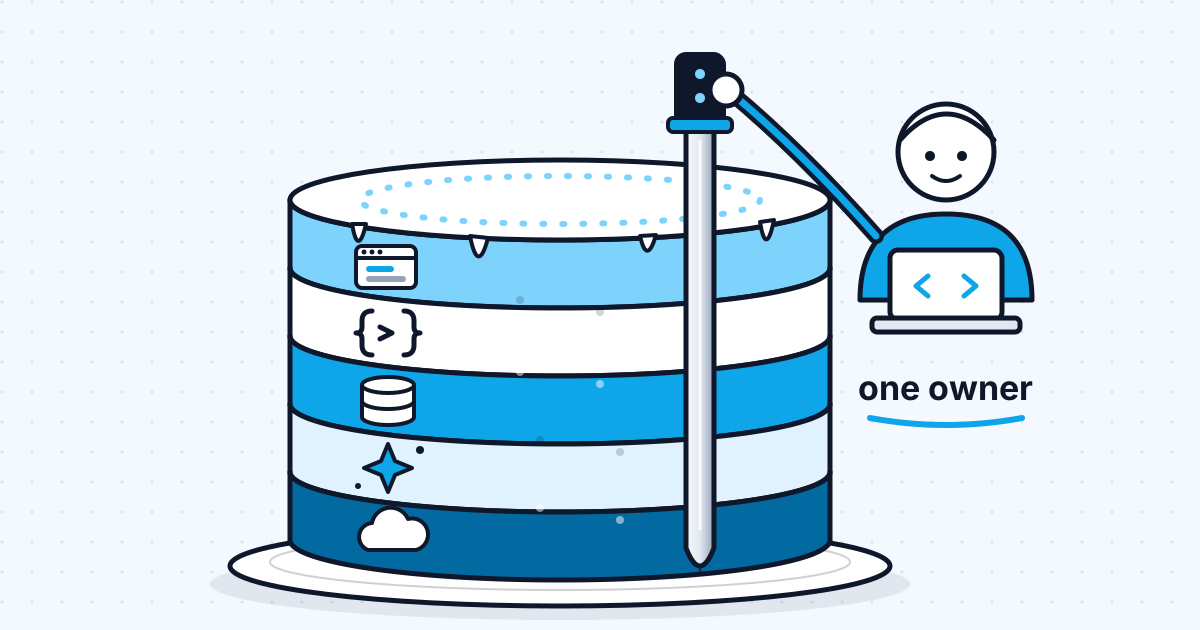
An AI full stack developer builds the whole product around a language model, not just the model call. That means the interface people use, the API that talks to the model, the data the model reads, the guardrails on what it returns, the tests that prove it works, and the deployment that keeps it running and affordable. One person owns the feature from screen to server.
It is the title I use for most of my client work, so I want to define it from the inside. Job adverts for the role list a long, mixed stack and rarely say what the job is like day to day. Below is the short version: the layers, a real feature traced through all of them, the skills that matter, and how the role differs from its neighbours.
What is an AI full stack developer?
An AI full stack developer is a full-stack engineer whose products depend on a model, and who takes responsibility for every layer that makes the model useful. The model is one dependency among several. Most of the work, and most of the risk, sits around it.
Alpesh Nakrani's hiring guide for full-stack AI developers puts it neatly: the role "owns three layers, not two": frontend AI UX, backend model integration and the evaluation loop, plus the seams between them. I agree, and I would add two more that clients feel immediately: the data layer the model reads from, and the cloud layer that decides cost, speed and uptime.
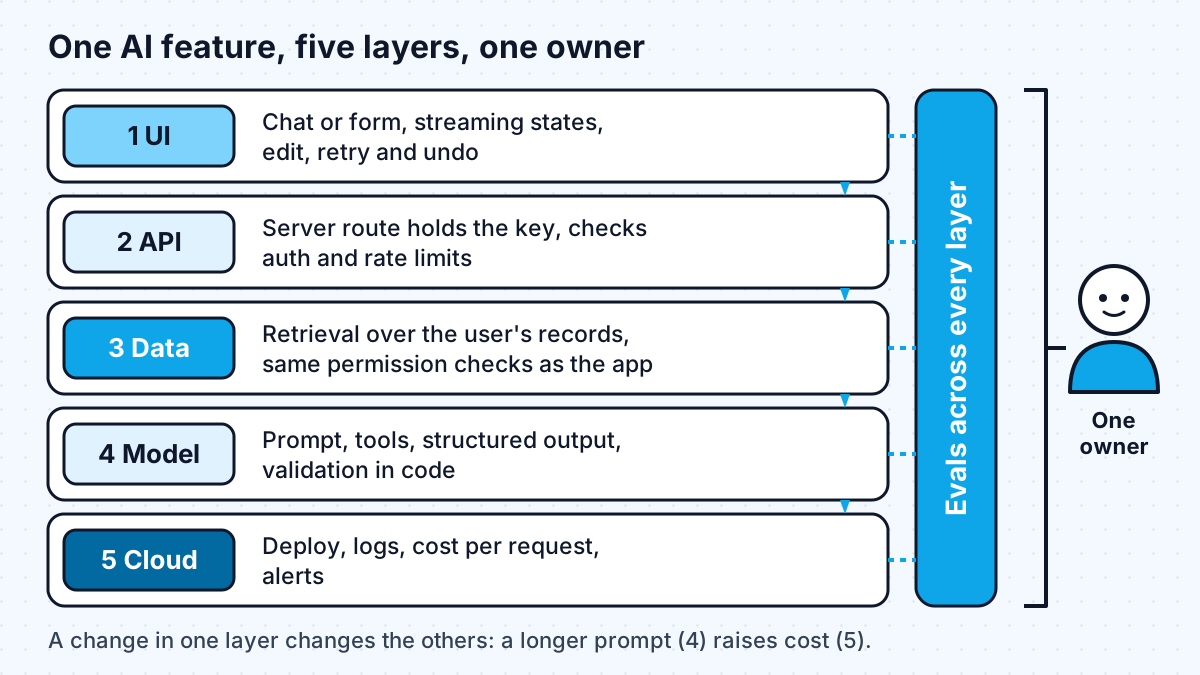
The five layers, and what I do in each
Each layer has its own failure mode, which is why splitting them across people tends to leave gaps at the joins.
| Layer | What the work is | What goes wrong if nobody owns it |
|---|---|---|
| UI | Chat or form, streaming output, loading and error states, edit and undo | A frozen spinner, half-rendered answers, no way to fix a bad result |
| API | Server routes that hold keys, check auth, rate-limit and call the model | Keys in the browser, one user draining the budget |
| Data | Retrieval over the right records, scoped to what the user may see | Wrong or leaked answers, stale context |
| Model | Prompts, tool definitions, structured output, validation | Outputs that look right but break the app downstream |
| Cloud | Deployment, logs, tracing, cost per request, alerts | Surprise bills, timeouts, no evidence when something fails |
None of these layers is exotic on its own. The job is holding all five in your head at once, because a choice in one changes the others. A longer prompt in the model layer raises cost in the cloud layer. A streaming UI needs an API route that can stream. A retrieval step in the data layer needs the same permission checks as the rest of the app.
A real feature, traced end to end
The clearest way to show the job is one feature I built. ScanX is an AI note-taking web app: a user uploads a PDF and asks questions about it, and answers come back with citations to the source pages. Here is how its case study maps onto the five layers.
- Data: uploaded PDFs are parsed, split into overlapping chunks and embedded, and each chunk keeps a reference to its source page so answers can cite it.
- Model: a question is matched against the stored vectors and only the top-matching chunks go to the model, which keeps token cost proportional to the question rather than the document.
- API and auth: authentication is handled by Clerk, and every query is scoped to the owning user, so one account cannot retrieve another account's chunks. The retrieval layer will return any vector it can reach, so the boundary has to be enforced in code.
- UI: answers stream in rather than sitting behind a blocking spinner, and ingestion progress updates live, because embedding a large PDF is slow enough that a silent screen reads as broken.
- Cloud: Next.js keeps the API keys and the retrieval call on the server, so no model credential reaches the browser.
Notice how little of that list is "call the model". The model call is a few lines. The product is everything that makes those few lines safe, fast, correct and worth paying for.
What does an AI full stack developer do day to day?
Most days are ordinary full-stack engineering with a model-shaped twist. On client projects my week usually includes some mix of the following.
- Turning a vague request ("can the AI summarise these?") into a feature with inputs, outputs and a definition of done.
- Writing server routes that call a model, stream the result and handle the failure cases.
- Building the screens: streaming text, partial results, retry and edit controls.
- Shaping the data the model reads, often retrieval over the client's own records. I compare the approaches in RAG vs fine-tuning.
- Writing and running evaluations: a set of real examples with expected results, re-run on every prompt or model change. My guide to evaluating AI agents covers the method.
- Watching logs and cost per request after release, and tuning prompts, model choice or caching.
The evaluation work is the part that most separates this role from a general full-stack job. The same hiring guide calls it "the load-bearing skill", and advises hirers to "test the streaming path, the failure path, and the eval path explicitly". That matches my experience of what breaks in production: rarely the happy path, almost always the edges.
Which skills does the role need?
The skills are mostly full-stack fundamentals, plus a smaller set of model-specific ones. Here is how I would weight them.
- TypeScript, React and a server framework. Most of my work is Next.js on Vercel, because one codebase covers UI and server routes and streaming is built in.
- Databases and auth. Retrieval is a database query with extra steps, and it needs the same access rules as every other query.
- Model APIs. Messages, streaming, tool use and structured output across at least one major provider.
- Evaluation. Building test sets, scoring outputs, and deciding with numbers when a feature is good enough to ship.
- Cost and reliability. Knowing what a request costs, where the timeouts are, and what happens when the provider is slow.
- Judgement about when not to use a model. Anthropic's guidance on building effective agents recommends "finding the simplest solution possible, and only increasing complexity when needed". Sometimes the simplest solution is a regular expression.
You do not need to train models or know the maths of transformers to do this job well. You do need to treat model output as untrusted input and design the product so a wrong answer is cheap to spot and fix.
How is it different from an AI engineer or an ML engineer?
The difference is where the work stops. An ML engineer trains, tunes and serves models. An AI engineer, in the way the term is usually used, builds systems on top of existing models: pipelines, agents, evaluations. An AI full stack developer covers that and also ships the product a customer touches: the interface, the auth, the billing hooks, the deployment.
| Role | Main output | Typical stack focus |
|---|---|---|
| ML engineer | Trained or fine-tuned models, training and serving pipelines | Python, data, GPUs |
| AI engineer | Model-powered systems: RAG, agents, evals | Python or TypeScript, model APIs |
| AI full stack developer | A shipped product feature, screen to server | TypeScript, React, server routes, model APIs, cloud |
The titles overlap and companies use them loosely, so read the job description, not the label. If you are deciding which path to take, my guide on how to become an AI engineer covers the learning route.
When should you hire one?
Hire an AI full stack developer when the AI feature has to live inside a real product with users, data and a bill, and you want one person accountable for all of it. That is most early-stage AI products and most "add AI to our app" projects. If you already have a strong product team and need deep model work such as training or fine-tuning, an ML specialist is the better fit.
The practical test: ask a candidate to walk through one feature they shipped, layer by layer, and ask what happens when the model is slow, wrong or expensive. A full-stack AI developer will have an answer for each layer. For current market rates, see how much it costs to hire an AI developer.
Work with me
This is the work I do for clients: one feature or a whole product, owned from the interface to the deployment. See full-stack development and AI integration, or browse my work for case studies like ScanX, and book a scoping call.
Frequently asked
What does an AI full stack developer do?
An AI full stack developer builds complete products that use language models: the user interface, the server routes that call the model, the data the model reads, the validation of what it returns, the evaluations that prove it works, and the deployment. They own the feature from screen to server rather than only the model call.
What skills does an AI full stack developer need?
Strong full-stack fundamentals come first: TypeScript, React, a server framework, databases and auth. On top of that come model APIs (streaming, tool use, structured output), retrieval, evaluation, and cost and reliability work. Training models is not usually part of the role.
Is an AI full stack developer the same as an AI engineer?
They overlap, but not fully. An AI engineer usually focuses on model-powered systems such as retrieval pipelines, agents and evaluations. An AI full stack developer does that work too and also builds and ships the product around it: interface, auth, deployment and cost controls.
Do AI full stack developers need machine learning experience?
Not in the sense of training models. They need to understand how models behave: that outputs vary, can be wrong, cost money per token and need validating. That understanding comes from building and evaluating features, not from studying model architectures.
Sources
Related services
Building something like this?
Naman Gundaniya takes on full-stack and AI projects fixed quote after a free 30-minute scoping call, replies within 24 hours.
Get in touch