 By Naman Gundaniya
AI Full Stack Developer Roadmap: What to Learn and Why
To become an AI full stack developer, learn in six stages: web fundamentals, LLM APIs, retrieval, agents and tools, evaluation and production, then cloud and security. Finish each stage with a small shipped project that proves it. Employers and clients judge you on deployed work that handles real failure cases, not on courses completed.
Most roadmaps for this role are either a machine learning curriculum, which is the wrong job, or a list of tools that will change by next year. This one is ordered by what you need to ship an AI feature for a real client, and it is the order I would follow if I were starting again. For what the job involves day to day, see what an AI full stack developer does.
What is an AI full stack developer, and how is it different from an ML engineer?
An AI full stack developer builds complete products that use AI models, from the interface to the database to the model calls, rather than training models. roadmap.sh's AI engineer roadmap draws the same line: it describes AI engineers as people who use "pre-trained models and existing AI tools" and "focus on applying AI in practical ways, without building models from scratch", while ML engineers "focus more on creating new models or developing AI theory."
That means the maths-heavy parts of an ML curriculum are optional here. What is not optional is solid web engineering, because every AI feature still needs authentication, data storage, error handling and a deployment.
What does the roadmap look like?
The roadmap has six stages, each with a skill set and a project that proves it.
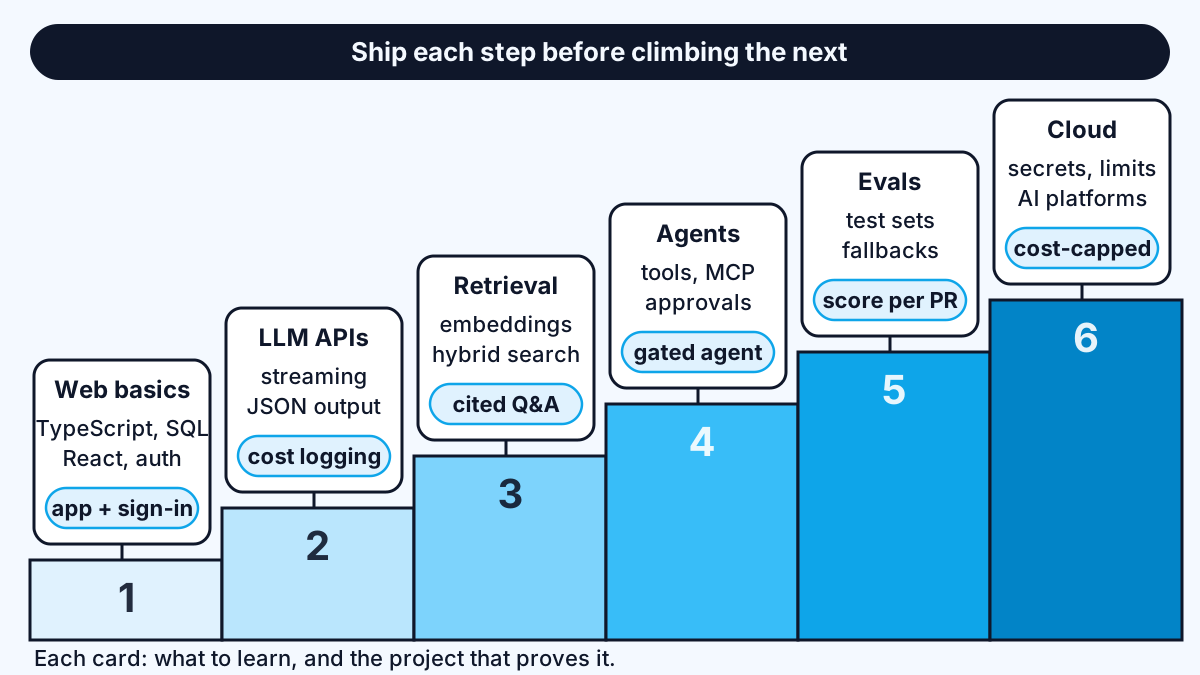
| Stage | Learn | Prove it with |
|---|---|---|
| 1. Web fundamentals | TypeScript, a React framework, HTTP, SQL, auth | A deployed app with sign-in and a database |
| 2. LLM APIs | Messages, streaming, structured output, tokens, errors | A streaming AI feature that logs cost per request |
| 3. Retrieval | Embeddings, chunking, hybrid search, citations | Q&A over documents with source links |
| 4. Agents and tools | Tool use, MCP, workflows vs agents, approvals | An agent with a few tools and a human approval step |
| 5. Evals and production | Test sets, output checks, fallbacks, monitoring | An eval suite run on every change, with a score |
| 6. Cloud and security | Deployment, secrets, rate limits, cloud AI platforms | The project on a cloud account with a cost cap |
Stage 1: Which web fundamentals matter most?
The fundamentals that matter most are the ones every AI feature sits on: a typed language, a frontend framework, a server, a database and authentication. I would pick TypeScript, one React framework such as Next.js, Postgres and a managed auth provider, and go deep rather than wide.
Specifically, be comfortable with:
- Server versus client code, and why API keys only ever live on the server.
- SQL and data modelling, including scoping every query to the signed-in user.
- HTTP and streaming responses, because AI output arrives token by token.
- Git, pull requests and CI, since that is where your work gets reviewed.
Project: a small app with sign-in, a database and one useful feature, deployed on a public URL.
Stage 2: What should you learn about LLM APIs?
Learn to call a model API directly, before any framework. Anthropic's Building effective agents puts it plainly: "We suggest that developers start by using LLM APIs directly". You learn what tokens, context windows, system prompts and stop reasons actually are, which makes every framework easier later.
Cover these in order: a basic messages call, streaming to a UI, structured output validated against a schema, token counting and pricing, and error handling for rate limits and overloads. My walkthrough on integrating Claude into a Next.js app covers the first few in one project.
Project: a streaming AI feature inside your Stage 1 app, with a per-request cost log and a clear error state.
Stage 3: How much retrieval do you need to know?
You need enough retrieval to ground answers in a client's own data and show where each answer came from. That means embeddings, chunking strategies, vector search, keyword search and combining the two, plus citations.
Also learn when not to build retrieval at all. Anthropic's contextual retrieval article notes that for a knowledge base under 200,000 tokens you can "include the entire knowledge base in the prompt", using prompt caching to keep it affordable. Knowing that saves clients a vector database they do not need.
Project: question answering over a set of PDFs, with each answer linking to the source page. The ScanX case study is an example of this shape: uploaded PDFs are chunked and embedded, and answers cite their source pages.
Stage 4: When should you learn agents and MCP?
Learn agents after you can build a reliable single model call with retrieval, because an agent is a loop of those calls with tools. The same Anthropic article separates workflows, "where LLMs and tools are orchestrated through predefined code paths", from agents, "where LLMs dynamically direct their own processes and tool usage", and recommends "finding the simplest solution possible".
Learn tool definitions and tool-use loops, the Model Context Protocol for exposing tools in a standard way, and approval steps for risky actions. That last one is what separates a demo agent from one a business will let near its systems.
Project: an agent with two or three tools, one of which needs human approval before it runs, with every action logged.
Stage 5: Why are evals and production skills a separate stage?
Because this is where most AI projects fail, and where an AI full stack developer earns their keep. Hamel Husain's essay Your AI Product Needs Evals argues that "unsuccessful products almost always share a common root cause: a failure to create robust evaluation systems", and lays out three levels: unit tests, model and human evaluation, and A/B testing.
Learn to build a test set of real inputs, grade outputs with code where possible, add fallbacks for provider failures, enforce per-user limits and monitor cost and quality. My checklist for taking an AI prototype to production is the full list.
Project: an eval suite for your Stage 3 or 4 project that runs on every pull request and reports a score.
Stage 6: What cloud and security skills do you need?
You need enough cloud to deploy, secure and pay for an AI app on a client's own account. That covers environment secrets, least-privilege access, rate limiting, logging and cost alerts, plus a working knowledge of at least one cloud AI platform, since many companies buy model access through their existing cloud contract.
Security belongs here too: keeping keys server-side, scoping data per user and understanding prompt injection. None of it is exotic; it is ordinary web security applied to a new kind of input.
Project: your agent or retrieval app running on a cloud account, with secrets managed properly and a spend cap set.
How should you use AI tools while learning?
Use coding agents, but read and understand everything they write. The 2025 Stack Overflow Developer Survey found 84% of respondents using or planning to use AI tools in development, while more distrusted the accuracy of those tools (46%) than trusted it (33%). Both numbers matter: the tools are expected, and judging their output is the skill.
When you are learning, the code you could not have written yourself is the code you most need to read. I explain the difference between disciplined use and blind acceptance in vibe coding vs agentic engineering.
Work with me
If you need an AI full stack developer rather than a roadmap, this is the stack I build on for clients, from the database to the model calls to the deployment. See full-stack development and AI integration, or browse my work and book a call.
Frequently asked
How long does it take to become an AI full stack developer?
It depends mostly on your starting point. A working web developer can usually move through the AI stages faster than someone learning web fundamentals from scratch. Measure progress by shipped projects at each stage rather than by weeks, and move on only when the stage's project is deployed and working.
Do I need machine learning or maths to become an AI full stack developer?
Not in depth. The role uses pre-trained models through APIs rather than training them. You need to understand tokens, embeddings, context windows and evaluation, but not the maths behind training. Strong web engineering matters more.
What projects should an AI full stack developer have in a portfolio?
Projects that are deployed and handle failure: a streaming AI feature with cost tracking, document Q&A with citations, an agent with tools and a human approval step, and an evaluation suite showing how you measured quality. A short write-up of trade-offs for each makes them far more convincing.
Which programming language should I learn for AI full stack development?
TypeScript is a strong choice because it covers the frontend, the server and the official model SDKs in one language. Python is also widely used for AI work, particularly for data processing and evaluation scripts, so reading it comfortably helps.
Sources
Related services
Building something like this?
Naman Gundaniya takes on full-stack and AI projects fixed quote after a free 30-minute scoping call, replies within 24 hours.
Get in touch