 By Naman Gundaniya
Cutting LLM App Costs: Caching, Routing, Smaller Models
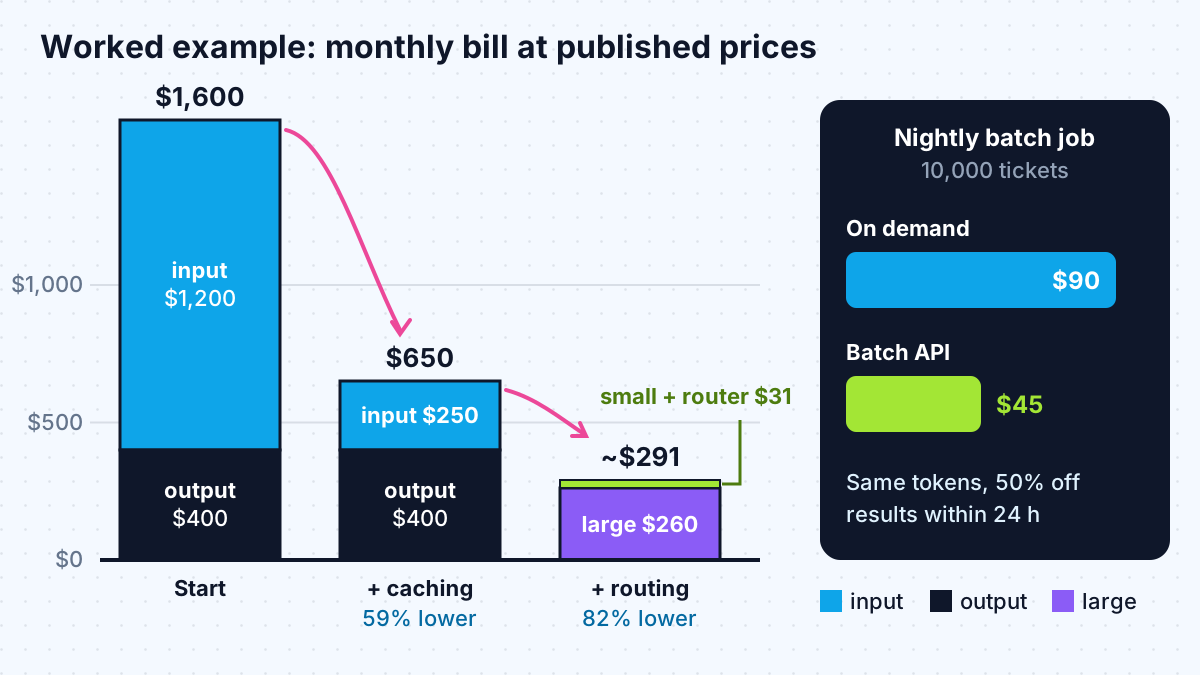
To reduce LLM costs without hurting quality, measure where tokens go, then apply four levers in order: cache the repeated start of every prompt, route simple requests to a smaller model, send work that can wait to a batch API at half price, and cap output length. In the worked example below, the first two levers take a monthly bill from $1,600 to about $291 at published prices.
Once an AI feature has real users, the model bill stops being a rounding error. The good news is that most of it is waste you can remove without touching answer quality: repeated context, an expensive model doing easy work, and urgent pricing on jobs that are not urgent. This post walks through each lever with arithmetic based on Anthropic's published prices as of late 2026, so you can redo it with your own numbers.
Start by measuring where the tokens go
You cannot cut a bill you have not broken down. Before changing anything, log four numbers per request for each feature: stable input tokens (instructions, tools, shared documents), variable input tokens (the user's message, retrieved context, history), output tokens, and which model served it. The usage ledger I use for per-user cost caps records exactly this.
That breakdown usually tells you which lever matters most:
- Large stable input points to caching.
- Many short, simple requests on a large model point to routing.
- Big offline jobs point to batching.
- Long answers point to output limits, since output tokens usually cost several times more than input.
If the feature is wired through a gateway, much of this logging is already there. Vercel's AI Gateway, for example, records token usage and cost per request and supports budgets, which I covered in running AI agents on Vercel.
One trap is worth knowing before you compare models on price alone. Tokens are not a fixed unit across models. Anthropic's pricing page notes that Claude 4.7 and later models use a newer tokenizer that "produces approximately 30% more tokens for the same text". A model with a lower per-token price can still cost more per request, so compare cost per request on your own traffic, not price per million tokens.
The worked example: a support assistant
Here is the scenario I use for the maths. It is illustrative, not a client's figures. A support assistant handles 100,000 requests a month. Each request sends 5,000 stable tokens (instructions, tool definitions and product docs), 1,000 variable tokens, and gets 400 tokens back. Everything runs on Claude Sonnet 5.5, which Anthropic's pricing page lists at $2 per million input tokens and $10 per million output tokens.
- Input: 600 million tokens at $2 per million = $1,200.
- Output: 40 million tokens at $10 per million = $400.
- Total: $1,600 a month.
Lever 1: cache the stable part of every prompt
Prompt caching bills repeated input at a fraction of the normal price, so it is the first thing to turn on. For Sonnet 5.5, Anthropic lists cache reads at $0.10 per million tokens, 0.05x the input price. I explain the mechanics, and the prompt structure it needs, in prompt caching explained.
In the example, the 5,000 stable tokens per request are the cacheable prefix. Assuming steady traffic keeps the cache warm, so cache writes are a negligible share:
- Cached stable input: 500 million tokens at $0.10 per million = $50.
- Variable input: 100 million tokens at $2 per million = $200.
- Output: unchanged at $400.
- Total: $650 a month, about 59 percent less, with identical answers.
Notice what is left: output is now the biggest line. Caching cannot help with that, which is why the next lever matters.
Lever 2: route easy requests to a smaller model
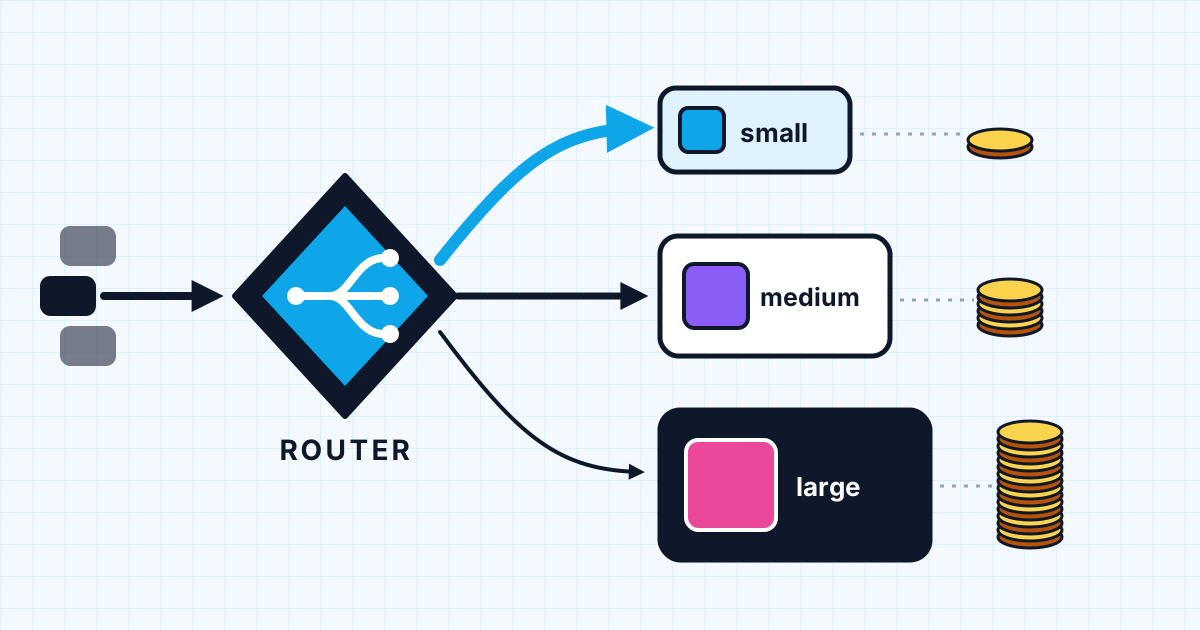
Most products have a mix of easy and hard requests, and the easy ones do not need the largest model. Routing sends each request to the cheapest model that can handle it. Research backs the idea: the RouteLLM paper reported that learned routers cut costs "by over 2 times in certain cases" without compromising response quality (Ong et al., 2024).
The price gap between tiers is large. Anthropic lists Claude Haiku 5.5, for prompts up to 100,000 tokens, at $0.10 per million input tokens, $0.01 for cache reads and $0.50 per million output tokens. That is 20 times cheaper than Sonnet 5.5 on both input and output.
Suppose your evaluations show that 60 percent of requests, such as order status, password help and simple how-to questions, get equally good answers from Haiku 5.5. A small Haiku call classifies each request first.
| Part | Calculation | Monthly cost |
|---|---|---|
| Router (Haiku 5.5) | 100k requests x 1,000 input tokens, plus 5 output tokens each | about $10 |
| Easy 60% on Haiku 5.5 | 300M cached at $0.01, 60M input at $0.10, 24M output at $0.50 | $21 |
| Hard 40% on Sonnet 5.5 | 200M cached at $0.10, 40M input at $2, 16M output at $10 | $260 |
| Total | about $291 |
That is 82 percent below the original $1,600. The 60 percent share is an assumption you must test, not a target. Route on evidence: build a set of real requests with expected answers, run both models over it, and only route a category once the smaller model matches. My post on AI agent evaluation covers how I set those tests up.
A simpler variant skips the classifier: try the small model first and escalate when a cheap check fails, such as invalid JSON or a low-confidence flag. It costs a second call on the hard cases but needs no router.
Lever 3: send work that can wait to a batch API
Anything that does not need an answer within seconds should go through a batch API, which every provider I checked prices at half. Anthropic's Batch API gives "a 50 percent discount on both input and output tokens", Amazon Bedrock offers batch inference for select models "at a 50% lower price compared to on-demand inference pricing", and Microsoft's Foundry deployment types list Global Batch at 50 percent less than Global Standard with a 24-hour target turnaround.
In the example, suppose a nightly job summarises 10,000 tickets for the support team, each with 3,000 input and 300 output tokens on Sonnet 5.5.
- On demand: 30 million input at $2 plus 3 million output at $10 = $90.
- Batch: the same tokens at $1 and $5 per million = $45.
Good candidates are tagging, summarising backlogs, generating embeddings or descriptions, and running evaluation suites. Caching discounts stack with the batch discount on Claude, according to the same pricing page, so a batch job with a shared prefix gets both.
Lever 4: cap output and trim the context
Output tokens cost five times the input price on the models above, so long answers are expensive. Three cheap controls:
- Set a maximum output length on every call. It stops runaway generations and makes cost per request predictable.
- Ask for the format you need: a short answer, a JSON object or a list, not an essay.
- Trim the input: send the last few turns of a conversation rather than all of it, and retrieve fewer, better chunks, as I describe in agentic RAG. Lower variable input also makes caching more effective.
For narrow, high-volume tasks such as classification or extraction, a small open model you host yourself can be cheaper still, at the cost of running it. I weigh that trade-off in small language models and on-device AI.
Before and after
| Lever | Monthly bill | Change |
|---|---|---|
| Starting point, all Sonnet 5.5 | $1,600 | |
| Plus prompt caching | $650 | 59% lower |
| Plus routing 60% to Haiku 5.5 | about $291 | 82% lower than start |
| Nightly job moved to batch | $90 to $45 | 50% lower |
The order matters. Caching is safe and changes no answers, so it goes first. Routing changes which model answers, so it needs evaluations. Batching changes when answers arrive, so it only suits offline work. Output limits are worth adding at any point.
Work with me
I help teams bring LLM bills under control without losing quality, from token logging and caching to routing backed by evaluations. See AI integration and full-stack development, browse my work, and book a scoping call.
Frequently asked
What is the fastest way to reduce LLM costs?
Turn on prompt caching for the stable start of your prompts. It needs little code, does not change answers, and on current Claude pricing bills cached input at 0.05x to 0.1x of the normal price. In the worked example it cut a $1,600 monthly bill to $650.
Does using a smaller model reduce quality?
Only if it handles requests it is not good at. Route by evidence: test the smaller model on real requests with known good answers, and send only the categories where it matches the larger model. Keep hard or high-stakes requests on the larger model.
How much does a batch API save?
Half. Anthropic, Amazon Bedrock and Microsoft Foundry all price batch processing at 50 percent below their standard rates, in exchange for results that can take up to 24 hours. It suits offline work such as tagging, summarising and evaluation runs.
What is LLM model routing?
Model routing sends each request to the cheapest model likely to answer it well, using a small classifier or a cascade that escalates to a larger model when a check fails. Research such as RouteLLM reported cost cuts of over two times in some cases without lower response quality.
Should I fine-tune a model to cut costs?
Rarely as a first step. Caching, routing, batching and output limits are faster and reversible. Fine-tuning a small model can make sense later for a narrow, high-volume task with plenty of labelled examples, once you know exactly what quality you need.
Sources
Related services
Building something like this?
Naman Gundaniya takes on full-stack and AI projects fixed quote after a free 30-minute scoping call, replies within 24 hours.
Get in touch