 By Naman Gundaniya
From Developer to AI Consultant: A Practical Path
A developer becomes an AI consultant by shifting from building what is asked to working out what should be built. In practice that means picking a narrow niche, shipping one measurable result for a real client, learning to scope and price outcomes, and practising the non-code skills: discovery questions, writing, and saying no. The code is the part you already have.
I came to consulting from engineering. I have spent four years doing AI and full-stack work for clients in the US, UK, Canada, Germany, the UAE, Australia and India. I hold Top Rated Plus status on Upwork and am now CTO and Founding Engineer at Avenuor. This is the path as I would describe it to a developer who wants to make the same move: not a course outline, but the shifts in how you work.
What does an AI consultant actually do that a developer does not?
An AI consultant is paid for judgement about what to build, not only for building it. A developer usually receives a defined task. A consultant receives a business problem, often vaguely stated, and has to find out whether AI is the right answer, which part to tackle first, what it will cost to run, and how anyone will know it worked.
The best AI consultants still build. The market has plenty of advisers who leave a slide deck behind. A developer who can run discovery and then ship the system is rarer, and that combination is close to what a forward deployed engineer does. I compare the roles in FDE vs solutions engineer vs AI consultant.
There is also a trust gap you can fill. The 2025 Stack Overflow Developer Survey found that 84% of developers use or plan to use AI tools, but more developers actively distrust the accuracy of AI tools (46%) than trust it (33%). Business owners feel the same uncertainty without the technical background to judge it. Someone who can explain where AI is reliable, where it is not, and how to check it is worth a lot to them.
The path, step by step
The path has five stages: choose a niche, get one real result, write it up, learn to scope and price, and build a repeatable offer. You do not need to quit your job to start; the first two stages fit around one.
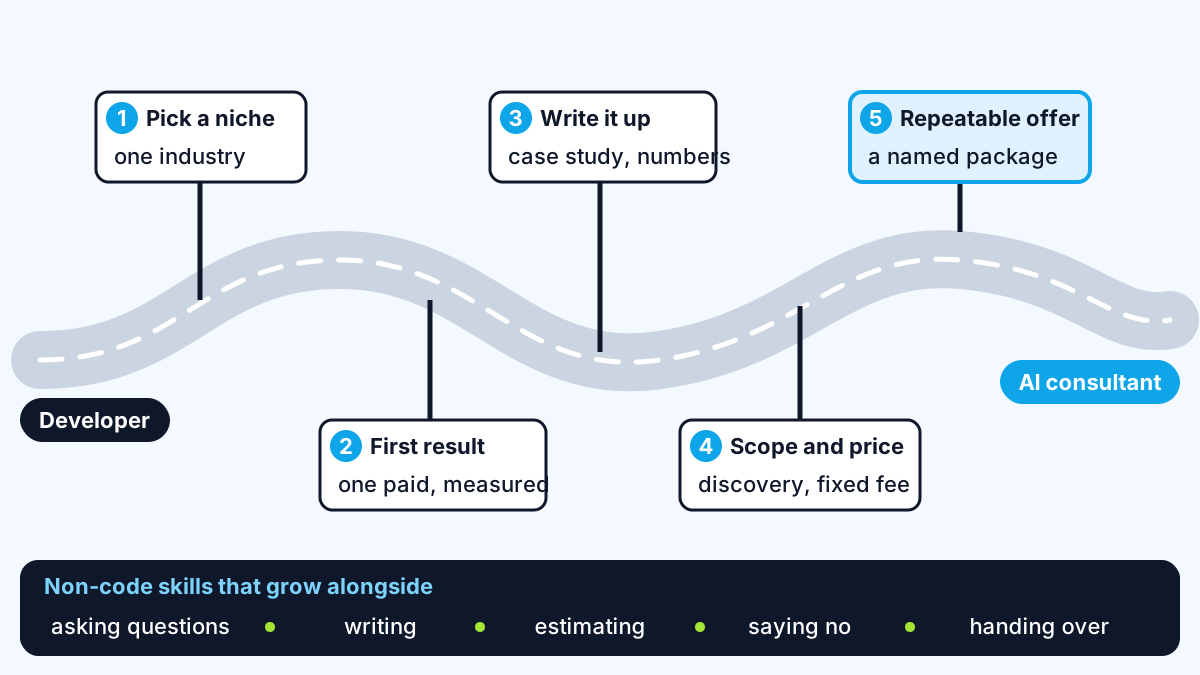
1. Pick a niche you can explain in one sentence
"AI consultant" on its own tells a buyer nothing. "I build AI assistants for recruitment agencies" or "I automate document handling for small accounting firms" tells them whether to keep reading. Lilach Bullock, a UK AI consultant, puts it plainly in her guide to the career: pick an industry, not a technology.
Choose a niche where you already have context: an industry you worked in, a type of system you have built many times, or a problem you understand from the inside.
2. Get one real, measured result
Your first case study matters more than any certificate. Bullock's line is that nobody checks your qualifications, they check your case studies. Find one business with one repetitive, measurable problem, agree a small scope, and measure the before and after: hours per week, response time, error rate.
Good first projects are narrow: a support-reply assistant, a document extraction workflow, an internal search tool. Avoid anything that needs months of data clean-up before it shows value.
3. Write it up with numbers
A case study needs four parts: the problem in the client's words, what you built, the measured result, and what you would do differently. Get the client's permission to publish. If they will not be named, describe the industry and size instead, and keep the numbers.
4. Learn to scope and price outcomes
This is where most developers struggle, because hourly billing feels safe. The pattern that works for AI is a short paid discovery, then a fixed-price build of one clearly defined thing, then an optional retainer. The models and sourced market ranges are in my post on how much an AI consultant costs. I do not publish my own rates; price depends on scope, and so should yours.
Scoping well means writing down what is in, what is out, how success will be tested and who owns the accounts. For what a first month should deliver, my 30-day deliverables post is the template I hold myself to.
5. Build a repeatable offer
After two or three similar projects, turn the pattern into a named package with a fixed deliverable: an "AI readiness review", a "support assistant in four weeks", a "document automation pilot". A repeatable offer is easier to sell, easier to price and easier to deliver well.
Which skills matter beyond code?
The skills that separate consultants from developers are mostly about communication and judgement. In my experience these matter most:
| Skill | What it looks like in practice | How to practise it |
|---|---|---|
| Discovery questions | Finding the real problem behind the requested feature | Ask "what happens today, step by step?" before proposing anything |
| Plain writing | One-page proposals, weekly updates, handover notes | Write a summary of every call within a day |
| Estimating | Ranges with assumptions stated, not single numbers | Track your estimates against actual time |
| Saying no | Turning down work AI is wrong for, or scope that will not fit | Recommend the non-AI option when it is better |
| Build vs buy judgement | Knowing when an existing tool beats custom work | Score options before building; see build vs buy for AI features |
| Handover | Leaving the client able to run what you built | Accounts in their name, documentation, a test set |
Saying no is the one developers underrate. Clients remember the consultant who told them a cheaper tool would do the job. That honesty is what turns a project into a referral.
Where do the first clients come from?
The first clients usually come from people who already know your work: former employers, colleagues who moved companies, and existing freelance clients. Bullock estimates one to three months to a first client with an existing professional network, and four to six months starting cold, from her own experience.
Beyond your network, three channels work for developers:
- Freelance marketplaces. They handle payment and trust for both sides, which helps early on. My comparison of Toptal, Arc and Upwork covers how they differ.
- Writing in public. Short posts about real problems you solved in your niche. Specific beats clever.
- Partnerships. Agencies and software consultancies often need someone who can build AI features for their clients.
Whatever the channel, lead with the case study, not your tech stack. Buyers care about the result.
Work with me
If you are a business looking for someone who both scopes and builds AI systems, see AI integration and AI agent development, browse my work, and book a scoping call.
Frequently asked
Can a software developer become an AI consultant?
Yes. A developer already has the hardest part to fake, the ability to build and ship working systems. The additional skills are discovery, scoping, pricing, plain writing and the judgement to recommend against AI when it does not fit. One real, measured client result is the best starting point.
Do you need a certification to become an AI consultant?
No certification is required, and clients rarely ask for one. Certifications can help you learn a cloud platform or show a baseline, but a case study with measured results does far more to win work. Spend your first months getting one real result.
How do AI consultants charge?
AI consultants charge by the hour, by the day, by fixed project fee or by monthly retainer. A common pattern is a short paid discovery, then a fixed-price build of one defined deliverable, then a retainer if the system needs ongoing support. Sourced market ranges are in my post on AI consultant costs.
How long does it take to get the first AI consulting client?
It depends mostly on your existing network. One UK consultant estimates one to three months with an established professional network and four to six months starting from nothing. Picking a narrow niche and publishing a real case study shortens it.
Sources
Related services
Building something like this?
Naman Gundaniya takes on full-stack and AI projects fixed quote after a free 30-minute scoping call, replies within 24 hours.
Get in touch