 By Naman Gundaniya
Toptal vs Arc vs Upwork vs Direct: Hiring an AI Engineer
Toptal and Arc sell pre-vetted shortlists and a trial period, so you pay for speed and screening. Upwork gives the widest choice and payment protection, but you do the vetting yourself. Hiring directly avoids platform fees and gives you the closest relationship, but contracts, payments and vetting are all on you. Pick by how much screening you can do in-house.
Buyers comparing these routes usually look at hourly rates first, and rates are the least comparable thing across them. What actually differs is who does the vetting, how fees are charged, how fast you get a shortlist, and what happens if the hire does not work out.
A disclosure before the comparison: I am a Top Rated Plus freelancer on Upwork and also work with clients directly. I have tried to stick to each platform's published terms and to say where I could not verify something.
How do Toptal, Arc, Upwork and direct hiring compare?
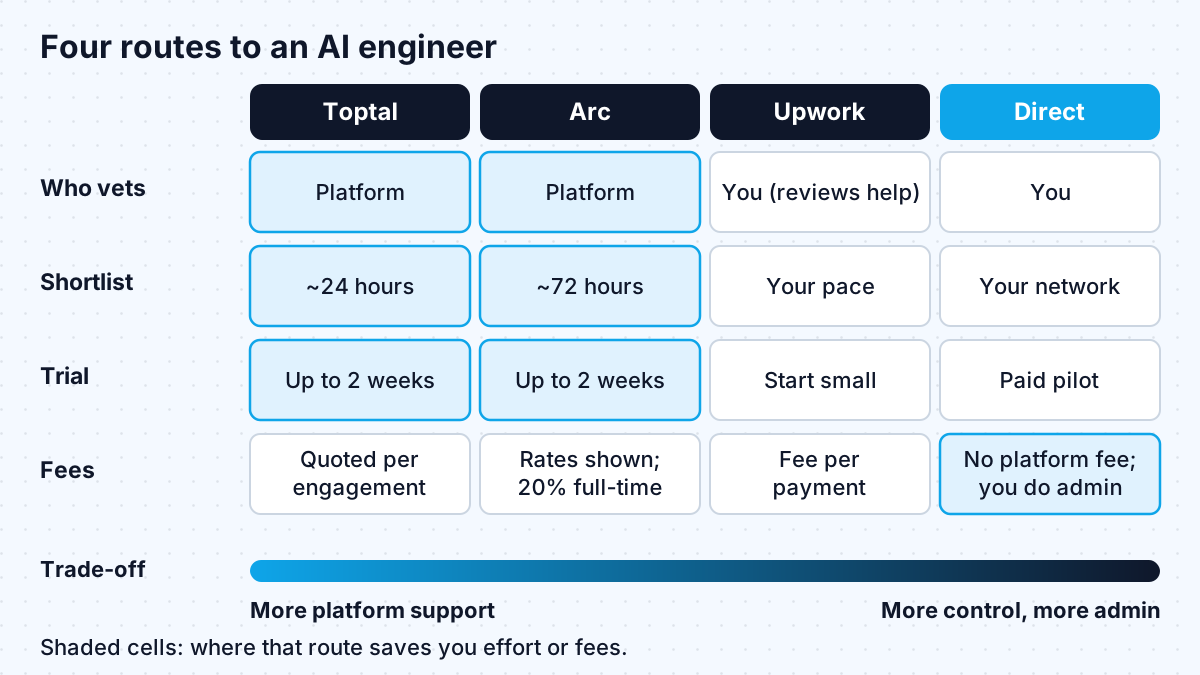
The four routes trade fees and convenience against control. Here is the summary from each platform's own pages as of late 2026; the sections below add detail and caveats.
| Toptal | Arc | Upwork | Direct | |
|---|---|---|---|---|
| Vetting | Screened network; says fewer than 3% of applicants are accepted | Vetted talent; says top 2% for AI developers | Open marketplace; you vet using profiles, reviews and interviews | You vet entirely |
| Speed to candidates | Usually within 24 hours, per its FAQ | Roughly 72 hours for freelance, per its AI page | As fast as you can review proposals | Depends on your network |
| Trial | Up to two weeks; not billed if not satisfied | Risk-free trial of up to two weeks | No platform trial; you can start small | Whatever you negotiate |
| Fees to you | $0 recruiting fee; rates quoted per engagement; FAQ mentions a $79 monthly subscription | Hourly rates shown; 20% of annual salary for full-time hires | Client marketplace fee per payment plus a contract fee | None to a platform |
| Moving off-platform | FAQ says you can usually hire them full-time; no terms published | Contract-to-hire fee applies; amount not published | Conversion fee within a non-circumvention period | Not applicable |
Sources are linked in each section. Treat the table as a starting point and read the current terms before you sign anything, because platforms change them.
Toptal: a screened network with a no-charge trial
Toptal's pitch is screening plus a safety net. Its FAQ says that "of the more than 200,000 people who apply to join the Toptal network each year, we accept fewer than 3%", that it will introduce candidates "within 24 hours" in almost all cases, and that each engagement starts with "a trial period of up to two weeks" during which you are not billed if you are not completely satisfied. Its pricing page lists a $0 recruiting fee and no termination costs.
What it does not publish is rates. You get a quote per engagement, and the FAQ also mentions "a flat monthly subscription fee of $79". It is a good fit when you need someone quickly, cannot run a technical screen yourself, and value the trial.
The thing to check is whether the screening covered AI work specifically. A general engineering screen does not tell you whether someone can build an evaluation set or control model costs.
Arc: vetted remote talent with published rate ranges
Arc sits between a vetted network and a marketplace, with more of its pricing visible. Its pricing page shows freelance rates of "$15 - $110+" per hour, a fee of "20%" of annual salary for full-time hires, and "a risk-free trial period of up to two weeks". Its AI engineer hiring page claims to offer "the Top 2% of Remote AI Developers", says it matches you with a senior developer in "roughly 72 hours", and puts typical freelance AI developer rates at "$60-100+/hour".
Two caveats. The same AI page also says "top 2.3%" in one place, so the exact figure is marketing rather than a measured standard. And it says "a contract-to-hire fee will apply" without stating the amount, so ask before you start if you might convert the hire to full-time.
Upwork: the widest choice, with vetting left to you
Upwork is an open marketplace: you post a job or invite freelancers, review proposals and profiles, and pay through the platform. Upwork's own help and pricing pages blocked automated access when I checked, so the fee figures here come from a 2026 breakdown by South, which lists a client platform fee of "3–5% on Marketplace or 8–10% on Business Plus" and contract initiation fees "from $0.99 to $14.99 per contract". The same page says a conversion fee applies if you hire a freelancer off-platform within 24 months of the first contract. Confirm all of these on Upwork's pricing page and terms before you rely on them.
Upwork's strength is reach and evidence. You can read real client reviews and job histories, see work samples, and start with a small fixed-price milestone. Its weakness is noise: the open market includes many people who have only built demos, and filtering them is your job. The questions in 15 questions to ask before you hire an AI developer are designed for exactly that filtering.
Direct: no platform fee, all the admin
Hiring directly means finding the engineer through referrals, their portfolio, open-source work or content they publish, and contracting with them yourself. You pay no platform fees and the relationship is entirely between you, which many long engagements end up preferring.
In exchange you carry everything a platform would otherwise handle:
- Vetting. No pre-screen, so your interview and pilot process must be solid.
- Contracts and IP. You need a written agreement with an IP assignment. If the engineer is abroad, check local rules; my guide to hiring an AI engineer in India covers the written-assignment requirements there.
- Payments and tax paperwork. International payments, invoices and forms such as the W-8BEN for foreign contractors.
- Dispute handling. No escrow or platform mediation, so milestones and acceptance criteria matter more.
When does each route make sense?
Choose based on how much vetting and admin you can do yourself, not on the lowest headline rate.
| Your situation | Route that usually fits |
|---|---|
| Need someone this week, no in-house technical screen | Toptal or Arc |
| Want published rate ranges and a trial | Arc |
| Have a technical lead who can vet, want wide choice and reviews | Upwork |
| Small first project to test a working relationship | Upwork milestone or a direct paid pilot |
| Long-term engagement with someone you already trust | Direct |
| Planning to convert to full-time later | Check conversion terms first on any platform |
One point applies to every route: platform vetting is general, and AI work needs AI-specific checks. A candidate who passes a coding screen may still have never built an evaluation set, estimated token costs or limited what a model can do with your data. Ask about those directly, and ask to see a shipped AI feature rather than a demo. A short written brief describing your problem, data and success metric also makes quotes from different routes comparable, because every candidate is answering the same question.
Whichever route you take, structure the start the same way: a short, paid pilot with written success criteria, repositories and API keys in your accounts from day one, and a review at the end before committing further, which heads off the usual reasons AI pilots stall. If you are still deciding between one engineer and a firm, freelance AI engineer vs agency covers that choice, and how much it costs to hire an AI developer covers market rates.
Work with me
You can hire me through Upwork or directly, whichever suits your procurement. See AI agent development and AI integration, or browse my work and book a scoping call.
Frequently asked
Is Toptal better than Upwork for hiring an AI engineer?
Toptal is better if you want a pre-screened shortlist quickly and a no-charge trial, and do not have time to vet. Upwork is better if you can vet candidates yourself and want a wider choice with visible reviews. The quality of the individual matters more than the platform.
Does Arc charge a fee for full-time hires?
Arc's pricing page lists a fee of 20% of annual salary for full-time hires. For freelance engagements it shows hourly rate ranges, and its AI hiring page mentions a contract-to-hire fee without stating the amount.
Can I hire an Upwork freelancer directly instead?
Upwork's terms include a non-circumvention period during which moving a relationship off the platform requires paying a conversion fee. Check the current terms on Upwork before arranging any direct contract with someone you met there.
What is the cheapest way to hire an AI engineer?
Hiring directly avoids platform fees, but it shifts vetting, contracts, payments and dispute risk onto you. The cheapest route overall is the one that gets you a competent engineer on the first try, so include the cost of a failed hire in the comparison.
Sources
Related services
Building something like this?
Naman Gundaniya takes on full-stack and AI projects fixed quote after a free 30-minute scoping call, replies within 24 hours.
Get in touch