 By Naman Gundaniya
Hiring an AI Engineer in India: A Guide for US Teams
To hire a senior AI engineer in India, look beyond rate tables: vet for production AI work the same way you would at home, plan a fixed daily overlap window around the 9.5 to 13.5 hour time difference, and sign a written contract that assigns IP with stated duration and territory. Run the first weeks as a scoped, paid pilot.
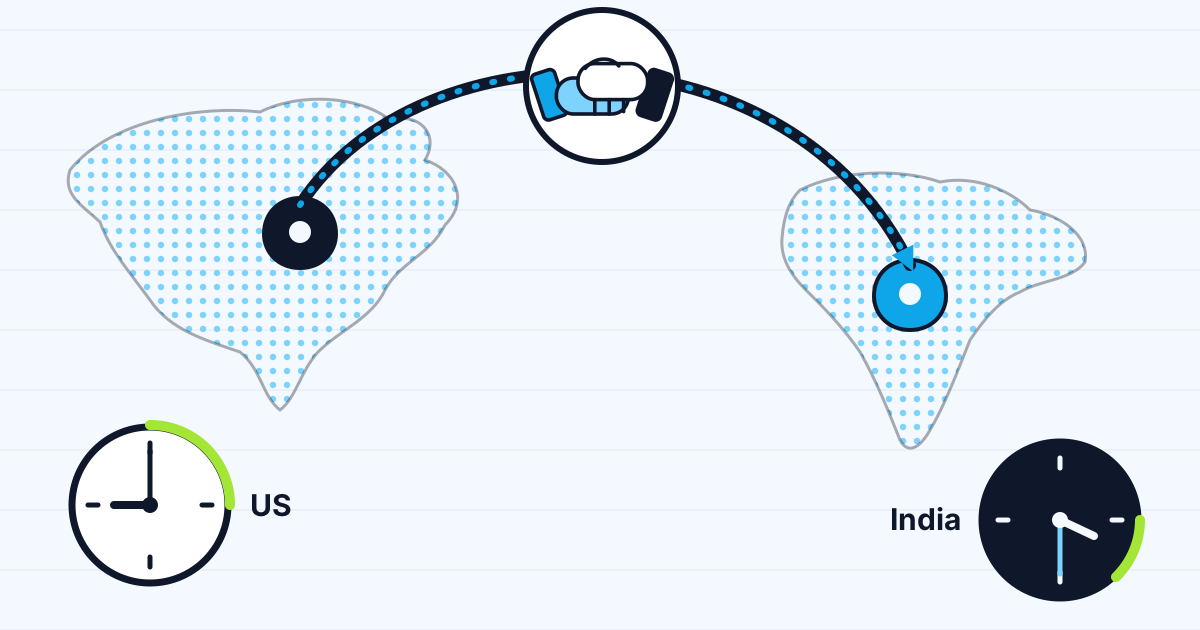
Search for this topic and you mostly get marketplaces quoting low hourly rates. Rates are the least interesting part of the decision. What decides whether the engagement works is whether you hire for the right skills, set up the working rhythm deliberately, and get the paperwork right on IP.
I am an AI engineer based in India working with clients abroad, so I have an obvious interest here. I will keep this to what a US team needs to check, with sources for the facts that matter.
Why do US teams hire AI engineers in India?
The main reason is access to a very large and growing pool of engineers, not just cost. GitHub's Octoverse 2025 report says India added more than 5.2 million developers on GitHub in 2025, rose to second place with 21.9 million developers, and is projected to reach 57.5 million by 2030. It also says India is "poised to overtake the US developer population within the next few years".
A large pool cuts both ways. There are many excellent engineers and many more who have only built tutorials, so vetting matters more than geography. The time difference also has an upside many teams discover after a few weeks: work can move forward while your team sleeps, if the hand-offs are set up well.
Where to look, and what each route gives you
There are four common routes, and they differ more in vetting and fees than in talent.
| Route | What you get | Trade-off |
|---|---|---|
| Vetted networks | Pre-screened candidates, faster shortlist | Platform fees and markup |
| Open marketplaces | Wide choice, reviews and payment protection | You do the vetting; platform terms apply |
| Direct (referrals, GitHub, portfolios) | Direct relationship, no platform fees | You handle contracts, payments and vetting |
| Employer of record | Full-time employee without an Indian entity | Monthly fees, longer setup |
For senior AI work I would weight evidence over the channel: a portfolio with shipped AI features, public code, written case studies and client reviews tell you more than any badge. If a candidate's portfolio only shows chatbots built from tutorials, keep looking.
How to vet an AI engineer remotely
Vet the same way you would vet a local hire: on production evidence, not on demos. The questions that matter are about evaluation, data access, running cost, safety and handover, and I list fifteen of them, with good answers and red flags, in questions to ask before you hire an AI developer.
Remote hiring adds three checks:
- Written communication. Much of the collaboration will be asynchronous. Ask for a short written proposal for your problem and judge its clarity.
- Overlap commitment. Ask exactly which hours in your time zone they will be available, and get it in the contract.
- A paid pilot. One to three weeks on a scoped piece of real work, with success criteria agreed up front, tells you more than any interview.
Make sure you are hiring the right role, too. AI developer vs AI engineer explains the difference between someone who wires up an API and someone who owns quality and cost in production.
Time zones: how much overlap is realistic?
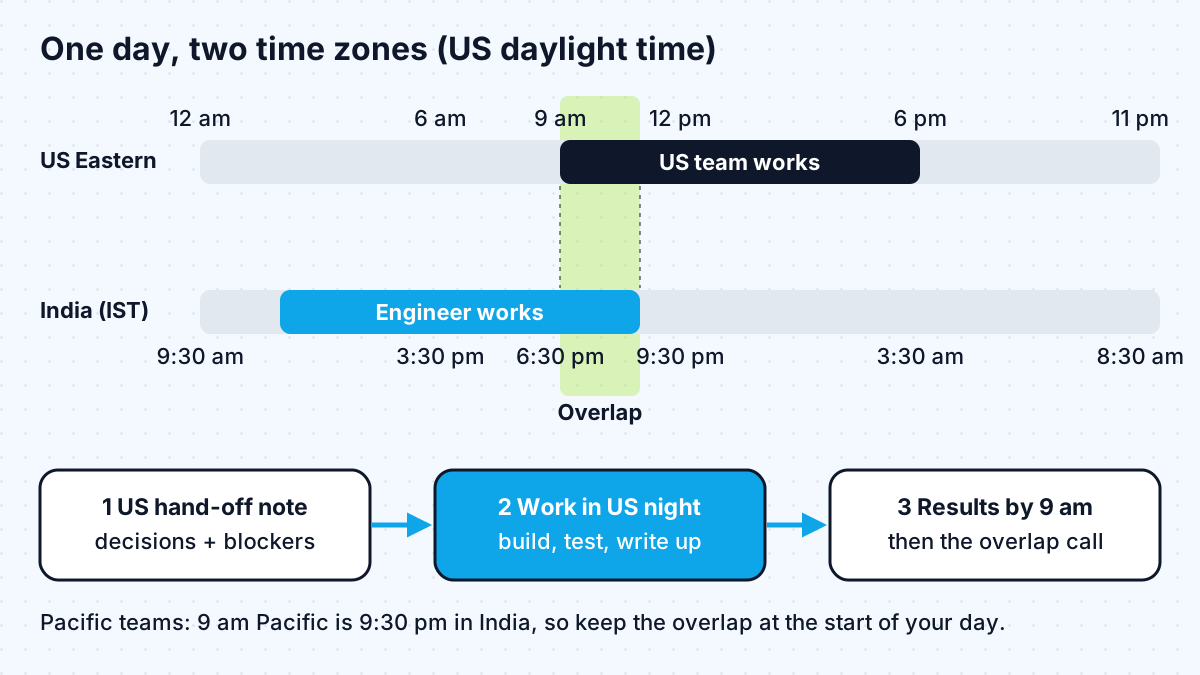
Plan for a fixed overlap window of two to three hours a day, usually your morning and the engineer's evening. Indian Standard Time is UTC+5:30 and, as Indian Standard Time notes, India does not observe daylight saving time. US clocks do change, so the gap shifts by an hour twice a year.
| US time zone | Hours India is ahead | 9:00 am US time in India |
|---|---|---|
| Eastern, daylight time (UTC-4) | 9.5 | 6:30 pm |
| Eastern, standard time (UTC-5) | 10.5 | 7:30 pm |
| Pacific, daylight time (UTC-7) | 12.5 | 9:30 pm |
| Pacific, standard time (UTC-8) | 13.5 | 10:30 pm |
East Coast teams have the easier fit: a 9 to 11 am meeting block lands in the Indian evening. West Coast teams usually either meet early in their morning or rely more heavily on written hand-offs.
What works in practice is a relay, the same rhythm I describe for a remote FDE working from India. Your team ends the day with a written note of decisions and blockers; the engineer works through your night; you start the next day with results, a short update and any questions. Keep one standing call a day or a few a week, not ad hoc meetings scattered across the calendar.
Contracts, tax forms and IP
Get three things in writing: the scope and payment terms, the IP assignment, and the tax paperwork. This is general information, not legal advice, so have your counsel review the final contract.
IP assignment is the one most often done badly. Under Indian copyright law an independent contractor is not treated like an employee for ownership purposes. A guide to IP assignment clauses in India by a law firm explains that a freelancer or outsourced developer "would not ordinarily fall within" the employee provision, so copyright "will generally remain with the author" unless it is effectively assigned. It also notes that an assignment must be in writing and signed, and that if the duration is not specified it is deemed to be five years, and if the territory is not specified it is presumed to extend only within India. So do not rely on a US-style "work made for hire" label alone: include an express written assignment that states it is worldwide and for the full term of the rights.
Cover the AI-specific assets. List prompts, evaluation datasets, fine-tuning data, model configuration and infrastructure-as-code alongside source code in the assignment. Require that repositories, cloud accounts and API keys live in your organisation from day one; who owns your automations when the freelancer leaves shows what happens when they do not.
Tax forms. For a foreign individual contractor, the IRS says to give Form W-8BEN "to the withholding agent or payer", meaning you collect it rather than send it to the IRS. If you want a full-time employee rather than a contractor, an employer-of-record service can employ them in India on your behalf.
Confidentiality and data. If the engineer will touch customer data, add a data processing clause, restrict copies to your systems, and decide in advance which model providers may receive that data.
What working together looks like
A good engagement with an India-based AI engineer looks much like one with a strong remote engineer anywhere, with a little more structure around the hand-offs:
- Week one: access to your repos and tools set up in your accounts, a written plan, and the evaluation set for the first feature agreed.
- Weekly: a short demo of working software, the evaluation score, and running-cost numbers.
- Daily: written updates and one fixed overlap window.
- At handover: documentation, a walkthrough recorded for your team, and everything already living in your accounts.
If you are weighing this against building an internal team, AI freelancer vs in-house AI team covers that decision, and how much it costs to hire an AI developer covers market rates.
Work with me
I am an AI engineer in India working with US and other overseas teams, with a fixed overlap window, everything in your accounts and IP assigned in writing. See AI integration and AI agent development, or browse my work and book a scoping call.
Frequently asked
Is it safe to hire an AI engineer in India?
It can be, with the same controls you would use for any remote contractor: vet on production evidence, keep code, cloud accounts and keys in your organisation, sign a written IP assignment with worldwide scope and full term, and add confidentiality and data processing terms.
What is the time difference between the US and India?
India is 9.5 hours ahead of US Eastern daylight time and 13.5 hours ahead of US Pacific standard time, with other US zones in between. India does not change its clocks, so the gap moves by an hour when the US starts or ends daylight saving time.
Do I need a contract to own code written by a contractor in India?
Yes. Under Indian copyright law a contractor generally owns what they create unless the rights are assigned in writing. The assignment should name the work and state the duration and territory, otherwise defaults of five years and India only can apply.
What forms do US companies need to pay a contractor in India?
For a foreign individual contractor, US payers typically collect IRS Form W-8BEN, which documents foreign status for withholding purposes. Check your specific situation with an accountant, especially if you pay through a company rather than an individual.
Sources
Related services
Building something like this?
Naman Gundaniya takes on full-stack and AI projects fixed quote after a free 30-minute scoping call, replies within 24 hours.
Get in touch