 By Naman Gundaniya
Remote FDE From India for US Teams: How the Overlap Works
A remote forward deployed engineer in India works with a US team by shifting part of the working day into the US morning, which gives two to four hours of live overlap with the East Coast, and handing work over in writing for the rest. Add an IP assignment in the contract, access through your own accounts with least privilege, and the distance stops mattering much.
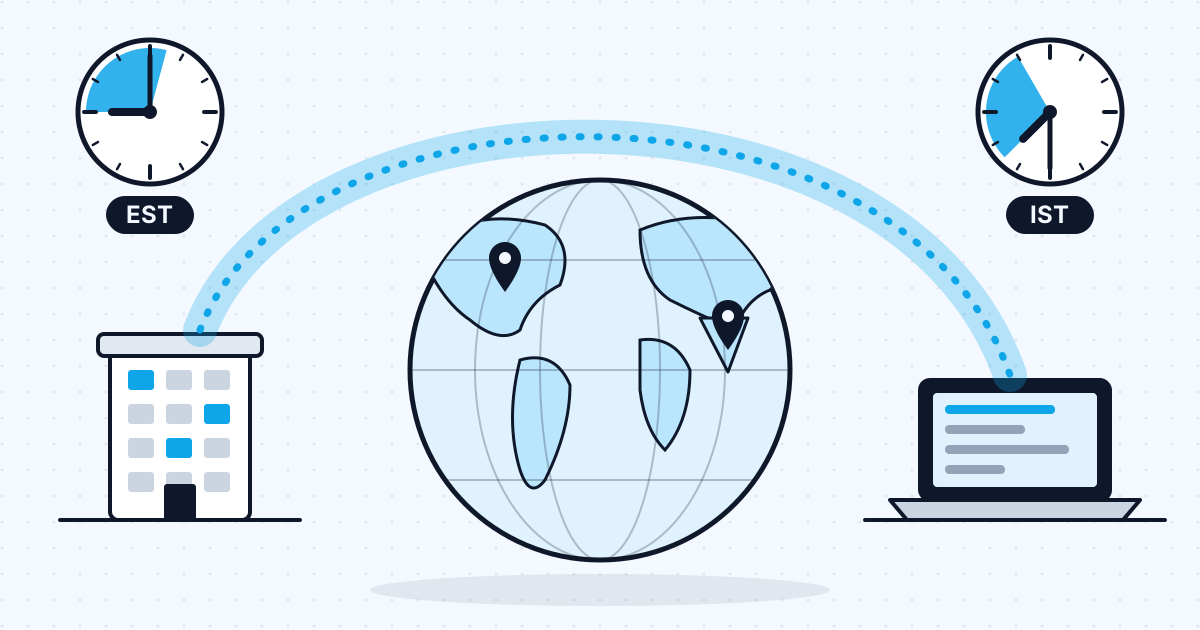
I am a forward deployed engineer based in India, and most of my clients are in the US, UK, Canada, Germany, the UAE and Australia. The questions buyers ask about working with someone offshore are almost never about skills. They are about hours, contracts, money and security. Most pages about FDEs in India are salary pages for job seekers; this one is for the buyer.
How many hours overlap between India and the US?
India is ten and a half hours ahead of US Eastern time in winter and nine and a half hours ahead in summer, so a normal Indian working day barely touches a US one. India Standard Time is UTC+05:30 and India does not observe daylight saving time, while US Eastern time is UTC−05:00 in winter and UTC−04:00 in summer. US Pacific time is UTC−08:00, or UTC−07:00 in summer.
That last detail catches people out. Because India never changes its clocks, the overlap moves by an hour twice a year when the US does. US daylight saving time starts on the second Sunday in March and ends on the first Sunday in November, so recurring meetings booked in one time zone need a check in March and November.
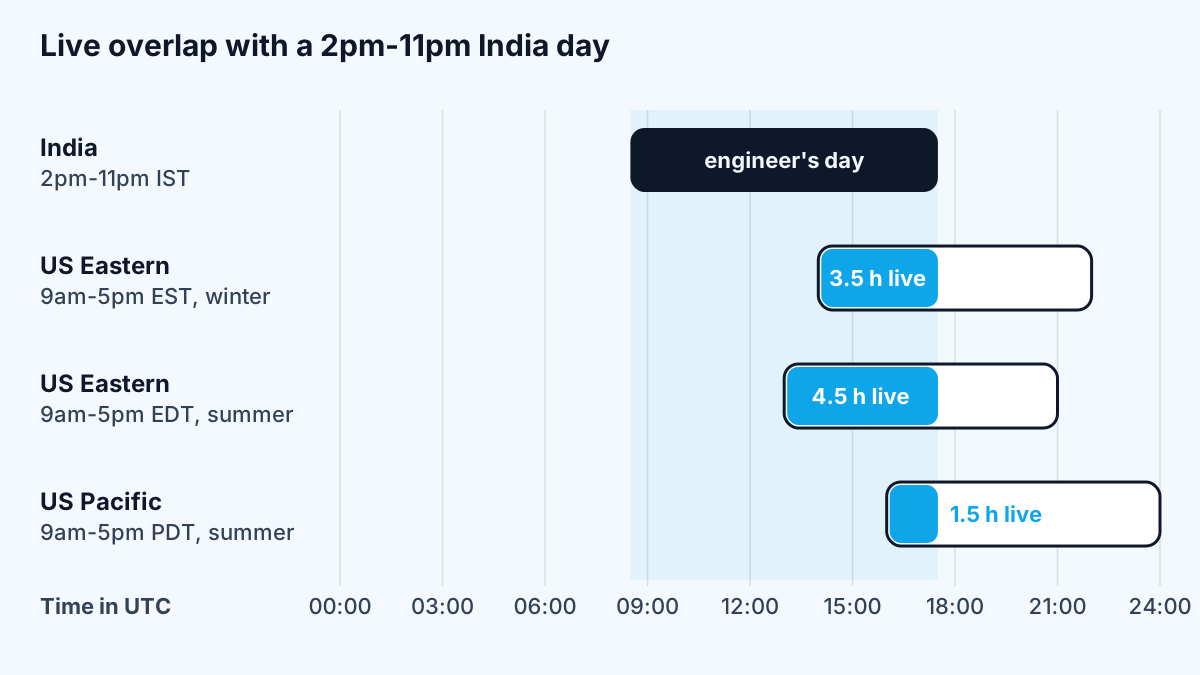
The practical answer is a shifted day. If the engineer works from 2pm to 11pm in India, the East Coast gets a solid morning of overlap:
| Client time zone | Client 9am is, in India | Overlap with a 2pm-11pm IST day |
|---|---|---|
| US Eastern, winter (EST) | 7:30pm | 9:00am-12:30pm EST, 3.5 hours |
| US Eastern, summer (EDT) | 6:30pm | 9:00am-1:30pm EDT, 4.5 hours |
| US Pacific, summer (PDT) | 9:30pm | 9:00am-10:30am PDT, 1.5 hours |
| UK, winter (GMT) | 2:30pm | The whole UK working day |
| Australia East, winter (AEST) | 4:30am | None; use an Indian morning day instead |
The UK is the easy case: it is on UTC+00:00 in winter and UTC+01:00 in summer, so India is only four and a half to five and a half hours ahead. Eastern Australia runs the other way, on UTC+10:00, or UTC+11:00 in states that observe daylight saving, so the overlap is the Indian morning and the Australian afternoon.
Three overlap models that work
There are three workable patterns, and the right one depends on how much live collaboration the project needs.
- Shifted day (most US East Coast work). The engineer starts in the Indian afternoon and covers the US morning. Stand-ups, discovery sessions and reviews happen live; building happens before the US team logs on.
- Handoff (follow the sun). The US team ends its day with questions and test results; the engineer works through them overnight and leaves a written update for the US morning. Less live time, faster cycles on well-defined tasks.
- Anchor sessions (US West Coast). With only an hour or two of natural overlap, fix two or three longer calls a week, early Pacific morning, and run everything else in writing.
For discovery, the first week of an engagement, I recommend more live time than usual, even if it means some late Indian evenings. You cannot learn how a team works from tickets alone. Once the build starts, written handoffs carry most of the load.
What makes asynchronous work actually work
Async collaboration works when decisions are written down where everyone can find them, not when people simply reply to messages later. On remote engagements I rely on:
- A daily written update in a shared channel: what shipped, what is blocked, what I need from whom.
- Short recorded walkthroughs of new features, so reviewers can watch at their own time.
- One decisions log in the repository or the team's wiki, so nobody re-litigates choices across time zones. It also feeds the context coding agents need.
- A named owner on the client side who can unblock questions within a working day.
- Tickets with acceptance criteria, so work done overnight can be checked against something.
Contracts, IP and payment with an offshore engineer
Your contract with an offshore engineer should say, in writing, that you own what they build. This matters more than buyers expect. Under US copyright law, a commissioned work only counts as a "work made for hire" if it falls into one of nine listed categories and both parties agree in a signed written instrument, and software is not on that list. So ask your lawyer for an explicit assignment of intellectual property, not just a "work for hire" sentence.
Things I would expect in any contract, wherever the engineer is:
- assignment of IP in the deliverables to the client on payment,
- a list of any pre-existing tools or libraries the engineer brings, which they keep but license to you,
- confidentiality terms covering your data and code,
- the governing law and how disputes are handled,
- what happens to access and data when the engagement ends.
Payment is simpler than it sounds. Most clients either pay through the platform where they hired (I work through Upwork as well as directly) or pay an invoice in their own currency by international transfer. Agree the currency, the invoicing schedule and who bears transfer fees before the work starts. Pricing itself follows scope; I explain how a pilot budget is built in what an FDE pilot costs.
Secure data access when the engineer is offshore
The safest pattern is that the engineer never holds your data or credentials outside your systems: they work inside your accounts, with the minimum access the task needs, and that access can be switched off in minutes. AWS's IAM guidance is a good template even if you use another cloud. It recommends that human users, including external collaborators, use federation and temporary credentials, that permissions follow least privilege, that MFA is required, and that unused users, roles and credentials are regularly reviewed and removed.
In practice that means:
- Accounts in your organisation: the engineer is invited to your cloud, repository, model provider and project tools, rather than you being invited to theirs. I explain why in who owns your automations.
- Least privilege first: read-only access to production data during discovery, write access only where the system needs it.
- Masked or sample data for development where possible, and no production personal data copied to laptops.
- API keys created in your provider accounts, stored in your secrets manager, rotated when the engagement ends.
- An offboarding checklist agreed at the start, so removing access is routine rather than awkward.
None of this is specific to India. It is how you should work with any external engineer, and it is also what makes the handover clean. I cover the vetting side in my buyer's guide to hiring a freelance FDE.
Work with me
I work from India with teams in the US, UK, Canada, Germany, the UAE and Australia, usually starting with a fixed pilot and a shifted day that overlaps your morning. See AI agent development and full-stack development, browse my work, and book a scoping call at a time that suits your time zone.
Frequently asked
Can a forward deployed engineer in India work for a US company?
Yes. Most US engagements use a shifted working day in India that overlaps the US morning, plus written handoffs for the rest. The contract, IP assignment, payment and access controls work the same way as with any external engineer.
How many hours of overlap are there between IST and EST?
None in a standard nine-to-five on both sides. India is 10.5 hours ahead of US Eastern time in winter and 9.5 hours ahead in summer, so a 2pm to 11pm IST day overlaps 9am to 12:30pm EST in winter and 9am to 1:30pm EDT in summer.
Does India have daylight saving time?
No. India Standard Time stays at UTC+05:30 all year, so the gap to the US, UK and Australia changes whenever those countries change their clocks. Check recurring meetings in March, April, October and November.
Who owns the code an offshore freelancer writes?
You should, but put it in writing. In the US, commissioned software does not automatically become a work made for hire, so the contract needs an explicit IP assignment. Keep repositories and accounts in your organisation from day one.
How do I give an offshore engineer secure access to our systems?
Invite them into your own accounts with individual logins, MFA, least-privilege permissions and temporary credentials where your platform supports them. Use masked data for development, keep API keys in your secrets manager, and agree an offboarding checklist at the start.
Sources
- UTC+05:30 and India does not observe daylight saving time (en.wikipedia.org)
- UTC−05:00 in winter and UTC−04:00 in summer (en.wikipedia.org)
- UTC−08:00, or UTC−07:00 in summer (en.wikipedia.org)
- nist.gov
- UTC+00:00 in winter and UTC+01:00 in summer (en.wikipedia.org)
- UTC+10:00, or UTC+11:00 in states that observe daylight saving (en.wikipedia.org)
- law.cornell.edu
- docs.aws.amazon.com
Related services
Building something like this?
Naman Gundaniya takes on full-stack and AI projects fixed quote after a free 30-minute scoping call, replies within 24 hours.
Get in touch