 By Naman Gundaniya
Hire a Freelance Forward Deployed Engineer: A Buyer's Guide
Hire a freelance forward deployed engineer when you have a specific business problem, the data and systems to solve it, and nobody in-house with the time to turn an AI model into working software. Vet them on shipped production work, not demos, agree a fixed pilot of about six weeks with a go or stop decision, and make sure everything is built in your accounts.
I work as a forward deployed engineer (FDE), and most of the people who contact me have already read what the role is. What they have not found is the buyer's side: how to tell whether you need one, how to check the person is real, and what the engagement should look like. Search results for this are mostly marketplaces and recruiters: useful for finding names, not for judging them.
This guide is what I would want a client to know before the first call, including the parts that do not favour hiring me.
What a freelance forward deployed engineer does for your company
A freelance FDE embeds with your team for a fixed period, finds the workflow where AI will actually save time or money, builds the production system end to end, and hands it over. The recruiting firm Paraform puts the difference from other technical roles neatly: an FDE writes production code, but not for the core product, and "the spec comes from a client's problem, not a product roadmap."
The freelance version differs from the in-house version in one way that matters to you: the engineer works for you, not for a software vendor. A vendor's FDE is there to make the vendor's platform succeed in your business. A freelance FDE should be neutral about tools and pick whatever fits your stack, budget and data rules.
In practice one person covers discovery, integration, the build, evaluation and handover, work normally split across several roles. If you want the longer definition, I wrote it up in what a forward deployed engineer is.
Signs you need a forward deployed engineer, not another hire
You need an FDE when the bottleneck is turning AI into a working system inside your business, not a lack of ideas or a lack of general developers. These are the signs I look for on a first call:
- A pilot that demoed well and then stopped. Someone built a prototype, leadership liked it, and it has not reached real users.
- A clear, repeated task with a measurable cost. Support triage, document extraction, quote preparation, internal search: work that people do every day.
- Data that exists but is scattered. The answer is in a CRM, a shared drive and an inbox, and nobody has joined them up.
- A busy engineering team. Your developers are fully booked on the core product and cannot spend six weeks learning model evaluation.
- No appetite for a permanent AI team yet. You want to prove value before you commit headcount. I compare the two paths in AI freelancer vs in-house AI team.
And the signs you do not need one: you have no specific problem yet (you need a workshop, not an engineer), the task happens a few times a month (automate it with an off-the-shelf tool), or you already have an AI team that only needs extra hands (hire a contractor developer instead).
How to vet a freelance FDE
Vet a freelance FDE on evidence of production systems they shipped and handed over, because that is the part of the job demos cannot fake. Marketplaces do some screening for you. Toptal, for example, says that fewer than 3% of applicants are accepted and that engagements start with a trial period of up to two weeks. That is useful, but it checks general engineering ability, not whether someone can find the right problem inside your business.
These are the questions I would ask any FDE, including me:
| Question | A good answer sounds like | A red flag sounds like |
|---|---|---|
| Show me a system you built that real users still rely on. | A specific workflow, who used it, what it connected to | Only demos, hackathons or screenshots |
| How did you know it worked? | An evaluation set, accuracy or time saved, user feedback | "The client was happy" |
| What did you hand over at the end? | Repo, runbook, evals, accounts in the client's name | "I still maintain it for them" as the only option |
| What would make you stop this project? | A named go or stop criterion | No answer, or "we can always make it work" |
| Which parts would you not use AI for? | Specific steps that should stay rules or humans | Everything should be an agent |
| Whose accounts will the code, keys and data live in? | Yours, from day one | Theirs, for convenience |
The last question matters more than it looks. A system built in the freelancer's cloud account, with their API keys, is a system you cannot take back without a migration.
Engagement shapes: pilot, fractional and project
Most freelance FDE work fits one of three shapes, and the right one depends on how clear the problem is.
| Shape | What it looks like | Best when |
|---|---|---|
| Fixed pilot | About six weeks, one workflow, a go or stop decision at the end | The problem is clear and you want proof before committing |
| Fractional | A set number of days a week over several months | You have a stream of AI work and no one to own it |
| Fixed project | A defined system with acceptance criteria | Requirements are already well understood |
For a first engagement I almost always recommend the pilot. It caps your risk, forces both sides to define success up front, and ends with a clear decision rather than a slow drift.
On price, market data is thin and wide. Second Talent's rate card, for example, lists US freelance FDE rates of $95 to $142 an hour for junior and $155 to $235 for senior engineers, with much lower bands for South Asia. Treat any single figure with care: the scope of the pilot moves the total far more than the hourly rate does. For broader context on AI developer rates, see how much it costs to hire an AI developer.
What the first six weeks look like
A good six-week pilot moves from understanding the problem to a working system in real users' hands, with a decision point before you spend more.
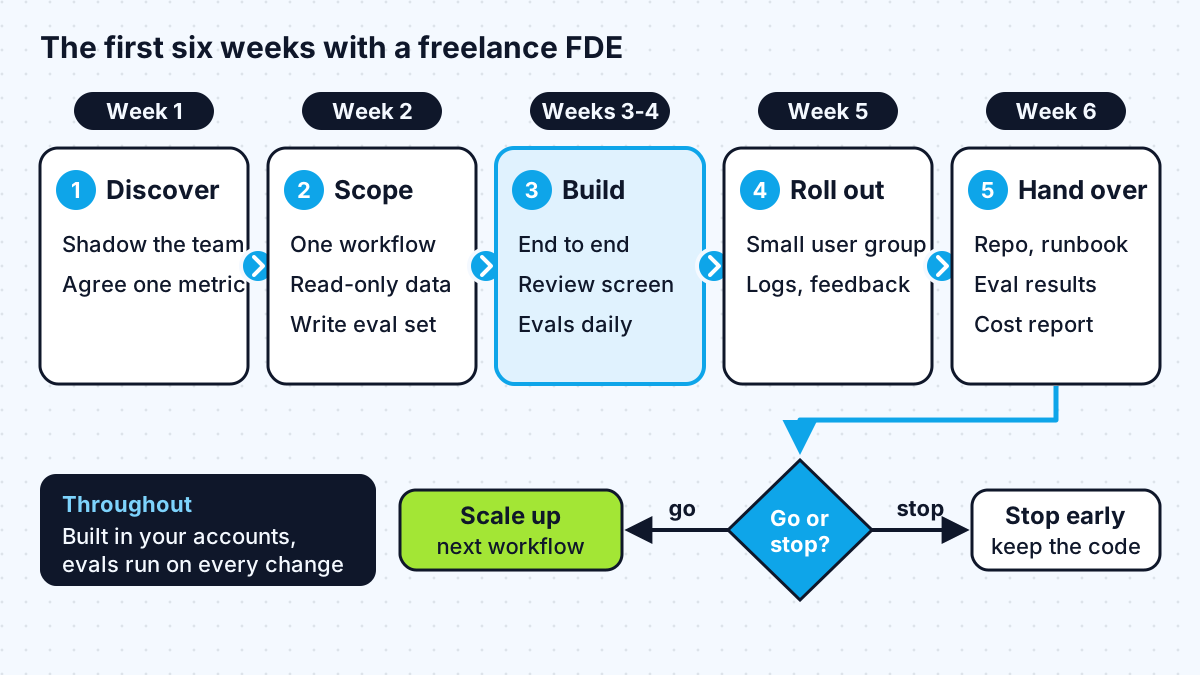
- Week 1, discovery. I sit with the people who do the work, read real tickets or documents, and agree one success metric in their terms, such as minutes per case or share of cases handled without edits.
- Week 2, scope and access. We pick the single workflow, set up read-only access to the data it needs in your accounts, and build a test set of real examples with expected answers.
- Weeks 3 and 4, build. The system goes end to end: data access, model calls, validation, the screen a person uses to review output, and the integration back into your tools. Evaluations run on every change.
- Week 5, rollout. A small group uses it on real work, with logging and a simple way to flag bad output.
- Week 6, handover and decision. You get the repository, a runbook, the evaluation results and a running-cost estimate, and you decide whether to scale, change course or stop.
The handover is part of the pilot, not an extra: if the system only works while the engineer is around, the pilot has failed. The same approach applies when the starting point is an existing product; I describe that pattern in adding AI to an existing app without a rewrite.
Red flags when you hire a forward deployed engineer
Walk away from a freelance FDE who cannot point to systems in production, who proposes a large build before any discovery, or who wants to keep the code and keys in their own accounts. Other warning signs:
- a fixed tool or framework they use for every client, whatever the problem,
- no mention of evaluation, logging or running costs,
- a proposal that promises full automation with no human review step,
- no written intellectual property assignment in the contract.
On that last point, if you are a US company, do not assume commissioned code belongs to you by default. Under US copyright law, a commissioned work only counts as a "work made for hire" if it falls into one of nine listed categories and the parties agree in a signed written instrument, and software is not on that list. Ask your lawyer for an explicit assignment clause. I compare the freelancer and agency routes more broadly in freelance AI engineer vs agency.
Work with me
I work as a freelance forward deployed engineer for teams in the US, UK, Canada, Germany, the UAE and Australia, usually starting with a fixed pilot on one workflow. See AI agent development and AI integration, browse my work, and book a scoping call to talk through your problem.
Frequently asked
How do I hire a forward deployed engineer?
Start with one specific problem and the data behind it, then shortlist engineers who can show production systems they built and handed over. Run a short call on your real workflow, agree a fixed pilot of around six weeks with a written success metric, and make sure the work happens in your accounts.
What is the difference between a freelance FDE and a vendor's FDE?
A vendor's forward deployed engineer works for the software company and makes its platform succeed in your business. A freelance FDE works for you, so they should choose tools on fit rather than on which product they represent.
How long does a forward deployed engineering pilot take?
A focused pilot on one workflow usually takes about six weeks: one week of discovery, one of scoping and data access, two of building, one of rollout to real users, and one of handover and a go or stop decision. Larger or regulated workflows take longer.
How much does a freelance forward deployed engineer cost?
Published market data is limited and wide. One rate card lists US freelance FDE rates from $95 to $235 an hour by seniority, with lower bands in other regions. The total depends far more on the scope of the pilot than on the rate, which is why I price it after a scoping call.
Who owns the code when a freelance FDE leaves?
You should, but only if the contract says so and the work lives in your accounts. Ask for an explicit intellectual property assignment, keep repositories, cloud projects and API keys in your organisation from day one, and require a runbook at handover.
Sources
Related services
Building something like this?
Naman Gundaniya takes on full-stack and AI projects fixed quote after a free 30-minute scoping call, replies within 24 hours.
Get in touch