 By Naman Gundaniya
Forward Deployed Engineering for Startups: When You Need One
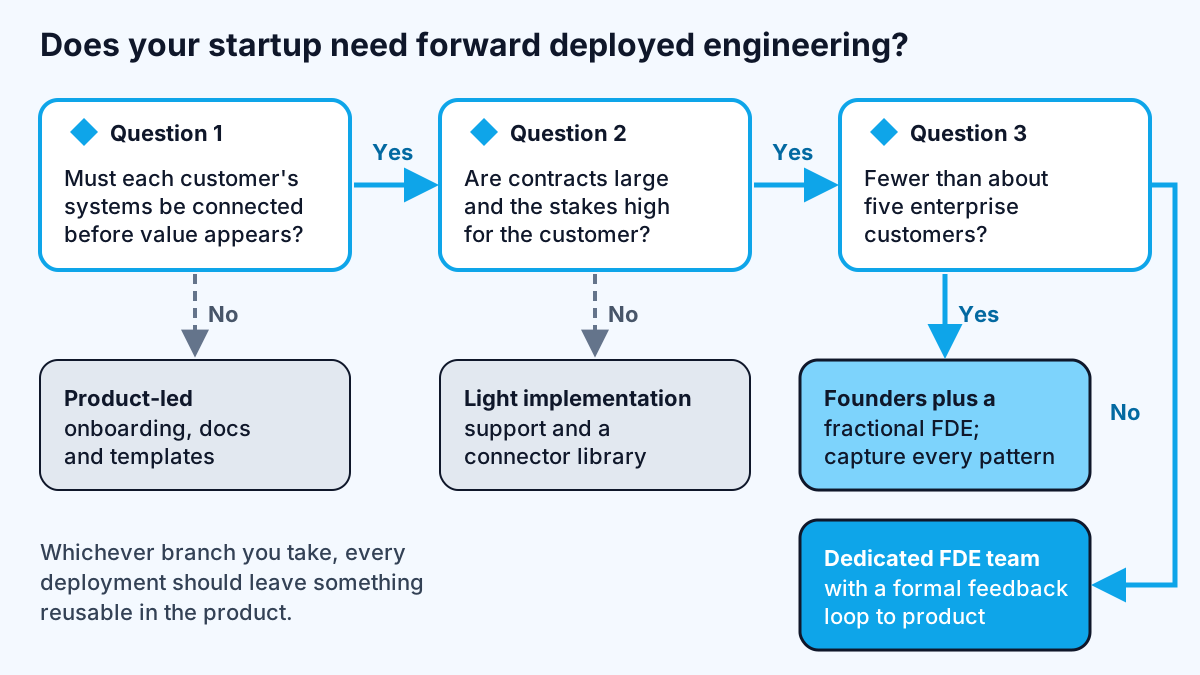
A startup needs forward deployed engineering when it sells to enterprises whose workflows, data and systems must be wired into the product before it delivers value, and when each deal is large and important enough to justify an engineer's time. It does not need it for self-serve customers. The rule that keeps it healthy: every deployment must feed something back into the core product.

Forward deployed engineering has become a startup pattern, not just a Palantir or OpenAI one. Founders read that their competitors have FDE teams and wonder whether they should too. Sometimes the answer is yes. Often it is "not yet", or "yes, but not the way you are imagining".
I work as a freelance forward deployed engineer, which puts me on one side of this decision: the capability without the headcount. I have tried to be fair about when that is not the right answer. This post is about when the model pays off, when it becomes a trap, and how to staff it without starving the product.
What forward deployed engineering means for a startup
For a startup, forward deployed engineering means putting engineers inside customer accounts to connect the product to the customer's real systems and workflows, and then bringing what they learn back to the product team. It is implementation work done by engineers who can change the product, not just configure it.
Joe Schmidt of a16z made the case in 2025 that this is how AI startups win enterprise customers: "Enterprises buying AI are like your grandma getting an iPhone: they want to use it, but they need you to set it up." He also noted that the role is often filled by professional services staff, "sometimes rebranded as a forward deployed engineer".
Startups already run this way in numbers. Bloomberry's analysis of about 1,000 FDE postings found that 58% of FDE roles were at companies with 11 to 200 employees, and that 45% of postings sit in a dedicated FDE team, 38% within engineering and 14% in sales or go-to-market.
Signs your startup needs forward deployed engineering
You need forward deployed engineering when enterprise deals stall or churn at the integration step, not at the sales step. These are the signals worth acting on:
- Deals close but customers never go live. The contract is signed, and three months later the product is still not connected to their data.
- Every enterprise customer needs a custom integration. Their CRM, their document store, their single sign-on, their approval rules.
- Your engineers are pulled into customer calls anyway, ad hoc and unplanned, which slows the roadmap more than a deliberate role would.
- Contracts are large and the stakes are high. A few accounts drive most of your revenue, and losing one hurts.
- You learn the most about your product inside customer deployments, and that learning is currently lost in Slack threads.
| Situation | Forward deployed engineering? | Better fit if not |
|---|---|---|
| A few large, complex enterprise accounts | Yes | |
| High contract value, high stakes for the customer | Yes | |
| Many small customers who self-onboard | No | Product-led onboarding, docs, templates |
| Integrations are standard and repeatable | Rarely | A connector library and an implementation guide |
| Unproven product, first one or two pilots | Yes, but lightly | Founders plus a fractional FDE |
Marc Andrusko at a16z put the condition simply: "The higher the stakes, the more a forward-deployed model can be justified," and embedded engineering "scales much better with a concentrated, high-ACV base", meaning high annual contract value.
The trap: a services business with a software valuation
The main risk of forward deployed engineering for a startup is turning into a consultancy by accident: every customer gets a bespoke build, nothing compounds, and margins never recover. This is the warning in the same a16z piece.
Andrusko writes that copying only the embedded-engineer part can leave "thousands of bespoke deployments that are impossible to maintain or upgrade", and that many copycats risk becoming "expensive services businesses with a software valuation multiple". His framing of the fix is that forward deployment should be "scaffolding, not the house".
Schmidt's 2025 piece is more optimistic about the trade but honest about its cost: this customisation "initially results in lower gross margins and higher burn rates". The bet is that the margin comes back once the product has absorbed what the deployments taught it.
So the test of a healthy FDE motion is not how many customers go live. It is how much of each deployment turns into product: a connector, a configuration option, a template, an evaluation set reused for the next customer.
How to staff forward deployed engineering without slowing product
Staff it in stages that match how many enterprise customers you have, and protect the core product team's time at every stage. There are four common shapes.
| Shape | When it fits | Watch out for |
|---|---|---|
| Founders do it | First two or three enterprise customers | Founders become the bottleneck |
| Product engineers rotate in | Small team, a few large accounts | The roadmap quietly stops |
| Fractional or contract FDE | Proving the motion before hiring | Knowledge leaving with the contractor |
| Dedicated FDE team | Steady pipeline of enterprise deals | A services team drifting from product |
The recruiting firm Paraform notes that early-stage companies with fewer than five enterprise clients often can't support a full internal team, and suggests contract or full-time FDEs found through specialist recruiters instead. That matches the order I would recommend: founders first, then a fractional FDE to prove the pattern, then a hire once the work is continuous. I compare the last two in fractional FDE vs full-time hire.
Whoever does the work needs the full skill set: production code, integrations, customer discovery and the judgment to say no. My FDE skills map is a useful checklist for writing the role.
How to run the motion so it compounds
A forward deployed motion compounds when deployments are scoped tightly, patterns are captured in the product, and the customer can run what was built. Four practices make that happen.
- Pick customers and scope deliberately. Schmidt's first rule for building a services team is to "pick the right customers and start small in scope". A tightly scoped first deployment is faster and teaches more than an open-ended one.
- Make the feedback loop formal. Gergely Orosz describes how at OpenAI, voice work with one customer led FDEs to build evaluations and take the data back to research, which improved the Realtime API for all customers. Set a regular review where FDEs bring patterns to the product team, and track how many become product.
- Align with sales. Schmidt argues forward deployed teams "need to be closely aligned with account executives", so what is promised in the deal is what can be deployed.
- Hand over every deployment. Each customer should own its configuration, credentials and documentation, so the FDE can move on. My FDE handover checklist lists what that means in practice.
If a deployment ends and nothing new exists in the product, ask why. Once is fine. Every time is the trap.
Work with me
If your startup is landing enterprise customers and needs forward deployed engineering before it can justify a team, I work as a fractional FDE on fixed pilots and deployments. See AI agent development and AI integration, read the buyer's guide to hiring a freelance FDE, browse my work, and book a scoping call.
Frequently asked
What is forward deployed engineering at a startup?
Forward deployed engineering at a startup is the practice of embedding engineers with enterprise customers to connect the product to their systems and workflows, then feeding what they learn back into the core product. It sits between implementation services and product engineering.
When should a startup hire its first forward deployed engineer?
A startup should consider its first forward deployed engineer when enterprise deals stall at integration, contracts are large, and founders or product engineers are spending too much time on customer deployments. With only one or two enterprise customers, founders plus a fractional FDE are usually enough.
Does forward deployed engineering hurt startup margins?
It can. Implementation-heavy work lowers early gross margins and raises burn, which investors acknowledge. The model pays off only when deployments turn into reusable product, so each new customer needs less custom work than the last.
What is the difference between forward deployed engineering and professional services?
Professional services usually configure and implement a product as it is, while forward deployed engineers can change the product and are expected to bring patterns back into it. In practice the titles overlap, so judge the role by whether its work feeds the roadmap.
Can a startup use a freelance forward deployed engineer?
Yes. A freelance or fractional FDE suits startups proving the motion with their first enterprise customers, as long as the work is built in the startup's and customer's own accounts and handed over properly.
Sources
Related services
Building something like this?
Naman Gundaniya takes on full-stack and AI projects fixed quote after a free 30-minute scoping call, replies within 24 hours.
Get in touch