 By Naman Gundaniya
Fractional FDE vs Full-Time Hire: Cost, Speed and Risk
Hire a full-time forward deployed engineer when you have a proven use case and a continuous stream of AI work to own for years. Bring in a fractional FDE when the use case is not yet proven, the work comes in bursts, or you need results in weeks rather than after a hiring process. Many teams start fractional and hire once the work justifies a seat.

Demand for FDEs has grown quickly; Paraform cites FDE job postings rising more than 800% between January and September 2025. Pay has followed, and many teams need the outcome of an FDE before they can justify the headcount. The choice is not only about price. It is about how quickly you need results, how certain you are that the work exists, and what happens to the knowledge when the person leaves.
I work as a fractional and freelance FDE, so I have an interest in one side of this. I have tried to make the comparison fair anyway, including the cases where a full-time hire is clearly the better choice.
What a full-time forward deployed engineer costs
A full-time FDE in the US costs a six-figure total compensation package, plus benefits, recruiting and onboarding time. Levels.fyi, based on 158 reported US salaries, shows a median total compensation of $225,000 for forward deployed engineers as of November 2026, with the 25th percentile at $172,000 and the 75th at $292,000. The recruiting firm Paraform reports an average of $238,000 and ties the level to scarce supply.
Total compensation is not the whole cost to the employer. The US Bureau of Labor Statistics found that for private industry workers in June 2026, benefits accounted for 30.0 percent of employer compensation costs, with wages and salaries making up the other 70.0 percent. That is an average across all private-sector jobs, not FDEs specifically, but it is a reasonable reminder that a salary figure understates what a hire costs.
Then there is time. Gem's 2025 recruiting benchmarks, based on hiring data from 2021 to 2024, found that average time to hire rose from 33 days to 41 days. That is across roles; specialised engineering roles are often slower, and the clock only starts once the job is open. Add notice periods and the weeks a new hire needs to learn your systems.
What a fractional FDE costs
A fractional FDE costs an hourly or daily rate for the time you use, with no benefits, equity or recruiting overhead, but at a higher rate per hour than a salary works out to. Published ranges are wide. Second Talent's rate card lists US freelance FDEs at $119 to $185 an hour at mid-level and $155 to $235 at senior level, with much lower bands in other regions, India's senior band being $42 to $100. FDE Academy suggests experienced fractional FDEs price at $250 to $400 or more per hour, arguing that the premium covers benefits, equity and the overhead of running an independent practice.
So per hour, fractional is often more expensive than a salary at the same level. The saving, where there is one, comes from paying only for the weeks you need, starting sooner and stopping cleanly. ISHIR, a services firm that sells fractional FDE work, estimates fractional talent often costs 30 to 60 percent of the equivalent full-time annualized cost; treat that as a vendor's estimate rather than independent data.
I break down where the money goes in a pilot in what an FDE pilot costs.
Cost, speed and risk side by side
The table below compares the two options on the factors that usually decide it.
| Factor | Fractional FDE | Full-time FDE |
|---|---|---|
| Cost shape | Rate × hours you use; stops when you stop | Salary, benefits, equity and recruiting, every month |
| Cost per hour | Higher | Lower, if fully used |
| Time to start | Days to weeks | Weeks to months to hire, then onboarding |
| Commitment | A pilot or a few months | Long-term headcount |
| Breadth | Patterns from many clients and stacks | Deep knowledge of your systems |
| Availability | Shared with other clients | Dedicated |
| Knowledge risk | Leaves with the engagement unless handed over | Leaves when the person leaves |
| Best for | Unproven use cases, bursts of work, rescues | Proven, continuous, core work |
Two rows are worth dwelling on. Knowledge risk applies to both: a full-time hire who resigns takes context with them just as a contractor does. The defence is the same either way, a proper handover with accounts, runbooks and evaluations in your hands; my FDE handover checklist lists what that includes. And availability cuts the other way: a fractional engineer is not on call for you at 2am unless the contract says so.
Which one should you choose?
Choose by two questions: is the use case proven, and is the work continuous? The answers place you in one of four boxes.
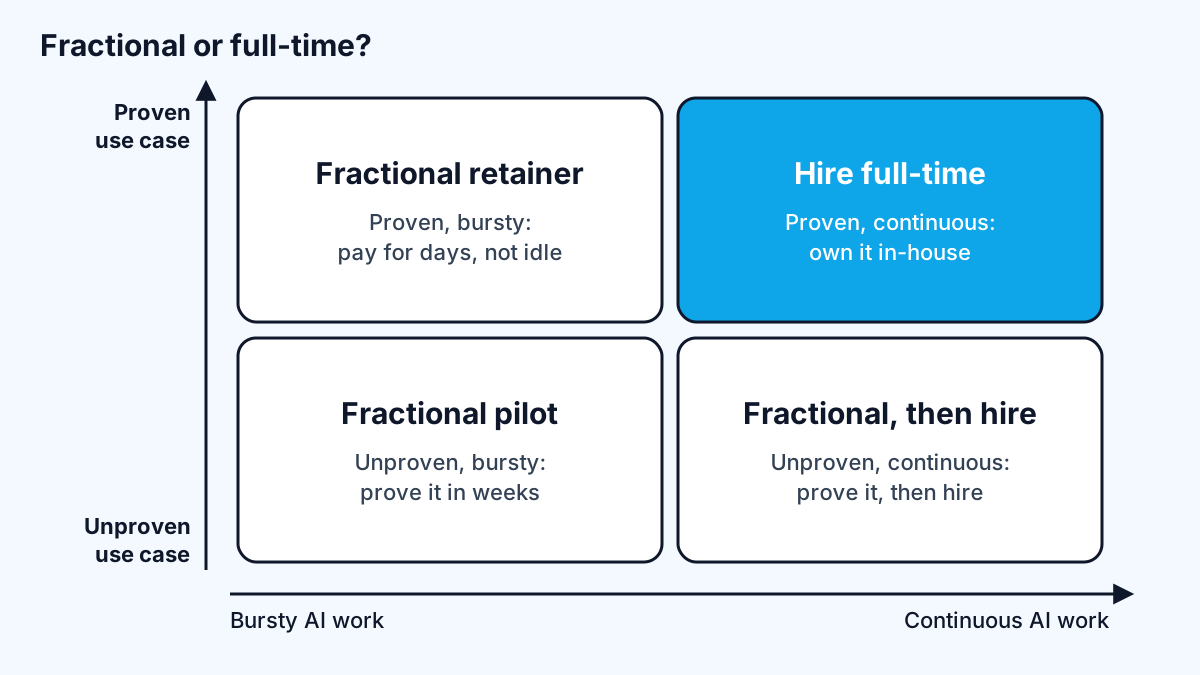
- Unproven and bursty: a fractional pilot. Prove the use case in weeks; do not hire for something that may not exist.
- Unproven but continuous: start fractional, then hire. The fractional engineer proves the value and writes the job description from real experience.
- Proven but bursty: a fractional retainer. A few days a month covers the work without paying for idle time.
- Proven and continuous: hire full-time. If the work is core to your product and will last years, owning the skill in-house is worth the cost and the wait; AI freelancer vs in-house AI team covers building that team.
FDE Academy makes a similar point from the practitioner's side: full-time FDE roles make sense at scale but rarely for a startup with one or two enterprise customers.
The hybrid path most teams end up on
The most common sensible path is fractional first and full-time later, with a deliberate handover between them. A fractional FDE runs the pilot, takes the first system to production and documents it. If the work keeps coming, you hire, and the fractional engineer helps write the role, interview candidates on the real system and hand over. After that, the fractional engineer can stay on a small retainer for specialist work or step away entirely.
This also lowers the risk of the hire itself. Hiring an FDE before you know what the job is tends to produce a vague job description and a mismatch; FDE vs solutions engineer vs AI consultant helps pin down which role you actually need. Hiring after a successful pilot means you know exactly what the person will own.
Location is a separate decision from engagement shape. If you are considering an engineer in another country, I cover the overlap hours, contracts and access in working with a remote FDE from India.
Work with me
I work as a fractional and freelance forward deployed engineer, usually starting with a fixed pilot and handing over cleanly whether you continue with me or hire in-house. See AI agent development and AI integration, browse my work, or read my buyer's guide to hiring a freelance FDE before you book a call.
Frequently asked
What is a fractional forward deployed engineer?
A fractional FDE is an experienced forward deployed engineer who works with your company part-time or for a fixed period, alongside other clients. They do the same work as a full-time FDE, scoping, building and handing over production AI systems, but you pay only for the time you use.
How much does a full-time forward deployed engineer earn?
In the US, Levels.fyi showed a median total compensation of $225,000 for forward deployed engineers in November 2026, with the middle half between $172,000 and $292,000. Employers also pay benefits, which averaged 30% of compensation costs across private industry in June 2026.
Is a fractional FDE cheaper than a full-time hire?
Per hour, usually not. Fractional rates are higher than salary-equivalent rates. A fractional FDE is cheaper overall when the work is bursty or unproven, because you pay only for the weeks you need and avoid recruiting time, benefits and long-term commitment.
When should I hire a full-time forward deployed engineer?
When the use case is proven, the AI work is continuous and core to your business, and you want the skills and context to build up inside the company over years. If you are not sure the work exists yet, start with a fractional pilot.
Can a fractional FDE hand over to a full-time hire?
Yes, and it is often the best path. The fractional engineer builds and documents the first system, helps define the role and interview candidates, then hands over accounts, runbooks and evaluations to the new hire.
Sources
- more than 800% between January and September 2025 (paraform.com)
- median total compensation of $225,000 (levels.fyi)
- benefits accounted for 30.0 percent of employer compensation costs (bls.gov)
- rose from 33 days to 41 days (gem.com)
- $119 to $185 an hour at mid-level and $155 to $235 at senior level (secondtalent.com)
- $250 to $400 or more per hour (fde.academy)
- ishir.com
Related services
Building something like this?
Naman Gundaniya takes on full-stack and AI projects fixed quote after a free 30-minute scoping call, replies within 24 hours.
Get in touch