 By Naman Gundaniya
What an FDE Pilot Costs and Where the Money Goes
A six-week forward deployed engineering pilot costs the engineer's hours multiplied by their rate, plus model usage, hosting and your own team's time. Published freelance rates for FDEs range from under $50 to over $200 an hour depending on region and seniority, and about a third of the effort goes into the build itself; the rest is discovery, evaluation, rollout and handover.

Almost nobody publishes what forward deployed engineering costs, so buyers arrive at the first call with no reference point. I will not quote my own price here, because it depends on scope, but I can show you how a pilot's budget is put together, where the effort goes, and what the published market rates are. That is enough to sanity-check any proposal you receive, including mine.
What a six-week FDE pilot costs in total
A pilot's cost is the engineer's hours times their rate, plus the running costs of the system and the time your own people spend on it. The rate is the part that varies most, so start there.
These are published market ranges, not quotes. Second Talent's rate card, which says it is updated quarterly, gives these hourly ranges for freelance forward deployed engineers:
| Market (freelance) | Mid-level | Senior |
|---|---|---|
| United States | $119-$185 | $155-$235 |
| United Kingdom | $74-$115 | $96-$146 |
| Germany | $66-$102 | $85-$129 |
| India | $28-$72 | $42-$100 |
| US agency or dev shop | $230-$380 | $295-$490 |
At the top end, FDE Academy, which trains engineers for the role, suggests experienced fractional FDEs price in the $250 to $400+ per hour range or an equivalent project fee, and that a typical engagement runs four to twelve weeks.
To turn a rate into a budget, multiply by hours. As a worked example only: a pilot at 30 hours a week for six weeks is 180 hours. At the US senior freelance band above, that is $27,900 to $42,300; at the India senior band, $7,560 to $18,000. Your pilot may need more or fewer hours, and the scope will move the total far more than the rate does.
Where the money goes: a line-by-line breakdown
About a third of a pilot's effort goes into building; the other two thirds go into the work that decides whether the build is useful and whether it survives the engineer leaving.
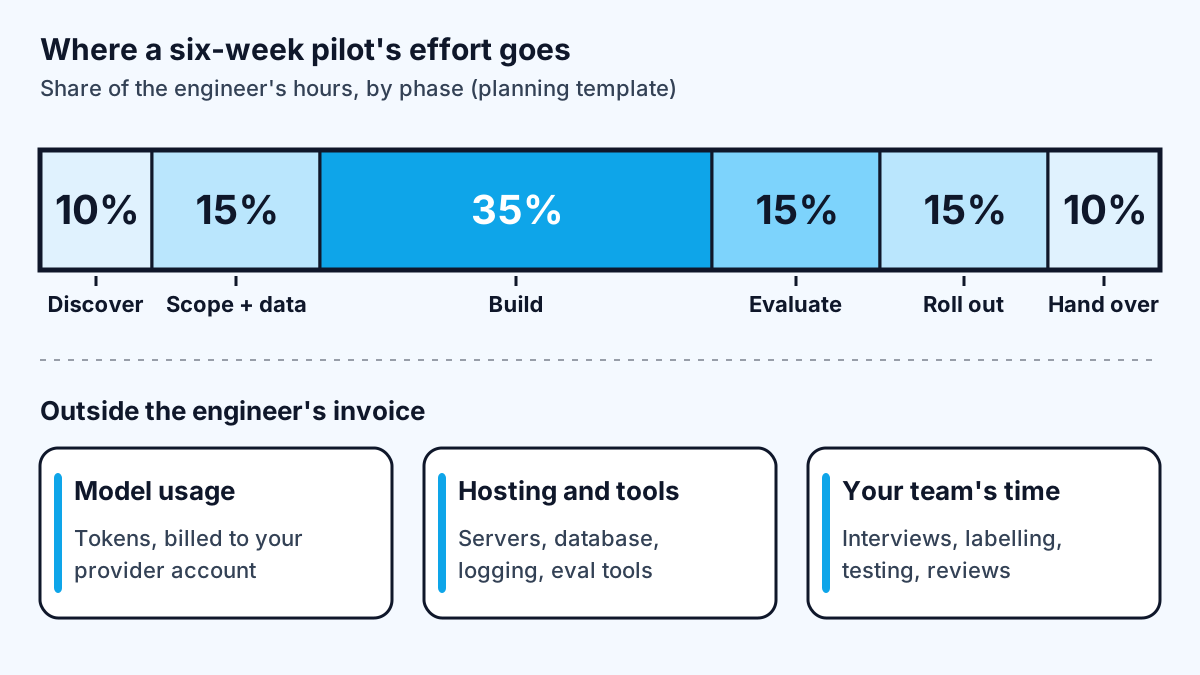
This split is how I plan pilots, not a published benchmark; treat it as a template to compare proposals against.
| Phase | Share of effort | Of 180 hours | What you should receive |
|---|---|---|---|
| Discovery | ~10% | ~18 h | Notes from sessions with the people doing the work, one agreed success metric |
| Scope and data access | ~15% | ~27 h | Chosen workflow, access set up in your accounts, a test set of real examples |
| Build | ~35% | ~63 h | The end-to-end system: data access, model calls, validation, review screen, integrations |
| Evaluation | ~15% | ~27 h | Automated checks that run on every change, with results you can read |
| Rollout | ~15% | ~27 h | Live use by a small group, logging, feedback, fixes |
| Handover | ~10% | ~18 h | Repository, runbook, evaluation report, running-cost estimate, a training session |
Two things to look for in a proposal. First, if evaluation is missing or tiny, you are paying for a demo, not a pilot. I wrote about why in the evals that stop AI agent projects failing. Second, if handover is missing, budget for it anyway, because you will pay for it later in a rushed migration or a support contract you did not plan.
The costs outside the engineer's invoice
Three costs sit outside the FDE's invoice, and a good proposal estimates all of them.
- Model usage. You pay the model provider for tokens, in your own account. For a pilot this is usually small next to the engineering time, but it scales with users, so get a per-task estimate before rollout. There are levers: Anthropic's Message Batches API, for example, cuts costs by 50 percent for requests that do not need an immediate answer, with most batches finishing in under an hour.
- Hosting and tools. Servers, databases, vector stores, logging and evaluation tools. Many have free tiers that cover a pilot; production is a different line.
- Your team's time. The people who do the work today need to sit in discovery sessions, label examples and test the system. If they cannot spare a few hours a week, the pilot will stall regardless of what you pay the engineer.
For perspective on scale: Gartner's 2024 analysis of generative AI projects put some enterprise deployment approaches at US$5 million to US$20 million and predicted that at least 30% of such projects would be abandoned after proof of concept, citing poor data quality, inadequate risk controls, escalating costs and unclear business value. A six-week pilot exists to find out cheaply which of those problems you have.
Fixed fee or time and materials?
For a first pilot, a fixed fee for a fixed scope protects you better than an open hourly arrangement, because it forces both sides to write down what "done" means. Time and materials suits work where the scope genuinely cannot be known in advance, such as rescuing a system nobody has documented.
| Pricing model | Good for | Watch out for |
|---|---|---|
| Fixed pilot fee | A clear workflow with a written success metric | Scope arguments if the metric is vague |
| Time and materials | Unclear scope, audits, rescues | Drift without weekly checkpoints |
| Fractional retainer | Ongoing AI work after a successful pilot | Paying for availability you do not use |
Whichever model you choose, insist on a go or stop decision at the end of the pilot. It turns the budget into a capped experiment rather than an open commitment. For how freelance and agency pricing compare more broadly, see how much it costs to hire an AI developer, and for how to vet the engineer, my buyer's guide to hiring a freelance FDE.
How to keep a pilot on budget
Most pilot overruns come from waiting, not from building. These are the habits that keep the cost close to the estimate:
- Have data access ready before week one. Waiting for credentials or approvals burns paid time on nothing.
- Pick one workflow. Two half-finished workflows cost more than one finished one and prove less. If you have not chosen it yet, an AI automation audit will shortlist candidates.
- Name an owner on your side who can answer questions within a day.
- Agree the success metric in writing before the build starts.
- Keep everything in your accounts so handover is a walkthrough, not a migration.
Work with me
I run fixed-scope pilots as a freelance forward deployed engineer and price them after a scoping call, once the workflow and data are clear. See AI agent development and AI integration, browse my work, and book a call to get a line-by-line estimate for your pilot.
Frequently asked
How much does a forward deployed engineer cost?
Published market data shows wide ranges. One rate card lists US freelance FDE rates of $119 to $185 an hour at mid-level and $155 to $235 at senior level, with India at $28 to $72 and $42 to $100. Fractional FDEs are suggested to charge $250 to $400 or more an hour. Total pilot cost depends mostly on scope and hours.
How much does an AI pilot cost?
A focused six-week pilot costs the engineer's hours times their rate, plus model usage, hosting and your team's time. As a worked example, 180 hours at published US senior freelance rates comes to roughly $28,000 to $42,000, and much less at Indian market rates. Enterprise-scale deployments can cost millions.
Why is so much of an FDE pilot not spent on building?
Because the build is only useful if it solves the right problem, can be measured, and keeps working after the engineer leaves. Discovery, evaluation, rollout and handover are what turn a demo into a system your team can run and trust.
Should I pay a fixed fee or hourly for an AI pilot?
For a first pilot with a clear workflow, a fixed fee for a fixed scope is usually safer, because it forces a written definition of done. Hourly billing suits unclear work such as audits or rescues, as long as there are weekly checkpoints.
Sources
Related services
Building something like this?
Naman Gundaniya takes on full-stack and AI projects fixed quote after a free 30-minute scoping call, replies within 24 hours.
Get in touch