 By Naman Gundaniya
Forward Deployed Engineer vs Solutions Engineer vs AI Consultant
A solutions engineer helps a vendor sell its product, an AI consultant tells you what to do, and a forward deployed engineer builds the working system inside your business. Pick a solutions engineer's help when you are evaluating a product, a consultant when you need a strategy or a decision, and an FDE when you need production software shipped.
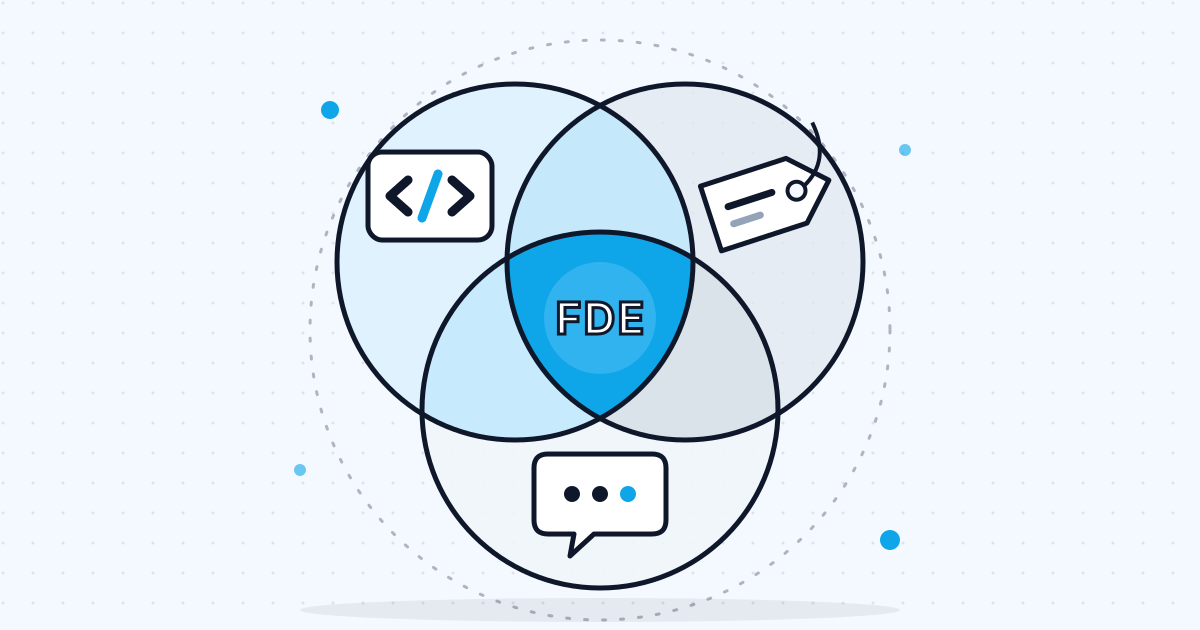
The three titles get used loosely, and buyers often find out which one they hired only when the deliverable arrives: a demo, a slide deck, or a running system. Each is the right answer to a different question.
I work as a forward deployed engineer, and the advisory part of consulting is a normal part of my engagements: I scope, recommend and then build. I have not worked as a vendor's solutions engineer, so for that role I lean on published descriptions rather than my own experience. Where I quote pay or incentives, the source is linked.
The short answer: who each role works for
The biggest difference between the three roles is who pays them and what they are measured on, because that shapes every recommendation they make.
- A solutions engineer (SE) works for a software vendor. The recruiting firm Paraform says the SE "lives in the pre-sales cycle", and that their primary metric is revenue influenced, not code shipped, with pay that "leans heavily on variable pay tied to deals closed."
- An AI consultant works for you, on advice. As the automation agency AY Automate puts it, a consultant delivers advice: recommendations your own team then has to act on.
- A forward deployed engineer builds for one customer. Paraform describes the FDE as someone who "writes production code, but not for the core product", where "the spec comes from a client's problem, not a product roadmap."
There is a twist with FDEs. Many work for a vendor and embed with that vendor's customers, while freelance FDEs work for the client directly. A vendor's FDE builds on the vendor's platform; a freelance FDE should pick tools on fit. I explain the background in what a forward deployed engineer is.
Side by side: scope, deliverables, incentives and cost
The table below compares the three roles on what you actually receive and what each person is rewarded for.
| Solutions engineer | AI consultant | Forward deployed engineer | |
|---|---|---|---|
| Works for | The software vendor | You | The vendor or you (if freelance) |
| When they appear | Before you buy | Before or alongside a project | After the decision to build |
| Main deliverable | Demos, proofs of concept, technical answers | Strategy, roadmap, vendor shortlist, business case | Production software, integrations, evals, runbook |
| Writes production code | Rarely | Usually not | Yes |
| Rewarded for | Deals closed | The quality of the advice | Whether the system works in production |
| Typical cost to you | Free, part of the sales process | Day rate or project fee | Day rate, pilot fee or fractional retainer |
| Biggest risk | Advice tilted towards their product | A plan nobody builds | Building before the problem is clear |
Two lines in that table deserve more attention. AY Automate's comparison says an FDE "is judged on whether the system works" while a consultant "is judged on whether the client liked the deck." That is blunt, but it names the incentive problem honestly: advice is easier to sell than outcomes, and harder to check.
The cost line matters too. A solutions engineer is free to you because the vendor pays them, which is exactly why their proof of concept will use the vendor's product. That is not dishonest; it is the job. Just do not mistake a sales proof of concept for an independent architecture review.
What the pay data says about each role
Published pay data shows FDEs at the top of the three, which reflects how scarce people are who can both scope a problem and ship the system. Paraform reports average FDE total compensation of $238,000, with a typical range of $205,000 to $486,000, against $155,000 to $210,000 for solutions engineers on target earnings. Levels.fyi, based on 158 reported US salaries, shows a median FDE total compensation of $225,000 as of November 2026.
Those are employee figures in the US, not what you pay a freelancer or consultant, and they will differ by company and region. They are still useful as a signal: the market prices the "builds and owns the outcome" role higher than the "helps close the deal" role. For what freelance FDE work costs, see my buyer's guide to hiring a freelance FDE.
Which role does your project need?
Your project needs whichever role matches the question you cannot yet answer: which product, what to do, or how to get it built. Work through it in order.
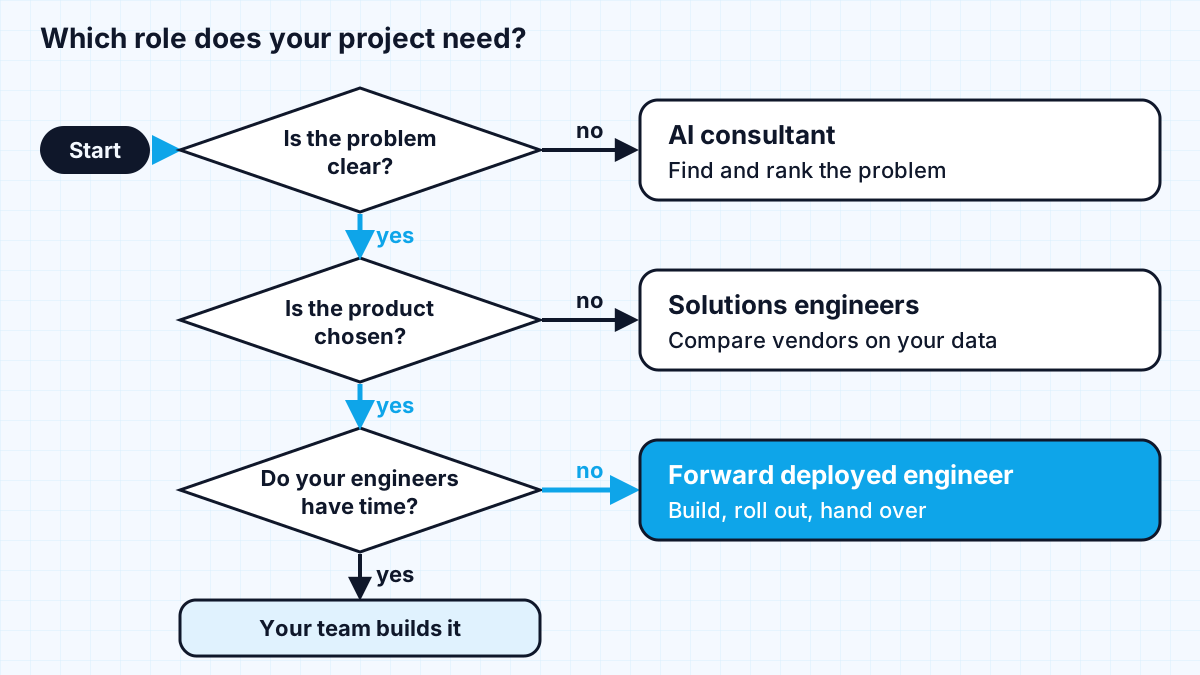
- You do not know which problem to solve. Start with a consultant, or with an FDE who will run a short paid discovery. Do not start with a build.
- You know the problem but not the product. Talk to the solutions engineers of two or three vendors. Ask each to run their proof of concept on your data, not their sample data.
- You know the problem and the product, and your engineers have time. Your team builds it, with the vendor's support.
- You know the problem and the product, and nobody has time. That is the forward deployed engineer's job.
In practice the lines blur. A good FDE does a consultant's job in the first week, because you cannot build the right thing without understanding the workflow. A good consultant knows enough engineering to avoid recommending something that cannot be built. The difference is where the engagement ends: with a document, or with a system people use.
Where each role goes wrong
Each role has a predictable failure mode, and knowing it in advance is the cheapest protection you have.
- Solutions engineer: the proof of concept runs on clean sample data and a narrow happy path. It shows the product can work, not that it will work on your messy data. Insist on your own examples.
- AI consultant: the roadmap is sound but nobody owns building it, so it ages on a shared drive. Before signing, ask who will implement each recommendation and when.
- Forward deployed engineer: the build starts before the problem is clear, or the system only works while the engineer is around. Ask for a written success metric in week one and a handover plan from the start.
If you are weighing an FDE against a team rather than against these roles, I compare those options in freelance AI engineer vs agency.
Work with me
I work as a freelance forward deployed engineer: I scope the problem with your team, then build and hand over the system. See AI agent development and AI integration, look through my work, and book a scoping call if your project is past the "which product" stage.
Frequently asked
What is the difference between a forward deployed engineer and a solutions engineer?
A solutions engineer works in the vendor's sales process, running demos and proofs of concept to help close deals. A forward deployed engineer works after the decision to build, writing production code inside one customer's workflow and being judged on whether it works.
Is a forward deployed engineer the same as a consultant?
No. A consultant delivers advice and recommendations that your team then implements, while a forward deployed engineer builds and ships the system. Many FDEs do some consulting at the start of an engagement, because scoping the problem is part of building the right thing.
Do forward deployed engineers earn more than solutions engineers?
Published US data suggests they do. Paraform reports average FDE total compensation of $238,000 against $155,000 to $210,000 for solutions engineers, and Levels.fyi showed a median FDE total compensation of $225,000 in November 2026. Figures vary widely by company and region.
Should I hire an AI consultant or a forward deployed engineer?
Hire a consultant if you do not yet know which problem AI should solve or need a strategy for leadership. Hire a forward deployed engineer when the problem is clear and you need working software in production. If you are unsure, a short paid discovery with an FDE can answer both questions.
Can a solutions engineer build my AI system?
Usually not beyond a proof of concept. Solutions engineers are measured on deals closed, and their proofs of concept are designed to show the vendor's product working. For a production system integrated with your data and tools, you need your own engineers or a forward deployed engineer.
Sources
Related services
Building something like this?
Naman Gundaniya takes on full-stack and AI projects fixed quote after a free 30-minute scoping call, replies within 24 hours.
Get in touch