 By Naman Gundaniya
Forward Deployed Engineer Interview Questions and Answers
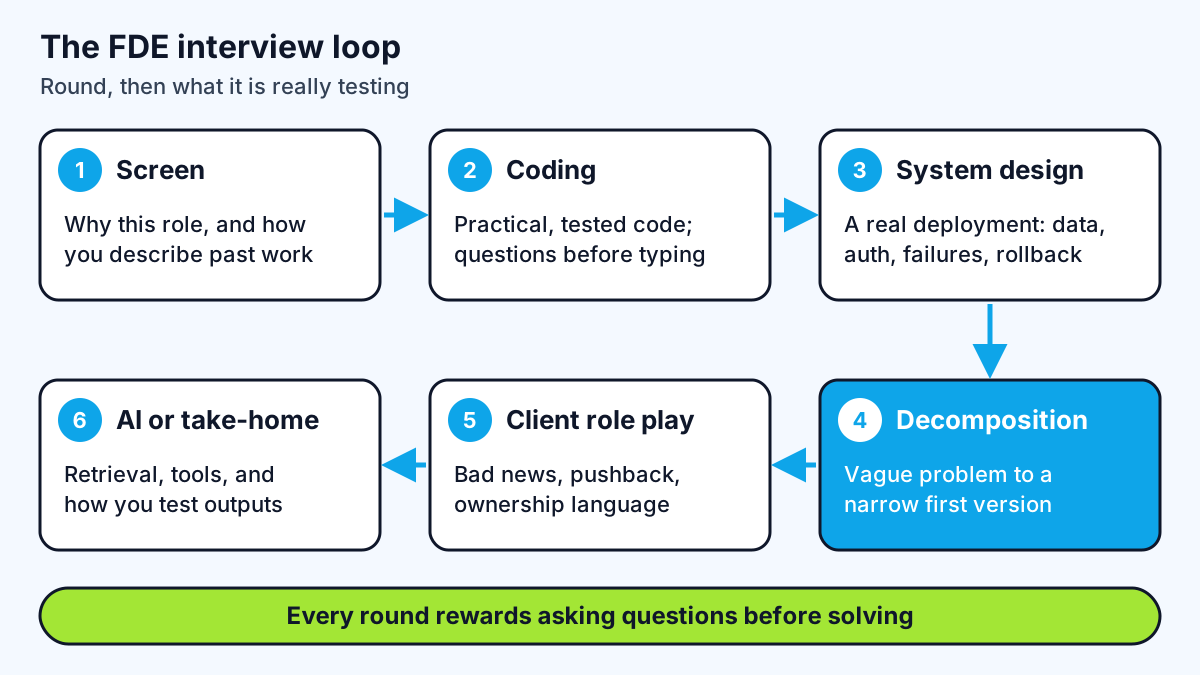
Forward deployed engineer interviews usually test five things: practical coding, system design for a real deployment, decomposing a vague customer problem, handling a difficult client conversation, and building with AI models. Strong answers start with clarifying questions, state assumptions, propose a thin first version and talk about the customer's outcome rather than the technology.

FDE interview loops look like software engineering loops with extra rounds bolted on, and those extra rounds are where most candidates struggle. A clean algorithm solution does not help if you cannot turn "our fraud process is a mess" into a plan for the first month.
The questions below are general practice questions I would use to prepare, grouped by the kind of round they belong to. They are not leaked questions from any company. Where I describe how specific companies run their loops, I link to the published guide I read. If you are still deciding whether the role suits you, start with how to become a forward deployed engineer.
What the FDE interview process looks like
Most FDE loops include a recruiter screen, a coding round, a system design round, a decomposition or case study round, a client or behavioural round, and sometimes a take-home. The mix varies by company.
The interview prep site Aced describes a typical loop of recruiter screen, hiring manager screen, coding, system design, decomposition or open-ended case, client simulation and behavioural rounds, with a take-home at some companies. It reports that OpenAI's process includes a take-home of about five hours and a walkthrough, and that the open-ended round is the hardest at Palantir. Its separate Palantir guide lists onsite rounds drawn from decomposition, learning, coding, re-engineering and system design, and notes that AI use is not allowed during them.
Recruiters are pushing in the same direction. Paraform advises hiring managers that most companies fail by running standard software engineer interviews, and recommends a practical integration task, system design under constraints, a decomposition case and a behavioural round on stakeholder conflict.
Coding and system design questions
Coding rounds for FDEs favour practical problems over puzzles, and system design rounds are framed around a customer's real deployment. Aced summarises the coding expectation as practical engineering over algorithm puzzles.
Practice questions:
- Write a rate limiter that enforces both a per-user and a global limit.
- Parse a messy CSV export from a customer's system, handle bad rows, and report what you skipped.
- Write a function that merges customer records from two systems where names and emails do not match exactly.
- Design a document search system for a customer whose data cannot leave their cloud account.
- Design a pipeline that syncs records from a legacy database into a new tool every hour without double-writing.
What a strong answer shows: you ask about volumes, failure cases and who uses the output before writing anything. You test as you go. In design rounds you cover data flow, permissions, logging, what happens when a dependency is down, and how you would roll back. You propose the simplest version that works end to end, then say what you would add next.
Decomposition and case study questions
Decomposition rounds give you a vague business problem and ask you to break it into something buildable, usually with little or no code. They test judgment more than any other round, and there is no single correct answer.
Practice questions:
- A hospital network says nurses spend too long on shift handover notes. What would you build first?
- A logistics company wants to "use AI on its emails". Plan your first two weeks.
- A bank has three fraud systems inherited from acquisitions. Scope the first 90 days.
- A retailer's support team wants a chatbot. How do you decide whether they need one?
What a strong answer shows: you ask who has the problem, how the work is done today and what success would look like in numbers. You name the information you are missing and state your assumptions out loud. You pick one narrow first version, explain why it comes first, and say what would make you stop. This is the same thinking as a real discovery phase; my FDE discovery playbook walks through it day by day, and it is good preparation for this round.
A common mistake is jumping to architecture in the first two minutes. Interviewers are watching how you frame the problem, not how quickly you name a vector database.
Customer scenario and behavioural questions
Client simulation rounds test whether you can protect the customer relationship and the project at the same time. They are role plays, and the interviewer will push back.
Practice questions:
- The deployment will slip by three weeks. Tell the customer's CTO.
- A customer asks you to give the AI agent write access to their production database "to save time". Respond.
- The customer's champion leaves halfway through the project. What do you do this week?
- Tell me about a time a system you built failed in production. What happened next?
- Tell me about a time you said no to a customer.
What a strong answer shows: you lead with the facts and the impact, then a plan, then the decision you need from them. You take ownership without grovelling. When you push back, you offer a safer alternative rather than a flat refusal. In behavioural stories, you describe the customer's outcome first and your implementation second, which is the signal Paraform calls a green flag.
If you are coming from a sales engineering background, expect these rounds to probe whether you can own delivery, not just the demo. I compare the roles in forward deployed engineer vs solutions engineer vs AI consultant.
AI and LLM questions for FDE roles
Most FDE roles now include building with large language models, so expect at least one round or take-home on retrieval, tool use, agents and evaluation. My list of AI engineer interview questions goes deeper on each. Job postings back this up: Bloomberry found that 35% of FDE postings mention AI agents and 31% LLM experience.
Practice questions:
- Build a question-answering tool over a folder of documents. How do you know its answers are right?
- An agent works in testing but makes wrong tool calls in production. How do you debug it?
- How would you decide between a prompt change, retrieval, fine-tuning or a rules-based step?
- The customer says the model is "getting worse". What do you check first?
- How do you keep the running cost of an LLM feature predictable?
What a strong answer shows: you treat the model as one component that needs inputs, checks and tests. You talk about an evaluation set of real examples, logging of prompts and outputs, validation before anything is saved, and a human review step where mistakes are expensive. I wrote about giving agents a way to verify their own work in give AI agents a way to check, which covers the kind of answer interviewers want here.
How to prepare in the last two weeks
Practise out loud, under time, on problems you have not seen. Reading answers is not the same as producing them while someone interrupts you.
| Round | How to practise | What to have ready |
|---|---|---|
| Coding | Timed practical problems, narrating as you go | Your testing habits, said out loud |
| System design | Design a real deployment end to end on a whiteboard | A standard checklist: data, auth, logs, failures, rollback |
| Decomposition | Have a friend give you a vague business problem | Five clarifying questions you always ask |
| Client simulation | Role-play bad news with someone who pushes back | A structure: facts, impact, plan, decision needed |
| AI | Build one small retrieval or agent project with evals | Numbers from your own evaluation runs |
| Behavioural | Write four stories in outcome-first form | One failure story you can tell honestly |
Prepare questions for them too. Ask how much time FDEs spend with customers, how work flows back to the product team, and what the last FDE shipped that a customer still uses. The answers tell you whether the role is engineering or relabelled sales support.
Work with me
If you are hiring for FDE work and want help designing a practical interview task, or need the work done while you hire, I run fixed pilots as a freelance forward deployed engineer. See AI agent development and AI integration, browse my work, and book a scoping call.
Frequently asked
What questions are asked in a forward deployed engineer interview?
Forward deployed engineer interviews typically include practical coding problems, system design for a customer deployment, decomposition of a vague business problem, client role plays such as delivering bad news, and questions on building with AI models. Most loops also have recruiter, hiring manager and behavioural rounds.
What is a decomposition interview?
A decomposition interview gives you an open-ended business problem and asks you to break it into parts and propose a buildable first version, usually with little coding. Interviewers look for clarifying questions, stated assumptions, a narrow first scope and awareness of the end user.
Do forward deployed engineer interviews include LeetCode questions?
Some do, but most FDE coding rounds favour practical problems such as parsing messy data, building a rate limiter or integrating with an API. Algorithm practice still helps, but practical, tested code and clear communication matter more.
How should I prepare for an FDE client simulation round?
Prepare for an FDE client simulation by role-playing difficult conversations out loud, such as a missed deadline or an unsafe request. Use a simple structure, facts, impact, plan and the decision you need, and offer alternatives instead of flat refusals.
Can I use AI tools during an FDE interview?
It depends on the company, so ask the recruiter. Some loops explicitly ban AI tools during live rounds, while take-home tasks may allow them. When they are allowed, interviewers usually want to see how you check and correct the output, not just that you used it.
Sources
Related services
Building something like this?
Naman Gundaniya takes on full-stack and AI projects fixed quote after a free 30-minute scoping call, replies within 24 hours.
Get in touch