 By Naman Gundaniya
How to Become a Forward Deployed Engineer
To become a forward deployed engineer, first get good at shipping production software, then add customer-facing work, practical AI system building and the judgment to scope problems. Most FDEs come from software engineering roles with three to five years of experience. A portfolio of systems real people use, plus evidence you can run discovery with a client, matters more than any course.
The forward deployed engineer role is attractive for good reasons: it pays well, it is varied, and you see the effect of your work directly. It is also easy to misread as "a software engineer who talks to customers". The customer part is the job, not a side duty.
I work as a freelance FDE, after four years of AI and full-stack client work across the US, UK, Europe, the Middle East, Australia and India. This guide is the path I would recommend to an engineer starting now, with a six-month plan and the portfolio projects that prove each skill. If you need the definition first, start with what a forward deployed engineer is.
Where forward deployed engineers come from
Most forward deployed engineers move into the role from software engineering, not straight from university. Bloomberry looked at 100 LinkedIn profiles of current FDEs and found their previous roles were software engineer (45%), solutions engineer or architect (22%), data engineer or scientist (15%), technical consultant (10%) and founder or early employee (8%).
The same analysis of about 1,000 job postings found 60% ask for three to five years of experience, 20% for six to eight, and only 12% for two years or less. There are exceptions. Gergely Orosz reports that Palantir hires FDEs with as little as one year of post-college experience, while Ramp prefers five or more years for senior roles.
So the realistic routes are:
- From software engineering: the most common. You already ship code; you need customer exposure and AI system experience.
- From solutions or sales engineering: you have the customer side; you need to prove you can own production code, not just demos.
- From data roles: you have the data skills; you need full-stack range and integration work.
- From founding or freelancing: you have done everything badly at least once, which is surprisingly good preparation.
The four skills: code, customers, AI and judgment
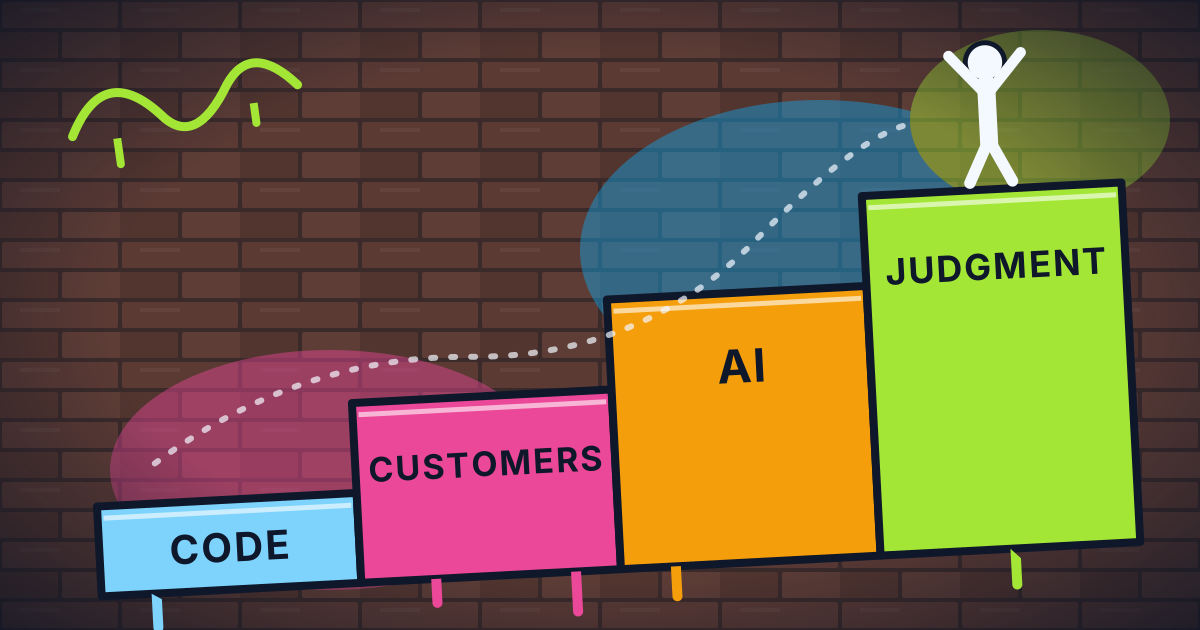
Forward deployed engineering needs four skills at once, and hiring managers test all four. Missing one is usually what ends a candidacy.
| Skill | What it means on the job | How it is tested |
|---|---|---|
| Code | Shipping full-stack production software: data, APIs, interfaces, deployment | Practical coding, system design |
| Customers | Running discovery, explaining trade-offs, delivering bad news | Client simulation, behavioural rounds |
| AI | Building with models: retrieval, tool use, agents, evaluations | AI system design, take-homes |
| Judgment | Scoping a vague problem, choosing what not to build | Decomposition or case study rounds |
Job postings back this mix. Bloomberry found the most common responsibilities are working directly with customers (55%), building and deploying AI or ML systems (37%) and integrating systems and APIs (32%). A since-closed Anthropic FDE posting asked for production experience with LLMs, including prompt engineering, agent development and evaluation frameworks, alongside strong Python and "strong communication skills for customer discovery".
The customer and judgment skills are the hardest to show on a CV. The recruiting firm Paraform tells hiring managers that customer empathy and ambiguity tolerance are the hardest to screen for, and that a green flag is a candidate who "frames past work by customer outcome, not implementation". Practise describing your work that way now.
A six-month plan to become a forward deployed engineer
If you already work as a software engineer, six months of focused evenings and weekends is enough to build a credible FDE portfolio. The plan below adds one skill at a time and ends with a real client project.
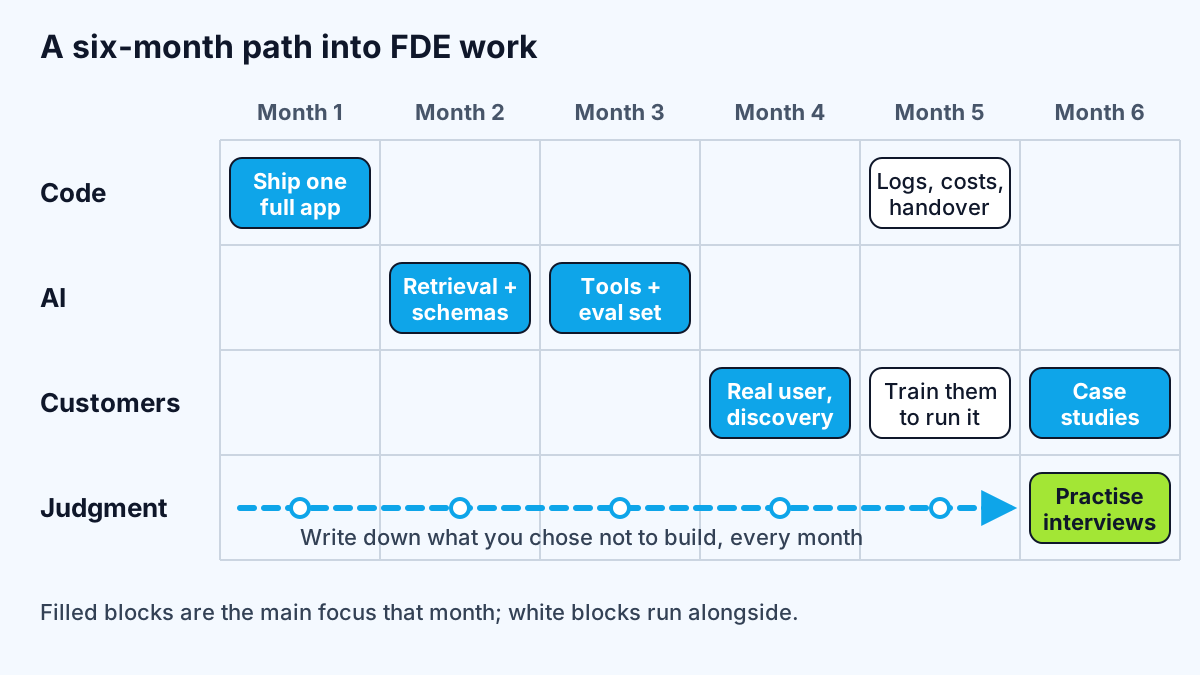
Month 1, production fundamentals. Ship one full-stack application to production: authentication, a database, a background job, logging and a deployment you can repeat. If you already do this at work, skip ahead.
Month 2, the AI building blocks. Build retrieval over a real document set, and get structured output from a model validated against a schema before you save it. Learn where it fails by reading the bad outputs, not the good ones.
Month 3, integrations and evaluation. Give the system tools: let it read from and write to a real system through an API, or build an MCP server for one. Write an evaluation set of real examples and run it on every change.
Month 4, a real user. Find someone with a real problem: a small business, a non-profit, a team at a friend's company. Run a short discovery: interview them, watch them work, and agree what success means. My FDE discovery playbook describes the steps. Then build the smallest thing that solves it.
Month 5, production hardening. Add what turns a demo into a system: error handling, logging, a review step for risky actions, a monthly cost estimate, and a handover document so they can run it without you.
Month 6, evidence and interviews. Write up each project as a short case study: the problem, what you built, what changed, what broke. Practise decomposition questions out loud. Then apply.
Portfolio projects that prove FDE ability
The best FDE portfolio projects are small systems someone actually used, each one proving a different skill. Three good ones beat ten tutorials.
- A document workflow for a real team. Extraction from messy inputs, validation, a review screen, and a measured result. Proves code, AI and customer work together.
- An integration that writes back. An agent or service that reads from one system and updates another with permissions and an audit log. Proves you can be trusted inside someone else's stack.
- An evaluation harness. A test set of real examples and a script that scores the system on every change, with a chart of results over time. Proves you know how to tell whether AI is working.
- A written scope and handover. The discovery notes, scope and handover document from your client project, with anything sensitive removed. Proves judgment, which almost nobody shows.
When you describe these, lead with the user and the outcome, then the stack. That is the format interviewers listen for.
Getting hired: titles, routes and expectations
Look beyond the exact title. Many companies hire for the same work as AI engineer, solutions engineer, applied AI engineer or customer engineer, and some roles titled FDE are closer to sales support. Bloomberry classified about 30% of the postings it read as sales-engineer roles with an FDE title, so read what the job actually asks you to build.
Expect travel and expect variety. In Bloomberry's sample, 68% of postings mention travel, and 58% of FDE roles were at companies with 11 to 200 employees, which means small teams and broad responsibility.
Freelancing is another route in, and the one I work in today. It gives you customer exposure fast, but you carry the sales and the risk yourself. If you go that way, the career ideas in how to become an AI engineer and the pay data in forward deployed engineer salary and demand are useful companions.
Work with me
If you are a company that needs forward deployed engineering now rather than in six months, I take on fixed pilots and longer engagements. See AI agent development and full-stack development, look at my work, and book a scoping call.
Frequently asked
What qualifications do you need to become a forward deployed engineer?
Most forward deployed engineer roles ask for a degree or equivalent experience plus several years of software engineering, usually three to five. Employers care more about evidence of shipped production systems, customer-facing work and practical AI experience than about any specific certificate.
Can you become a forward deployed engineer without experience?
It is possible but uncommon. Only about 12% of postings in one analysis of 1,000 FDE jobs asked for two years of experience or less, and a few companies hire graduates. Most people get there by working as a software, solutions or data engineer first.
What programming languages do forward deployed engineers use?
Python is the most requested language, appearing in about two thirds of FDE postings in Bloomberry's analysis, followed by TypeScript at about a third. Cloud platforms, SQL and API integration work matter as much as the language itself.
How long does it take to become a forward deployed engineer?
An experienced software engineer can build a credible FDE portfolio in about six months of focused work, adding AI systems and a real client project. Someone starting from scratch should expect several years, because the role assumes solid production engineering first.
Is forward deployed engineering a good career?
For engineers who enjoy working with people as much as with code, yes. It pays at or above senior engineering levels, the work is varied, and you see the result directly. It suits people less well if they want long stretches of uninterrupted product work or dislike travel and ambiguity.
Sources
Related services
Building something like this?
Naman Gundaniya takes on full-stack and AI projects fixed quote after a free 30-minute scoping call, replies within 24 hours.
Get in touch