 By Naman Gundaniya
AI Developer vs AI Engineer: Which One Do You Need?
An AI developer builds product features that call existing AI models, an AI engineer builds the system around those models (retrieval, evaluation, guardrails and cost control) so they hold up in production, and an ML engineer trains and serves the models themselves. Most businesses adding AI to a product need an AI engineer who can also ship the app.
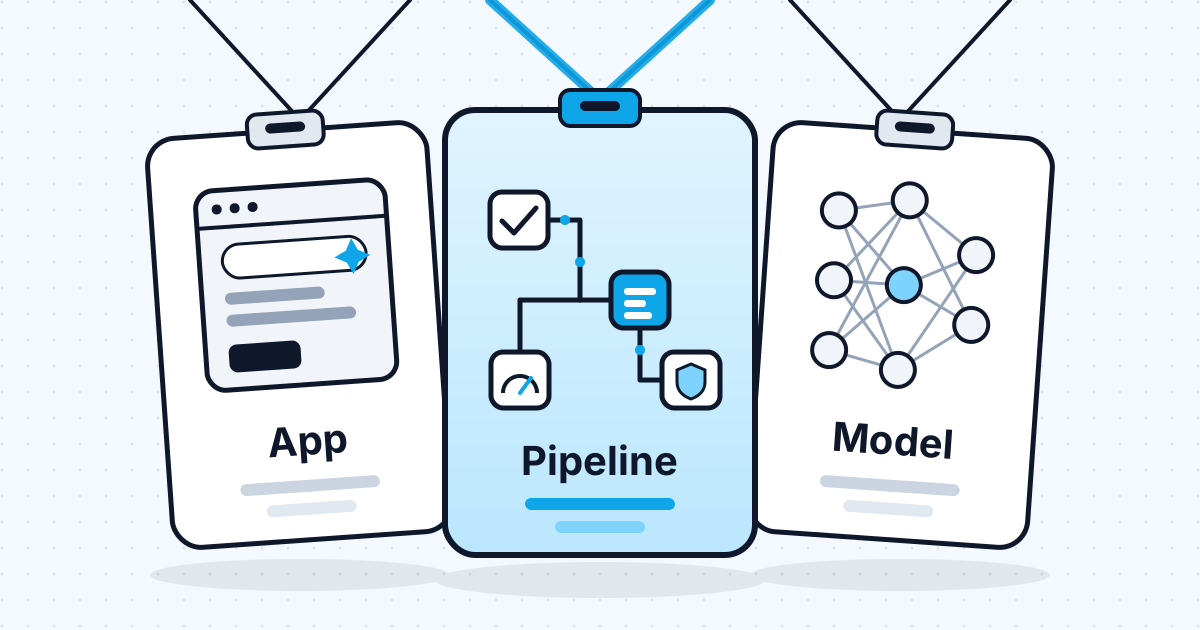
The trouble is that nobody enforces these titles. Job boards, marketplaces and agencies use "AI developer" and "AI engineer" interchangeably, and some use either one to mean a data scientist. If you hire on the title alone, you can end up paying for model training you never needed, or hiring someone who can wire up a chat box but cannot tell you whether it gives correct answers.
This post is the plain version I give clients when they ask which one they need. It describes the work, not the badge, so you can match the person to the project.
What is the difference between an AI developer and an AI engineer?
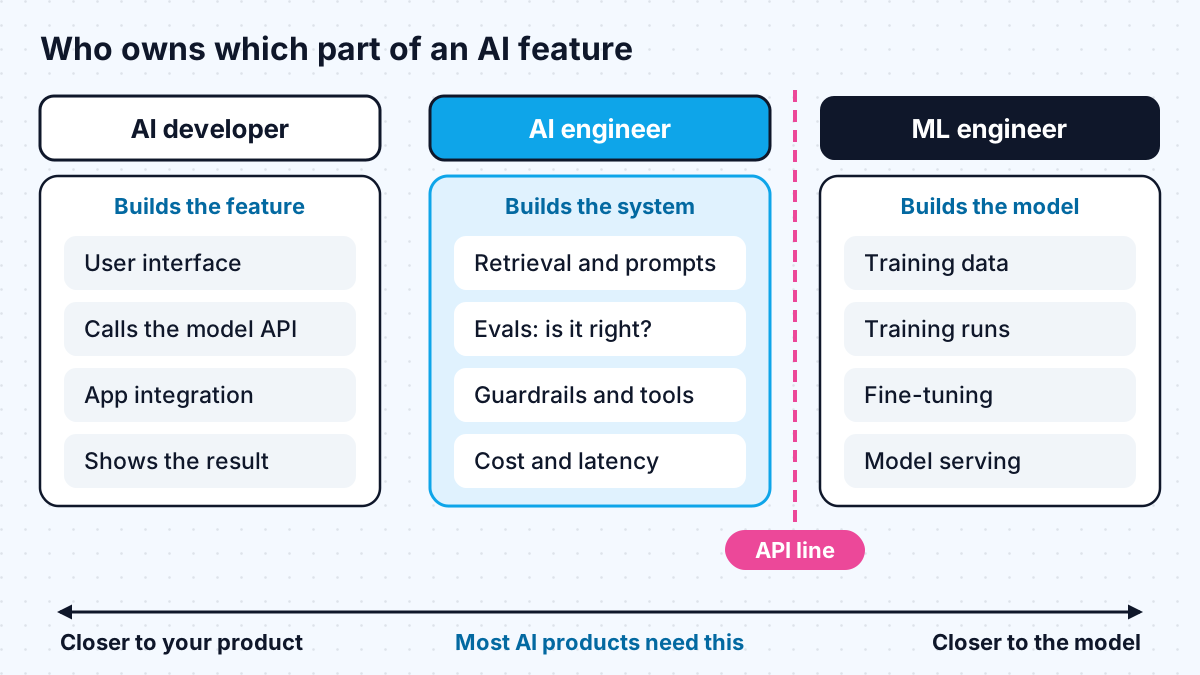
The difference is how far past the API call the person's responsibility goes. An AI developer is a software developer whose features happen to call a model: they build the screen, call the API, show the result. An AI engineer owns whether that result is good enough, every time, at a cost you can afford.
That second definition comes from how the field itself has described the role. Latent Space's 2023 essay The Rise of the AI Engineer described AI engineers as the people "taking AI advancements and shaping them into real products used by millions", and argued they should "view product-specific data and evals as their job". Chip Huyen, author of O'Reilly's *AI Engineering*, puts it as a shift in where the work goes: in her words, quoted in The Pragmatic Engineer, AI engineering "is less about model development, and more about adapting and evaluating models", and its focus on applications "brings AI engineering closer to full-stack development".
"AI developer" has no comparable definition. In practice it is used in two ways: as a loose synonym for AI engineer, or for a developer who integrates AI APIs without owning quality. When you see the title, ask which one they mean.
How is an ML engineer different from both?
An ML engineer works on the other side of the API line: they build, train, tune and serve models. Their daily work is datasets, training pipelines, GPUs, model registries and inference servers. Huyen notes in the same piece that "ML knowledge is no longer a must-have for building AI applications", because most applications now use a model someone else has trained.
That is the key buying insight. If your plan is to use a hosted model from Anthropic, OpenAI or Google, you probably do not need an ML engineer at all. You need one when you are training your own model, fine-tuning heavily on proprietary data, running open-weight models on your own infrastructure at scale, or working on classic predictive ML such as forecasting or fraud scoring. My comparison of RAG vs fine-tuning covers the most common case where people think they need training and usually do not.
A side-by-side comparison of the three roles
Here is the comparison in one table. Treat it as a description of work, because the titles on CVs will not line up neatly.
| AI developer | AI engineer | ML engineer | |
|---|---|---|---|
| Builds | Features and apps that call a model | The system around a model: retrieval, prompts, tools, evals, guardrails | Models and the infrastructure that trains and serves them |
| Typical outputs | Chat UI, summarise button, form autofill | RAG pipeline, agent with tools, evaluation suite, cost dashboard | Trained model, fine-tuning pipeline, inference service |
| Core skills | Web or mobile development, API integration | Software engineering, LLM APIs, retrieval, evaluation, security | Statistics, deep learning frameworks, data engineering, GPUs |
| Owns quality? | Usually not | Yes, measured with evals | Yes, measured with model metrics |
| Needs your data to train? | No | No, it retrieves it at run time | Often yes |
| You need this when | The AI part is small and low risk | AI is central to the feature and must be reliable | You must build or heavily adapt a model |
A strong AI engineer usually covers the AI developer column too. That is why I describe my own work as AI engineering with full-stack delivery: the same person builds the feature, the pipeline behind it and the checks that prove it works. If that shape interests you, what a Forward Deployed Engineer does explains the client-facing version of it.
Three example projects and who should build them
Matching projects to roles is easier with examples. These are typical requests I see, with the role I would put on each.
1. "Add a 'summarise this ticket' button to our support tool." A careful AI developer can ship this. The input already exists, a human reads the summary before acting, and a bad summary costs a few seconds. An AI engineer is still useful for an afternoon to set up output checks and cost limits, but it does not need one full time.
2. "Answer customer questions from our help centre and order history, inside our app." This needs an AI engineer. The hard parts are retrieval over your documents, permission checks so customers only see their own orders, refusing to answer when sources are missing, and an evaluation set that tells you how often answers are right. None of that is visible in a demo, and all of it decides whether the feature survives launch. My guide to evaluating AI agents shows what that testing looks like.
3. "Predict which subscribers will churn next month from our usage data." This is ML engineering, or data science, not LLM work. It is a classic supervised learning problem on structured data, and the person needs to be comfortable with features, training, validation and model monitoring.
If your project has elements of more than one, hire for the hardest part. A churn model with a chat interface on top is mostly an ML job; a chat assistant that uses a churn score from an existing model is mostly an AI engineering job.
What does each role cost?
Costs vary so widely by country, seniority and engagement type that any single number is misleading, and there is no official salary series for "AI engineer". Two public reference points help frame it, as of late 2026.
- The US Bureau of Labor Statistics reports a median annual wage of $135,980 in May 2025 for software developers, the category most AI developers and AI engineers fall into, and $140,300 for computer and information research scientists, which is closer to research-heavy ML roles.
- For freelance work, Arc's hiring page for AI engineers says freelance AI developers "typically charge between $60-100+/hour (USD)" on its platform.
The bigger cost difference is not the rate but the scope. Hiring an ML engineer for a project that only needs a hosted model adds weeks of unnecessary work. Hiring an AI developer for a project that needs an AI engineer tends to produce a feature that demos well and then gets switched off. For a fuller breakdown of market rates and engagement models, see how much it costs to hire an AI developer.
How to tell which one you are talking to
Titles will not tell you, but a few questions will. Ask the candidate to walk you through an AI feature they shipped and listen for these:
- How did you know it worked? An AI engineer talks about a test set of real examples and a score that changed over time. An AI developer usually says it "looked good" in testing.
- What happens when the model is wrong? Listen for fallbacks, validation, refusals and human review, rather than "the model is pretty accurate".
- What does it cost per request, and how did you control that? AI engineers know their token costs and the levers that reduce them.
- Did you train anything? If the answer is a lot of training and tuning, you are probably talking to an ML engineer, which is great if that is what you need.
Work with me
I work as an AI engineer who ships the whole feature: the interface, the retrieval and agent logic behind it, and the evaluation and cost controls that keep it reliable. See AI integration and AI agent development, or browse my work and book a scoping call to work out which role your project actually needs.
Frequently asked
Is an AI developer the same as an AI engineer?
Not reliably. The titles are used interchangeably, but the useful distinction is responsibility: an AI developer builds features that call a model, while an AI engineer also owns retrieval, evaluation, guardrails and running cost so the feature works in production. Ask what they measured on their last project.
Do I need an ML engineer to build an AI product?
Usually not. If you are building on a hosted model such as Claude or GPT, an AI engineer is the right hire. You need an ML engineer when you are training or heavily fine-tuning your own model, hosting open-weight models at scale, or building classic predictive models on structured data.
Can one person be an AI developer and an AI engineer?
Yes, and for most small and mid-sized projects that is the best option. An AI engineer with full-stack skills can build the user-facing feature and the system behind it, which avoids hand-offs between two people who each own half of the quality problem.
Which role should a startup hire first for an AI feature?
An AI engineer who can ship product. Early on you need someone who builds the feature, measures whether it works and keeps costs predictable. Specialist ML hires make sense later, if you find a problem a hosted model cannot solve.
Sources
Related services
Building something like this?
Naman Gundaniya takes on full-stack and AI projects fixed quote after a free 30-minute scoping call, replies within 24 hours.
Get in touch