 By Naman Gundaniya
Build vs Buy for AI Features: A Decision Framework
Buy an AI feature when the job is common, your data can safely leave, and speed matters more than control. Build when the feature is part of what makes your product different, depends on data or workflows no vendor can reach, or would lock you into a tool that is hard to leave. Most teams end up in between: buy the model, build the workflow.
The build or buy question used to be about writing your own software or licensing someone else's. With AI it has a third layer, because almost nobody builds the model itself. You are choosing how much of the stack around the model you own. Below is the framework I use with clients, a scoring sheet you can fill in for your own feature, and three worked examples.
What does the data say about build vs buy for AI?
Recent survey data leans towards buying, especially for a first project. Menlo Ventures' 2025 enterprise survey found that 76% of AI solutions were purchased rather than built in 2025, up from 53% in 2024, because off-the-shelf tools were reaching production faster and showing value sooner. The same report notes continued strong investment in internal builds.
The MIT NANDA "GenAI Divide" research points the same way. In press coverage of the study, purchasing AI tools from specialised vendors and building partnerships succeeded about 67% of the time, while internal builds succeeded about one-third as often. The study drew on 150 leader interviews, a survey of 350 employees and 300 public deployments.
Two cautions before you take that as "always buy". First, both are about large organisations, where internal builds often mean a central team far from the people doing the work. Second, a high success rate for bought tools partly reflects that teams buy for common, well-understood jobs. The data tells you to buy the commodity parts. It does not tell you to buy the part your customers pay you for.
The five factors that decide build vs buy
Five factors decide nearly every AI build or buy choice: cost over time, control, data, speed and lock-in. Score each one for your feature before anyone talks to a vendor or writes code.
| Factor | Points towards buy | Points towards build |
|---|---|---|
| Cost over time | Low volume, per-seat price is small next to the build cost | High volume, per-seat or per-task fees grow faster than usage-based model costs |
| Control | Default behaviour is good enough | You need to change prompts, steps, tone or edge-case handling often |
| Data | Data can safely go to the vendor and stays in a system they integrate with | Data is sensitive, scattered across your own systems or has residency rules |
| Speed | You need it working this month | You can spend weeks getting it right because it matters long term |
| Lock-in | Easy to export data and switch | Workflows, prompts and history would be trapped in the vendor's product |
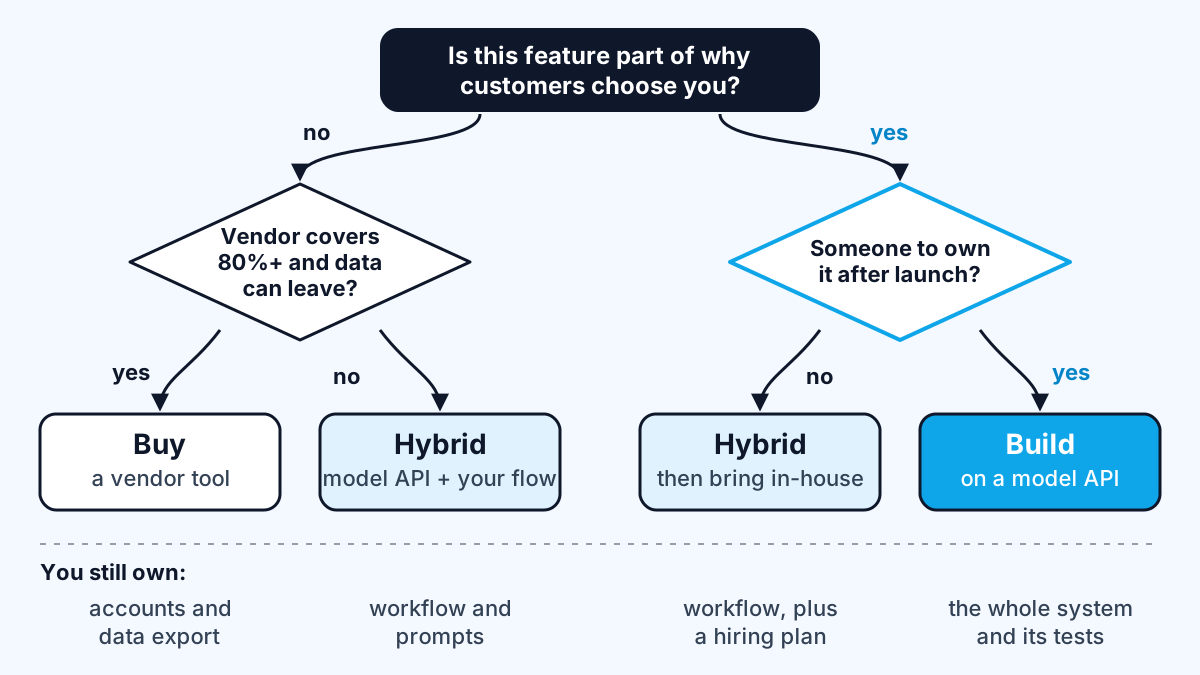
Add a sixth question on top: is this feature part of why customers choose you? If yes, it leans strongly towards build, because a vendor will sell the same feature to your competitors.
How to score your AI feature
Score each factor from 1 to 5, where 1 means strongly buy and 5 means strongly build, then add them up.
- 5 to 11: buy. Pick the vendor with the cleanest data export and the business-tier data terms you need.
- 12 to 18: hybrid. Buy the model and any commodity pieces, build the workflow, prompts and integrations yourself.
- 19 to 25: build, on top of a model API. You still do not train a model; you own everything around it.
Then apply the differentiation question as a tiebreaker. A score of 17 on a feature that customers choose you for should be treated as a build.
The scoring is deliberately crude. Its value is that it forces the conversation into specifics. "We should build it" becomes "we scored data at 5 because client contracts forbid sending records to a third-party SaaS", which is something a team can check.
Write the answers down before you start. My AI feature brief template has room for exactly this.
Three worked examples
These are made-up companies, to show how the scoring plays out.
A support inbox for a 20-person online shop: buy. Volume is modest, the help desk vendor already has an AI reply feature, data is order details the vendor already holds, and the shop needs it this quarter. Cost 2, control 2, data 1, speed 1, lock-in 2: total 8. Buy, and check the export.
Document extraction for an insurance broker: hybrid. Off-the-shelf tools handle common forms, but this broker's schedules come in many layouts and feed an in-house system. Cost 3, control 4, data 4, speed 2, lock-in 3: total 16. Use a model API for extraction and build the validation rules, review screen and integration in-house.
An AI planning assistant inside a SaaS product: build. It is the feature in the sales demo, it uses the customer's data from inside the product, and the team iterates on it weekly. Cost 4, control 5, data 4, speed 3, lock-in 5: total 21, plus it differentiates. Build on a model API, with evaluation tests from day one.
What does hybrid look like in practice?
Hybrid means you rent the intelligence and own the workflow. Typically:
- Bought: the language model via API, plus commodity services such as speech-to-text, vector search or an automation platform.
- Built: the prompts, the business rules, the data connections, the review steps, the test set and the user interface.
This keeps switching costs low. If a better model arrives, you change one integration and rerun your tests. If you outgrow an automation platform, the logic is documented and portable. My comparison of n8n, Zapier and Make covers which automation tools make that easiest.
The lock-in to watch is not the model. It is your workflow and history living inside a vendor's product with no export. Before you buy, ask the vendor to show you a full data export, and make sure accounts sit in your company's name; the same ownership checks apply as in who owns your automations.
Common mistakes in build vs buy decisions
The most common mistakes are counting only the first-month cost and forgetting who will own the feature next year.
- Comparing licence price with build price only. Include running costs on both sides: model usage, hosting, monitoring and someone's time to maintain it.
- Building because the team wants to. Interesting is not a reason. Run the score.
- Buying a tool for a differentiator. If a vendor can sell it to you, it can sell it to your competitor.
- No owner after launch. A built feature with nobody responsible decays. A bought one with nobody responsible gets misconfigured.
- Ignoring data terms. Check what the vendor does with your data, and whether your AI usage policy allows it.
Work with me
I help teams make the build or buy call, then build the parts worth owning on top of model APIs. See AI integration and SaaS MVP development, browse my work, and book a scoping call to score your feature together.
Frequently asked
Is it cheaper to build or buy an AI feature?
Buying is usually cheaper at low volume and for common jobs, because you share the vendor's build cost with other customers. Building on a model API can become cheaper at high volume, when per-seat or per-task fees grow faster than usage-based model costs. Compare total cost over at least a year, including maintenance.
What is a hybrid build vs buy approach for AI?
A hybrid approach buys the AI model and commodity services through APIs and builds the workflow, prompts, data connections and review steps in-house. It gives most of the control of building with much less effort, and it makes switching models straightforward.
Do I need to train my own AI model to build an AI feature?
No. Almost every AI feature today is built on an existing model accessed through an API, with your own prompts, data retrieval and business logic around it. Training a model from scratch is rarely justified outside large research or specialised companies.
When should a startup build its own AI feature instead of buying?
A startup should build when the AI feature is part of why customers choose the product, when it depends on data inside the product, or when the team needs to change its behaviour often. For back-office tasks such as support triage or meeting notes, buying is usually the better use of limited engineering time.
Sources
Related services
Building something like this?
Naman Gundaniya takes on full-stack and AI projects fixed quote after a free 30-minute scoping call, replies within 24 hours.
Get in touch