 By Naman Gundaniya
What the Top 1% of AI Users Do Differently
The strongest AI users do not have secret prompts. They pick tasks AI is actually good at, give it context, iterate instead of one-shotting, define what done means, verify the output, turn repeated work into reusable tools, and judge results by outcomes rather than feelings. Research on Claude users suggests these skills grow with practice.
"Top 1%" is a figure of speech: nobody has measured a precise percentile of AI skill. But the gap between casual and expert users is real and measurable in places. Anthropic's March 2026 Economic Index report found that people who had used Claude for six months or more had about a 10% higher success rate in their conversations, a gap not explained by the tasks they chose, their country or other factors. The authors suggest it may be learning-by-doing, and that the benefits of early adoption may be self-reinforcing. That makes it a career question, not just a productivity one.
These are the seven habits I see in people who get the most out of AI, and the ones I try to keep myself as a Forward Deployed Engineer.
Habit 1: they know where AI is strong and where it is not
Expert users choose the task before they choose the prompt. The best evidence for why comes from a study by Harvard Business School, Wharton, MIT and Boston Consulting Group, "Navigating the Jagged Technological Frontier". On 18 realistic consulting tasks inside the frontier of AI capability, 758 consultants using GPT-4 completed 12.2% more tasks, 25.1% more quickly, with more than 40% higher quality. On a task deliberately chosen to sit outside the frontier, consultants using AI were 19 percentage points less likely to produce a correct solution than those without it.
The frontier is "jagged" because tasks of similar difficulty can fall on either side. Strong users build a map of it from experience: drafting, summarising, boilerplate, refactoring and test writing on one side; novel judgement calls, unfamiliar edge cases and anything the model cannot check on the other. They lean in on the first group and slow down on the second.
Habit 2: they iterate instead of one-shotting
Average users fire a single request and accept or reject the result. Experts treat the first answer as a draft. The same Anthropic report found that higher-tenure users were "much less likely to delegate greater responsibility through directive use patterns", used Claude more to iterate on their work, and brought more challenging tasks to it.
In practice that looks like asking the model to critique its own plan before it builds, asking for two or three alternatives and their trade-offs, and pushing back when an answer is vague. The BCG study described two successful styles: "Centaurs", who divided work between themselves and the AI, and "Cyborgs", who integrated their task flow with the AI and kept interacting with it. Both are forms of collaboration; neither is a single prompt.
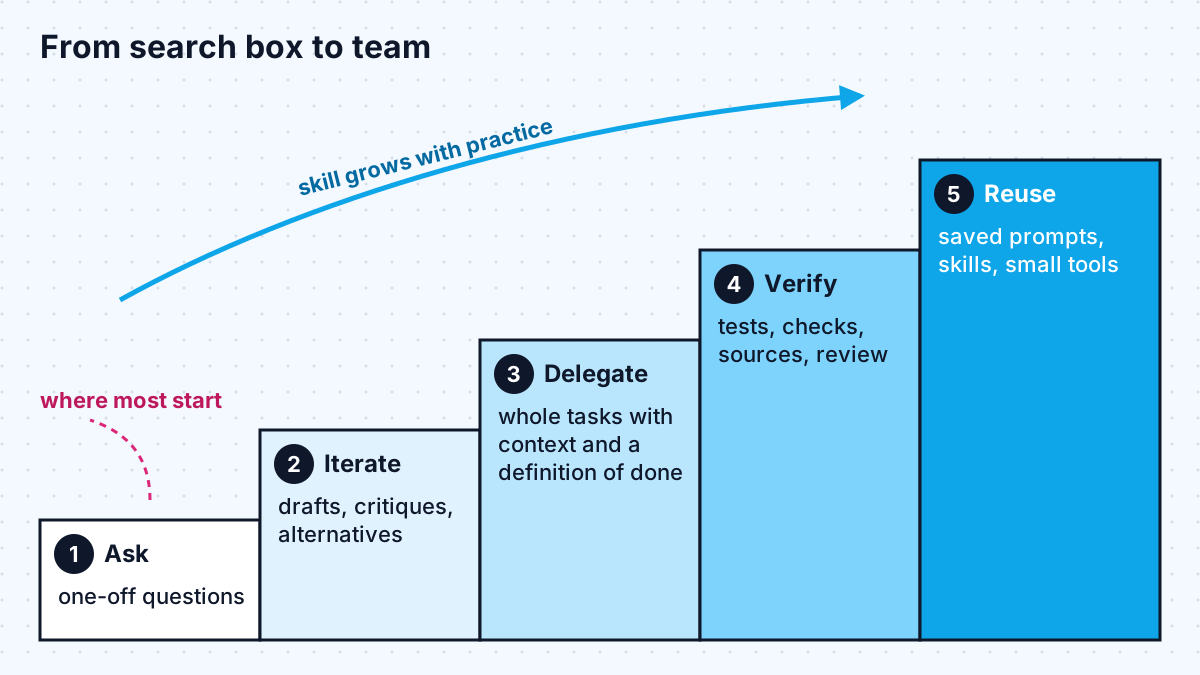
Habit 3: they give context, not just questions
The quality of an answer depends heavily on what the model knows. Experts hand over the relevant document, the constraints, the audience and examples of good output, instead of expecting the model to guess. They also leave things out: Anthropic's engineering team describes good context as the smallest possible set of high-signal tokens that make the desired outcome likely.
For coding agents, this means a short project memory file and specific prompts. Claude Code's best practices give a clean example: instead of "fix the login bug", say what users report, where to look, and to write a failing test that reproduces it before fixing it. I covered how to do this in someone else's repository in context engineering for client codebases.
Habit 4: they delegate whole tasks with a definition of done
Once context is in place, strong users hand over complete tasks rather than fragments. The difference between a fragment and a task is a definition of done. "Write a function" is a fragment. "Add rate limiting to the public API, per API key, return 429 with a retry header, and the existing tests plus three new ones must pass" is a task.
This is how people move from using AI as a typist to using it as a team member. The best practices page suggests, for work you will leave running, checking five things first: whether the agent knows what done looks like, whether it can check its own work, what it is allowed to touch, what stops it, and who signs off on the result.
Habit 5: they verify everything they can check
Experts trust AI in proportion to how easily they can check it. The Stack Overflow 2026 Developer Survey found that 48% of developers trust AI when they can easily validate the answer, which is the right instinct. Strong users go further and build validation into the work: tests and type checks for code, links back to sources for research, a second model or a fresh session reviewing the output.
The METR study is the cautionary tale here. Experienced developers in its early-2025 trial believed AI had sped them up by 20% when it had slowed them down by 19%. If careful engineers can misjudge the direction of the effect, everyone should be checking. I go through the evidence in does AI make developers faster.
Habit 6: they turn repeated prompts into reusable tools
If an expert types the same instructions three times, they save them. That can be a prompt template, a project instruction file, or a skill: Claude Code skills are saved procedures the agent reads only when a task calls for them, so a long release checklist costs nothing on an unrelated bug fix.
The next step is building small tools. A script that formats a weekly report, an automation that drafts replies from a template, a small internal app that wraps a prompt with the right data: these turn a personal habit into something a team can use. Much of my client work in workflow automation starts from exactly this kind of repeated manual prompt. To decide which repeated task to automate first, run a quick AI automation audit.
Habit 7: they judge by outcomes and keep practising
Strong users measure what shipped, what held up and what had to be redone, not how impressive a session felt. They also keep practising deliberately, trying new tools on real tasks and dropping what does not earn its place. The Anthropic tenure data hints at why this compounds: if skill comes from use and experimentation, the people who practise most pull further ahead.
| Average user | Strong user |
|---|---|
| Uses AI like a search box | Uses AI like a capable colleague |
| One prompt, accept or reject | Drafts, critiques and alternatives |
| Asks a bare question | Supplies context, constraints and examples |
| Hands over fragments | Hands over tasks with a definition of done |
| Trusts or distrusts by feel | Verifies with tests, sources and review |
| Retypes the same instructions | Saves prompts, skills and small tools |
| Judges by how fast it felt | Judges by what shipped and held up |
None of these habits needs a special tool. They need attention, which is why I think the gap between average and expert users will keep widening. For the specific tools I use to practise them, see the AI productivity stack I use every day.
Work with me
I help teams move from casual AI use to working systems: integrations, automations and agents that build these habits into everyday work. See AI integration and workflow automation, or browse my work and book a scoping call.
Frequently asked
How do I use AI more effectively?
Choose tasks AI handles well, give it the context it needs, and iterate on its first answer instead of accepting or rejecting it. Define what a finished result looks like, verify the output with tests or sources, and save prompts you repeat as templates or skills. Judge your results by outcomes, not by how fast the work felt.
What is the jagged technological frontier?
The jagged technological frontier is the idea, from a 2023 study of 758 BCG consultants, that AI is very capable at some tasks and weak at others of similar difficulty. Inside the frontier, consultants with GPT-4 did more work, faster and at higher quality. Outside it, they were 19 percentage points less likely to get the right answer.
Do people get better at using AI over time?
Evidence suggests they do. Anthropic's March 2026 Economic Index report found that users with six months or more of experience had about a 10% higher success rate, not explained by task choice or country. The authors note it could partly reflect early adopters being different, but also learning-by-doing.
What is the biggest mistake average AI users make?
The most common mistake is treating AI like a search box: one bare question, no context and no check on the answer. That approach misses most of the value and lets confident mistakes through. Giving context and verifying the output fixes both problems.
Sources
Related services
Building something like this?
Naman Gundaniya takes on full-stack and AI projects fixed quote after a free 30-minute scoping call, replies within 24 hours.
Get in touch