 By Naman Gundaniya
Writing With AI Without Sounding Like AI
To write with AI without sounding like AI, give the model your own voice before it drafts, then edit after it drafts. Keep a short style file with your rules and three to five real samples of your writing, have the AI draft from your notes rather than from a blank page, and finish with a red-pen pass that removes the phrases and patterns readers now recognise as machine-made.
Most AI writing does not sound like AI because the model is bad at writing. It sounds like AI because nobody told it whose writing it was. Ask a model for "a blog post about X" and you get the average of every blog post about X, in the average voice. This post is the system I use to avoid that: a style file before, notes during, and a red pen after.
Why does AI writing sound like AI?
AI writing sounds generic because a language model predicts a likely next word, and the likeliest word is rarely the most specific one. Google's guidance on using generative AI content puts it plainly: "generative models don't retrieve facts, but predict a likely sequence of words." Likely words are safe words, and safe words are what make text feel like it was written by nobody.
The habits are measurable. A study of more than 15 million PubMed abstracts by Kobak and colleagues, published in Science Advances, estimated that at least 13.5% of 2024 abstracts were processed with LLMs. The full paper found that "delves" appeared 28 times more often than expected, "underscores" 13.8 times and "showcasing" 10.7 times, and that the 2024 excess vocabulary "consisted almost entirely of style words." The models did not change what scientists said. They changed how it sounded.
The odd part is that people are poor at spotting AI text when they try. In a PNAS study across six experiments with 4,600 participants, people could not detect AI-written self-presentations, and relied on misleading cues such as first-person pronouns, contractions and family topics. So the goal is not to fool a detector. It is to write something that is clearly yours, because it says things only you would say.
Do readers and search engines penalise AI-written text?
Google does not penalise text for being written with AI; it penalises text with nothing in it. Its guidance says AI "can be particularly useful when researching a topic, and to add structure to original content," but that "using generative AI tools or other similar tools to generate many pages without adding value for users" may break its spam policy on scaled content abuse. It also says it is "critical to manually factcheck and review all AI-generated content" before publishing.
Readers are harsher than search engines. They will not run a detector, but they notice when a paragraph says nothing, and they stop trusting the next one. That matters even more now that AI answer engines quote passages directly; I covered how that works in generative engine optimisation. A generic paragraph has nothing worth quoting.
The system: style file, notes, draft, red pen
The fix is to put your voice in before the draft and take the machine out after it. I use four steps, and only one of them is the AI writing.
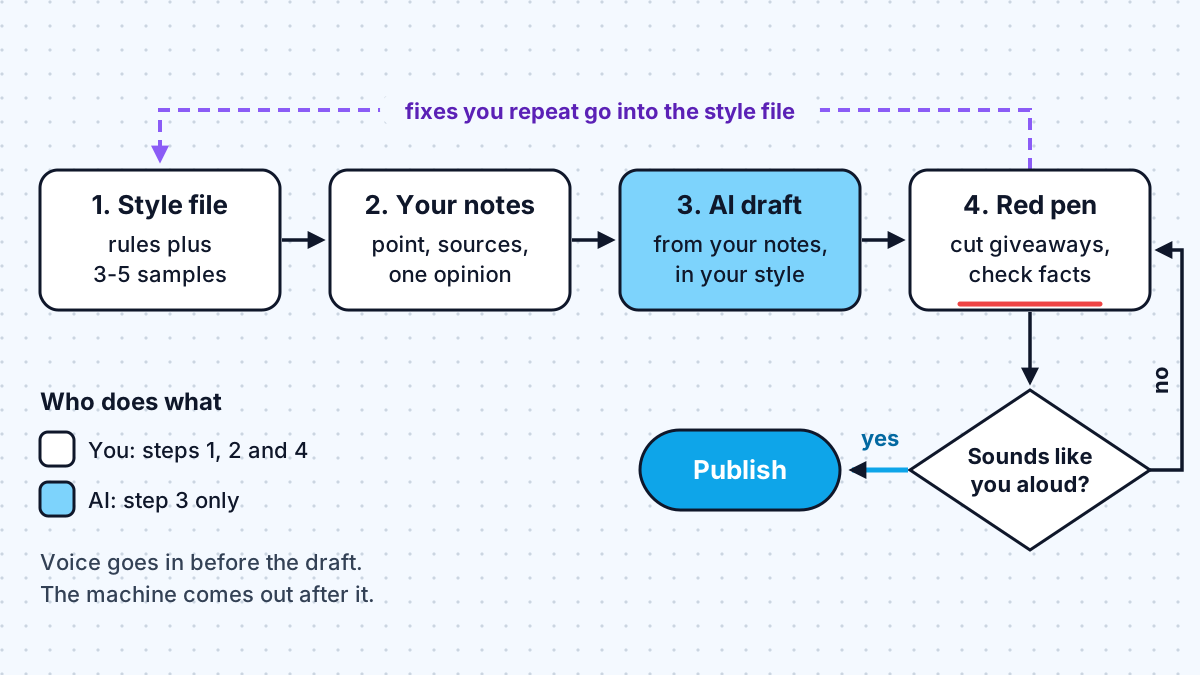
- A style file. A short document with your rules and real samples of your writing.
- Your notes. The point you want to make, the facts with their sources, and at least one opinion only you hold.
- The AI draft. The model writes from your notes, in the voice of your samples.
- The red pen. You edit with a checklist, read it aloud and cut.
The style file and the red pen both improve over time. Every phrase you cut twice goes into the style file, so the next draft arrives cleaner.
How do you write a style file the AI can follow?
A style file is a page of rules plus three to five samples of your own writing, given to the model before every draft. Samples matter more than rules. Anthropic's prompting best practices call examples "one of the most reliable ways to steer Claude's output format, tone, and structure" and suggest three to five of them. Rules describe a voice; samples show it.
What I put in mine:
- Who I am and who I am writing for. One line each. A post for founders reads differently from one for engineers.
- Sentence habits. Short paragraphs, plain words, British spelling, no exclamation marks.
- Words I never use. The list below, plus any word I have cut more than twice.
- What a good paragraph does. It opens with its point, gives one piece of evidence and stops.
- Three to five samples. Real paragraphs I wrote without AI, wrapped in example tags so the model can tell them apart from the instructions.
Write the rules as things to do rather than things to avoid. The same guide advises telling the model what to do instead of what not to do: "write in short, plain sentences" steers better than a long list of bans. I keep the ban list anyway, but I use it mostly for my own red-pen pass.
This works the same way as a project memory file for a coding agent. If you have written a CLAUDE.md, you already know the trick: short, specific, kept up to date, and loaded every time.
Which phrases give AI writing away?
The giveaways are patterns, not single words: inflated significance, vague praise, empty contrasts and lists of three. Wikipedia's editors maintain a field guide, Signs of AI writing, and it is the most useful red-pen list I have found. It is careful to say these are observations, not proof: one or two such words can be coincidence, many together are a strong signal.
| Pattern | Examples to cut | What to write instead |
|---|---|---|
| Overused AI vocabulary | delve, crucial, pivotal, testament, tapestry, underscore | The plain word, or nothing |
| Inflated significance | "serves as a testament", "setting the stage for" | Say what actually happened |
| Superficial analysis | "highlighting the importance", "valuable insights" | The insight itself |
| Vague attribution | "experts argue", "industry reports suggest" | A named source with a link |
| Negative parallelism | "it's not just X, it's Y", "not X, but Y" | State Y directly |
| Rule of three | Three adjectives where one would do | The one adjective that is true |
| Formulaic endings | "Despite these challenges", "Future outlook" | End when the point is made |
| Avoiding "is" | "serves as", "boasts", "features" | "is" and "has" |
My own additions, from editing many drafts: openings that restate the question, paragraphs that end with a one-line moral, "in today's fast-paced world" in any form, and any sentence that would fit equally well in a post about a different topic. That last one is the best test of all. If a sentence is portable, it is filler.
What should the red-pen pass check?
The red pen checks voice, substance and facts, and facts matter most. I do it in one sitting, ideally not straight after drafting, because a fresh read hears the template more clearly.
- Read it aloud. Anything you would not say to a colleague goes. This catches more than any word list.
- Cut the first paragraph. AI drafts warm up. The real opening is often the second paragraph.
- Run the word list. Search for every banned word and pattern from the table. Replace or delete.
- Check every fact. Each number, date and product claim needs a link to the page you read it on. If you cannot find the source, the sentence goes, however good it sounds.
- Add what only you know. A decision you made and why, a mistake you saw, an opinion you would defend. This is the part no model can draft, because it is not in its training data.
- Shorten. If a sentence survives with half its words, keep the half.
Judgement is the whole job here. A model can draft a thousand acceptable paragraphs; knowing which one is good, and why, is the skill I wrote about in the AI skills gap nobody talks about. The red pen is where that skill gets practised.
When should you not use AI to write at all?
Do not use AI for writing whose value is that you wrote it: an apology, a reference for a colleague, a personal note to a client. Readers forgive a clumsy sentence from a person far more readily than a smooth one from a template.
I also skip AI when I do not yet know what I think. A draft from a model gives you a confident shape before you have an argument, and it is surprisingly hard to argue with a tidy paragraph. In those cases I write rough notes by hand first. Once the point is clear, AI is useful again for structure, tightening and spotting gaps.
Work with me
I build AI writing and content workflows for teams, with style files, review steps and fact checks built in, so the output sounds like the company rather than the model. See AI integration and workflow automation, or browse my work and book a scoping call.
Frequently asked
How do I make AI writing sound more human?
Give the model three to five samples of your own writing and a short list of style rules before it drafts, and have it write from your notes rather than from a one-line prompt. Then edit with a checklist: read it aloud, cut the warm-up paragraph, remove overused words such as "delve" and "crucial", and add one point only you could make.
What words make writing sound like AI?
Words that research and editors have flagged include "delve", "underscore", "showcasing", "crucial", "pivotal", "testament" and "tapestry". Patterns matter more than single words: inflated significance, vague attributions such as "experts argue", "not just X, but Y" contrasts and lists of three adjectives. One such word is coincidence; several together read as machine-made.
Does Google penalise AI-generated content?
Google does not penalise content for being made with AI, according to its guidance on generative AI content. It does treat mass-produced pages that add no value for users as scaled content abuse, and it asks publishers to fact-check and review AI output before publishing. Quality and usefulness are what count, not the tool.
Can AI detectors tell if I used AI?
Detection is unreliable in both directions. Wikipedia's own guide warns that detection tools and human judgement both have significant error rates, and a PNAS study found people could not reliably spot AI-written text. Aim for writing that is useful and clearly yours rather than writing that evades a detector.
What is an AI style guide?
An AI style guide, or style file, is a short document you give a model before it writes: who you are, who you write for, your sentence habits, words to avoid and three to five real samples of your writing. It works like a memory file for a coding agent, and it gets better each time you add a fix from your editing pass.
Sources
Related services
Building something like this?
Naman Gundaniya takes on full-stack and AI projects fixed quote after a free 30-minute scoping call, replies within 24 hours.
Get in touch