 By Naman Gundaniya
Does AI Make Developers Faster? What METR and DORA Found
Probably yes for many tasks, but by less than developers feel and not on every team. METR's controlled trial in early 2025 found experienced developers were 19% slower with AI while believing they were faster; its late-2025 follow-up points to a speedup it cannot measure precisely. DORA's survey links AI to higher throughput, but also to less stable delivery.
This question gets loud answers in both directions. Vendors quote headline speedups, sceptics quote the METR slowdown, and both usually skip the detail that makes the studies useful. I build AI and full-stack products for clients every week with a coding agent in the loop, so I care less about winning the argument and more about what the evidence says I should do differently. Here is a fair reading of the three sources I trust most, and the practical takeaways.
What did METR's controlled trials find?
METR ran the most careful test so far: real developers, real tasks, and a coin flip deciding whether AI was allowed. In its early-2025 study, 16 experienced open-source developers worked on 246 real issues in large repositories they knew well, mostly using Cursor Pro with Claude 3.5 and 3.7 Sonnet. With AI allowed, they took 19% longer.
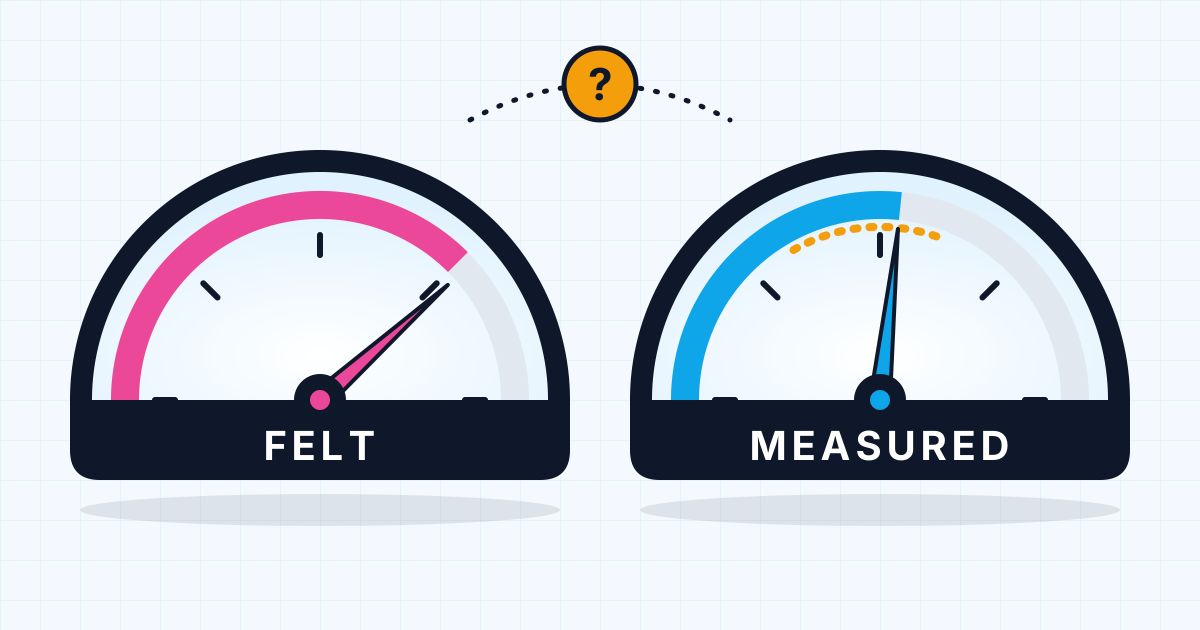
The striking part was perception. Before starting, the developers expected AI to speed them up by 24%. Afterwards, having been slowed down, they still believed it had sped them up by 20%. That gap between feeling and measurement is the most important finding in the whole literature, and the one most often left out.
METR was careful about what this did not show. The authors say they do not provide evidence that AI fails to speed up "many or most software developers", that their developers and repositories are not representative of most software work, and that participants had only a few dozen hours with the tool.
Then came the February 2026 update. This time 57 developers worked on more than 800 tasks across 143 repositories with late-2025 tools. The estimates flipped to a speedup: 18% for returning developers and 4% for new ones, but both confidence intervals include zero. METR also found a selection problem: 30% to 50% of developers said they skipped submitting some tasks they did not want to do without AI, and some declined to take part at all for the same reason. METR's own conclusion is that developers are likely more sped up now than in early 2025, that its estimate is probably a lower bound, and that the data is "only very weak evidence" of how much.
What does the DORA report say about AI and delivery?
DORA asks a different question: not how fast one person finishes one task, but how teams deliver software. Google Cloud's 2025 DORA report surveyed nearly 5,000 technology professionals. AI adoption reached 90%, with a median of two hours a day spent working with it. Over 80% said AI had improved their productivity and 59% reported a positive effect on code quality.
The more useful findings are about systems. The announcement on Google Cloud's blog reports a positive relationship between AI adoption and delivery throughput, reversing the previous year, but adds that "AI adoption does continue to have a negative relationship with software delivery stability." Its explanation is blunt: "Without robust control systems, like strong automated testing, mature version control practices, and fast feedback loops, an increase in change volume leads to instability."
DORA's summary line is that "AI doesn't fix a team; it amplifies what's already there." Strong teams get stronger. Teams with weak testing and review ship more changes, and more of them break.
Why does AI feel faster than it measures?
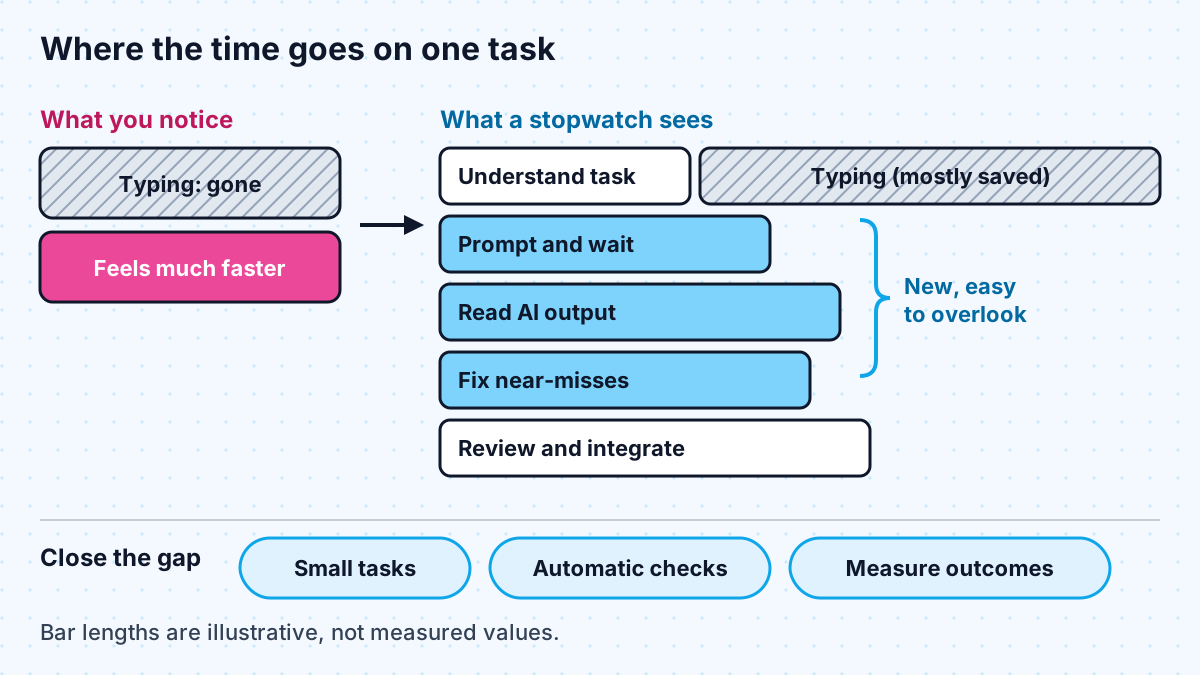
Felt speed and measured speed come apart because AI removes the visible effort and adds invisible effort. The typing disappears, which feels like a huge saving. The time spent prompting, waiting, reading, correcting and re-reviewing is spread across the task and is easy to discount.
| Source | What it measures | Headline result | Main limitation |
|---|---|---|---|
| METR early 2025 | Time per real task, randomised | 19% slower, felt 20% faster | 16 developers, early-2025 tools |
| METR late 2025 | Time per real task, randomised | 4% to 18% faster, not significant | Selection effects, weak evidence |
| DORA 2025 | Team delivery, survey of ~5,000 | Higher throughput, lower stability | Self-reported, correlational |
| Stack Overflow 2026 | Developer habits and attitudes | 73% of assistant and agent users use them daily | Opinion, not productivity |
The Stack Overflow 2026 Developer Survey shows how normal heavy use has become: coding assistants and agents are the top AI use case at 66%, and 73% of those users work with them daily. It also hints at the healthy instinct: 48% trust AI when they can easily validate the answer.
What should developers and teams take from the research?
The research says the gains are real but conditional, so the job is to create the conditions. On client projects I treat these as the practical takeaways:
- Do not trust the feeling. METR showed that experienced developers misjudged the direction of the effect. Judge by what ships and stays shipped, not by how fast a session felt.
- Add checks before adding speed. DORA's stability finding is a warning about volume without control. Type checks, tests and preview deployments are what let more changes land safely.
- Keep tasks small. Big AI-generated diffs take longer to review and hide mistakes, which is where invisible time goes.
- Use AI where it is strong. The Stack Overflow survey lists generating code in a familiar area (69.3%) and debugging or refactoring (63.8%) as the most common uses. Novel design work still needs more of your own thinking.
- Measure outcomes, not lines. If you want numbers for a team, look at delivery measures such as lead time, change failure rate and rework before and after a change in tooling, not at lines of code or prompts sent. The same principle applies to measuring AI automation ROI.
If you run your own comparison, keep it honest in the ways METR did: pick similar tasks for both conditions, decide in advance what counts as done, and include review and rework time, not just the time to a first pull request. A short, rough experiment on real work beats a confident guess.
None of this says "use less AI". It says that AI is a multiplier on your process, so improving the process is the highest-return thing you can do.
Will the answer change as tools improve?
Almost certainly, which is why I avoid quoting any single percentage as the truth. The tools in METR's first study are already old, and METR itself expects larger effects with newer agents and is redesigning its methods, including fixed-task experiments and analysis of real commit data. The direction of travel in both METR and DORA is towards bigger gains.
What I expect to stay true is the shape of the finding: AI speeds up generation, and the bottleneck moves to specifying the work and verifying the result. That is why the habits I describe in my AI productivity stack put so much weight on context and checks, and why the wider shift I wrote about in AI coding agents in 2027 is less about typing and more about judgement. If you are wondering what this means for careers, see will AI replace software engineers.
Work with me
I build AI and full-stack products with coding agents in the loop, and I help teams add the checks and context that turn AI speed into shipped work. See full-stack development and AI agent development, or browse my work and book a scoping call.
Frequently asked
Does AI actually make developers faster?
The best evidence says AI probably speeds up many developers today, but by less than they feel and not reliably on every task. METR found a 19% slowdown with early-2025 tools and a statistically uncertain speedup with late-2025 tools. DORA links AI adoption to higher team throughput but lower delivery stability.
Why did the METR study find AI made developers slower?
METR's early-2025 study found experienced developers took 19% longer on familiar, large codebases when AI was allowed. The authors caution that the developers had limited experience with the tool and that the result does not generalise to all developers. Their 2026 follow-up with newer tools estimated a speedup instead.
What is the DORA AI report?
The DORA report is Google Cloud's annual research on software delivery, and its 2025 edition, State of AI-assisted Software Development, surveyed nearly 5,000 professionals. It found 90% AI adoption, a positive link between AI and throughput, a continuing negative link with stability, and described AI as an amplifier of existing team strengths and weaknesses.
How should I measure whether AI tools help my team?
Measure delivery outcomes rather than how fast work feels or how much code is produced. Compare lead time, change failure rate and rework before and after a tooling change, and pair the numbers with a look at review load. Self-reported speed is unreliable, as METR showed.
Sources
Related services
Building something like this?
Naman Gundaniya takes on full-stack and AI projects fixed quote after a free 30-minute scoping call, replies within 24 hours.
Get in touch