 By Naman Gundaniya
AWS Generative AI Developer Certification: Is It Worth It?
The AWS Certified Generative AI Developer - Professional (AIP-C01) is worth it if you already build generative AI features on AWS and want proof that a hiring filter will recognise. It is a 75-question, 180-minute, 300 USD exam about integrating foundation models into production apps, not about training models. If you have never shipped on AWS, build a project first.

AWS added this exam to fill a gap: its older machine learning certificates were about training and data science, while most generative AI work today is integration. I have read the official exam guide closely and compared it with what I actually do on AI integration projects. This is my honest view of who should spend the time on it.
What is the AWS Certified Generative AI Developer - Professional?
It is a professional-level AWS certification for people who integrate foundation models into applications and business workflows. The official exam guide says it validates "a candidate's ability to effectively integrate foundation models (FMs) into applications and business workflows".
The facts that matter, from the guide and the certification page:
| Item | Detail |
|---|---|
| Exam code | AIP-C01 |
| Level | Professional |
| Questions | 75: 65 scored and 10 unscored, not marked |
| Question types | Multiple choice and multiple response |
| Time | 180 minutes |
| Cost | 300 USD |
| Delivery | Pearson VUE test centre or online proctored |
| Languages | English, Japanese, Korean, Simplified Chinese |
| Scoring | Scaled 100 to 1,000; pass mark 750 |
| Prerequisites | None required |
Scoring is compensatory, which the guide explains means "you do not need to achieve a passing score in each section". You pass on the overall score. Unanswered questions count as wrong and there is no penalty for guessing, so never leave a blank.
The exam is no longer new. AWS's announcement post set 31 March 2026 as the last day for the beta version, and an update to the same post says registration opened for the standard version. The same post set 31 March 2026 as the last date for the older Machine Learning - Specialty exam.
What does the AIP-C01 exam cover?
The exam has five domains, weighted by share of scored content:
- Foundation model integration, data management and compliance: 31%. Choosing models, retrieval augmented generation (RAG), vector stores and knowledge bases.
- Implementation and integration: 26%. Wiring models into apps and workflows, including agents.
- AI safety, security and governance: 20%. Guard rails, access control and responsible AI.
- Operational efficiency and optimisation: 12%. Cost and performance.
- Testing, validation and troubleshooting: 11%. Evaluating outputs and fixing failures.
The guide also lists what is out of scope: "model development and training", "advanced ML techniques", and "data engineering and feature engineering". That tells you who it is for. It is the integration engineer's exam, the person who takes a model someone else trained and makes it useful, safe and affordable inside a product.
The target candidate, in the guide's words, has "2 or more years of experience building production-grade applications on AWS or with open-source technologies" and "1 year of hands-on experience implementing GenAI solutions". It also expects comfort with AWS compute, storage, networking, security, infrastructure as code, monitoring and cost optimisation. That is a lot of general AWS knowledge for an exam with "generative AI" in its name, and it is where most people will find their gaps.
Who is the certification worth it for?
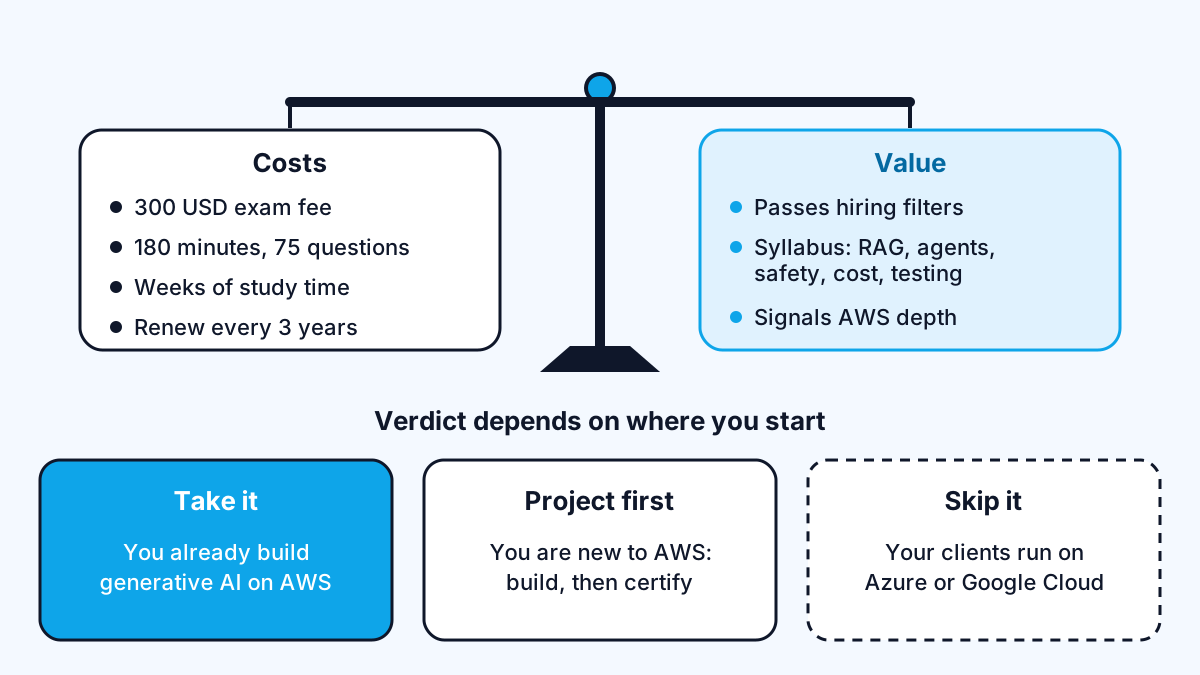
The certificate helps most when it confirms skills you already use, because then it costs you little extra study and pays back in hiring filters.
Worth it:
- Engineers already building generative AI on AWS who are applying to large companies, where recruiters often screen by certification before an engineer reads your CV.
- People at consultancies and AWS-focused service firms, where certified staff can matter for winning work.
- Freelancers whose clients are mostly on AWS and who want something concrete beside "I have built with Bedrock".
Probably not worth it yet:
- Developers new to AWS. The exam assumes broad AWS knowledge. Learn the cloud with a real project first, as I describe in which cloud an AI engineer should learn first.
- Engineers whose clients and employers run on Azure or Google Cloud. A certificate on the wrong cloud is a weak signal.
- Senior engineers with a public portfolio of shipped AI products. For them, the work speaks louder.
Be clear about what it does not prove. A pass shows you can choose the right AWS service for a scenario under exam conditions. It does not show that you can debug a retrieval pipeline returning the wrong documents, or keep an agent's costs under control in production. Interviewers who know the field will still ask about those.
How much does it really cost?
The visible cost is 300 USD per attempt. The bigger cost is time: several weeks of evenings for someone who already works on AWS, and more if domains like infrastructure as code or networking are new to you.
There are ways to reduce the money side. AWS's recertification page says many exams can be taken with a 50% discount voucher from your AWS Certification Account. The same page explains renewal: passing the latest version of an exam adds three years of validity, and a shorter one-year extension is available through an AWS Skill Builder subscription.
How should you prepare efficiently?
Prepare by building one project that touches every domain, then use practice questions only to find gaps.
- Read the exam guide end to end. Including the in-scope and out-of-scope services lists. It is free and is the most accurate description of the exam.
- Build a small RAG app on Bedrock. A knowledge base over your own documents, called from a deployed app with a least-privilege role, no stored keys and logs turned on. My guide to deploying a Next.js AI app on AWS Bedrock covers most of this.
- Add one agent with a tool. The guide lists "implement agentic AI solutions" as a core task.
- Add guard rails and evaluation. Content filters, a test set of questions with expected answers, and a way to compare model outputs. This covers the safety and testing domains together.
- Measure cost. Turn on prompt caching, compare a smaller model, and try batch processing. The ideas in prompt caching explained map straight to the optimisation domain.
- Then do practice questions. Use the official practice material to find weak domains, and go back to the project to fix them rather than memorising answers.
Do not skip the general AWS parts. The safety and security domain is a fifth of the exam, and much of it is ordinary IAM, encryption and network design applied to AI services.
Mistakes I would avoid when preparing
Most wasted study time on cloud exams comes from a few habits, and they apply here too.
- Memorising service names without building. Scenario questions describe a situation and ask for the best fit. If you have never configured a knowledge base or a guard rail, two plausible answers look the same.
- Ignoring the unscored questions. Ten of the 75 questions do not count, and you cannot tell which. Do not burn time on a question that seems oddly out of place; answer and move on.
- Studying only Bedrock. The target candidate description asks for compute, storage, networking, infrastructure as code, monitoring and cost knowledge too. Many of the hardest questions will be about the plumbing, not the model.
- Booking too early. At 300 USD per attempt, wait until practice results are steady across all five domains, not just your favourite one.
My verdict
If you already build generative AI on AWS, take it. You will learn the corners of the platform you have not touched, and it gives recruiters a quick yes. If you are new to AWS, the certificate is a good second milestone, not a first one. And if your clients are on another cloud, put the time into that cloud instead.
Work with me
If you need generative AI built into your product on AWS, with retrieval, guard rails and cost controls a security review will accept, see AI integration and AI agent development, or look through my work.
Frequently asked
Is the AWS Generative AI Developer certification hard?
The AWS Generative AI Developer - Professional exam is a professional-level test with 75 questions in 180 minutes and a pass mark of 750 out of 1,000. AWS's target candidate has two or more years building production apps and a year of hands-on generative AI work, so it is hard for anyone without that background.
Does the AWS generative AI exam cover model training?
No. The official exam guide lists model development and training, advanced machine learning techniques, and data engineering as out of scope. The exam is about integrating existing foundation models into applications with services such as Amazon Bedrock.
What replaced the AWS Machine Learning Specialty certification?
AWS set 31 March 2026 as the last date to take the Machine Learning - Specialty exam. For generative AI integration work, the closest replacement is the Generative AI Developer - Professional; for building and operating models, look at the Machine Learning Engineer - Associate, which AWS's announcement also mentions.
How long is the AWS Generative AI Developer certification valid?
AWS certifications are renewed for three years at a time by passing the latest version of the exam. AWS also offers a one-year extension through an AWS Skill Builder subscription, according to its recertification page.
Sources
Related services
Building something like this?
Naman Gundaniya takes on full-stack and AI projects fixed quote after a free 30-minute scoping call, replies within 24 hours.
Get in touch