 By Naman Gundaniya
Which Cloud Should an AI Engineer Learn First?
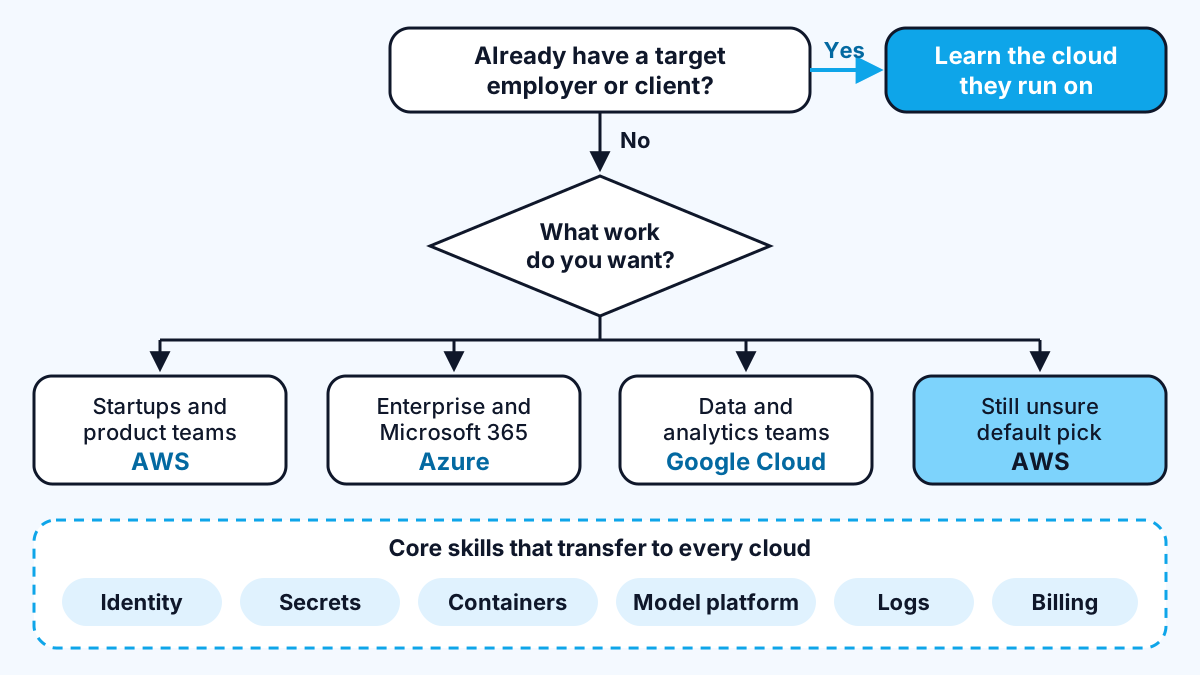
If you have no other signal, learn AWS first: it is the cloud most developers report working with and still holds the largest share of the market. But the better rule is to learn the cloud your target employers or clients already run on. Microsoft shops need Azure and Foundry, data-heavy teams on BigQuery need Google, and the core skills transfer between all three.
This is one of the most common questions I get from developers moving into AI work, and most answers online come from course sellers with a stake in the outcome. Below is how I would decide today, using public usage and market data rather than opinion, and what I would actually study in the first month.
Short answer: pick by who you want to work for
Learning a cloud is not like learning a language you will use everywhere. You learn it because the people paying you have their data, identity and spending commitments there. On client work, I find the cloud is almost never my choice: it is already decided by where the customer's data and contracts sit. That is the same rule I use when picking an AI platform, which I covered in Bedrock vs Azure AI Foundry vs Vertex AI.
So start with the work you want:
- Startups and product companies: AWS is the safest default, with Google Cloud close behind for teams built around data and analytics.
- Enterprises, banks, public sector and Microsoft 365 organisations: Azure, because identity runs through Microsoft Entra ID and AI work runs through Microsoft Foundry.
- Data platforms and analytics-heavy teams: Google Cloud, because BigQuery and Gemini sit next to each other.
- Freelancers and consultants: whichever cloud your first two or three clients use. Learn the second one when a client asks for it.
If none of these tells you anything yet, the data below points to AWS as the first pick.
What does the data say about AWS, Azure and Google Cloud?
Two public sources are useful here: what developers say they use, and where companies spend money.
| Signal | AWS | Azure | Google Cloud | Source |
|---|---|---|---|---|
| Developers who did extensive work on it in the past year (all respondents) | 43.3% | 26.3% | 24.6% | Stack Overflow Developer Survey 2025 |
| Same, professional developers only | 45.9% | 27.2% | 24.3% | Stack Overflow Developer Survey 2025 |
| Share of cloud infrastructure spending, Q3 2026 | 26% | 19% | 16% | Synergy Research Group via TechInsights |
Read these with care. The survey asks about extensive development work, so it reflects where developers spend their time, not where AI work happens specifically. The market share figures are for all cloud infrastructure, not AI alone. The same TechInsights summary says AI-specific cloud services now make up about one-third of the total market, and that Microsoft and Google are growing faster than Amazon. So AWS leads on both measures today, but the gap is not so wide that learning Azure or Google first is a mistake.
What I could not find is a trustworthy public count of AI job postings split by cloud. Job boards and course sellers publish numbers, but the methods are rarely shown and they disagree with each other. I would not base a career decision on them. Read twenty job ads for roles you actually want and count the clouds yourself. That small sample tells you more than any national figure.
How do the AI services compare on each cloud?
All three now sell a managed model platform with models from several providers, so the AI layer is less of a differentiator than it was two years ago.
- AWS sells models through Amazon Bedrock, with its own Nova family plus Anthropic, Meta, Mistral, OpenAI and others. The Bedrock pricing page lists the providers.
- Azure sells models through Microsoft Foundry, where OpenAI's GPT family is the home model family. Claude is also offered there, as I explained in Claude on AWS, Azure or Google Cloud.
- Google Cloud sells Gemini and partner models through what used to be Vertex AI. Google's release notes for 22 April 2026 say "Vertex AI is now part of Gemini Enterprise Agent Platform", so expect both names in job ads for a while.
For an AI engineer, the platform-specific part is smaller than people expect. Calling a model is a few lines of SDK code on any of them. What takes real learning is everything around the call: identity, networking, logging, quotas and cost. Those concepts are shared across clouds, even if the names differ.
What should you learn first on any cloud?
Learn the parts that every AI feature touches, in this order, and you will be useful on whichever cloud you pick.
- Identity and access. IAM roles and policies on AWS, Entra ID and role-based access on Azure, service accounts on Google. Most security reviews of AI apps start here.
- Secrets. Where keys and connection strings live, and how a running service gets them without anyone pasting them into code. I cover the app side in protecting API keys in AI web apps.
- Containers and one serverless option. Package an app as a container and deploy it, then do the same with the cloud's function service, so you know where each one breaks.
- The model platform. Call a model through Bedrock, Foundry or Google's Agent Platform with the cloud's own credentials rather than a pasted key.
- Logs and metrics. Find a failed request in the logs, and build one dashboard showing request count, latency and errors.
- Billing. Set a budget alert and learn to read the bill by service. AI apps can get expensive quietly, which is why I also cap LLM costs per user in code.
None of this needs a certification. A single project that touches all six teaches more than a month of video courses. I describe the wider skill set in how to become an AI engineer.
A 30-day plan for your first cloud
This is the plan I would follow if I were starting today with one cloud and a few evenings a week.
- Week 1: account and guard rails. Create the account, turn on multi-factor sign-in, set a budget alert, and create a non-admin identity for daily work.
- Week 2: one small app, deployed. A chat or summarisation endpoint in a container, calling a model through the cloud's model platform, with its credentials coming from a role rather than a key in the code.
- Week 3: data and retrieval. Add storage and a small retrieval step over your own documents. Put the database connection details in the secrets service.
- Week 4: run it like production. Logging, an alarm on errors, a cost report by service, and a written teardown so you can delete everything cleanly.
At the end you have a repository and a short write-up you can show in interviews. If you then want a certificate, the entry-level AI exams on each cloud are cheap and short. AWS's AI Practitioner exam is 90 minutes, 65 questions and 100 USD, and Google's Generative AI Leader is 90 minutes and 99 USD. I would still put the project first.
When should you learn a second cloud?
Learn a second cloud when a real piece of work asks for it, not before. In my experience, the second cloud is much faster than the first, because you are only learning new names for things you already understand. A role on AWS maps closely to a managed identity with a role assignment on Azure, or to a service account on Google.
The one exception is consulting. If you advise clients on platform choice, you need working knowledge of all three model platforms, at least enough to compare pricing tiers, data residency options and which models each one offers. For hands-on build work, depth in one cloud beats a shallow tour of three.
Work with me
If your team needs an AI feature built on the cloud you already use, I can scope it, build it beside your product and hand it over with the access, logging and cost controls in place. See AI integration and full-stack development, or look through my work.
Frequently asked
Is AWS or Azure better for AI engineers?
Neither is better in general. AWS has the largest share of developers and cloud spending, while Azure is the default in Microsoft-centred enterprises and hosts OpenAI's GPT models through Microsoft Foundry. Choose the one your target employers or clients use.
Should I learn Google Cloud for AI?
Learn Google Cloud first if you want to work with data-heavy teams, analytics platforms or products built on Gemini. Its model platform, formerly Vertex AI and now part of Gemini Enterprise Agent Platform, sits close to BigQuery. For most other paths, AWS or Azure is the more common first choice.
Do AI engineers need cloud certifications?
AI engineers do not need certifications to get hired, but some find them useful as a structured way to learn or as a filter in large-company hiring. A deployed project that shows identity, secrets, logging and cost controls usually carries more weight with technical interviewers.
How long does it take to learn a cloud for AI work?
Most developers can learn enough of one cloud for AI work in about a month of part-time study, if they build and deploy a real project rather than only watching courses. Expect the second cloud to take far less time, because the concepts carry over.
Sources
Related services
Building something like this?
Naman Gundaniya takes on full-stack and AI projects fixed quote after a free 30-minute scoping call, replies within 24 hours.
Get in touch