 By Naman Gundaniya
How to Choose an AI Automation Agency (Without the Listicles)
Choose an AI automation agency on evidence, not rankings: ask to see workflows they built and still run, check who will do the work, insist that you own the accounts and code, ask how they test and monitor AI steps, and start with a small paid pilot. Treat self-published "top 10" lists and unverifiable badges as marketing.
Search for "best AI automation agency" with a city name, whether London, Sydney, Singapore or Dubai, and page one is mostly lists. Some are written by agencies that rank themselves first. Others are directories where placement can be paid for. None of that tells you whether an agency will automate your process well.
I am not an agency, and I will not rank anyone here, including myself. This is the checklist I would use if I were buying, built from what I see go right and wrong when businesses automate with AI.
Why are "top 10 AI agency" lists a poor guide?
Most ranking pages are written by someone with a stake in the result, so they rarely measure what matters to you. An agency's own "best agencies in Sydney" post ranks the agency first. Directory pages often mix paid and organic placement: Clutch, for example, says on its help centre that sponsors are listed above non-sponsors on directory pages, while sponsorship does not affect its separate Leaders Matrix. That is a fair disclosure, but it means the order you see on a directory page is partly an advertising decision.
Badges need checking too. n8n, a popular workflow tool, describes its Expert Partner programme as a closed pilot with a waitlist. A badge can be genuine and still tell you little about whether an agency can handle your process, your data and your edge cases. Ask what the badge required, then verify it on the vendor's own site.
Finally, be wary of outcome claims that sound too good. In its Operation AI Comply announcement in September 2024, the US Federal Trade Commission took action against companies that used "AI-powered" claims to promise income or replace professional expertise without evidence. Most agencies are honest, but the lesson carries over: claims about AI should come with proof you can inspect.
What should you look for in an AI automation agency?
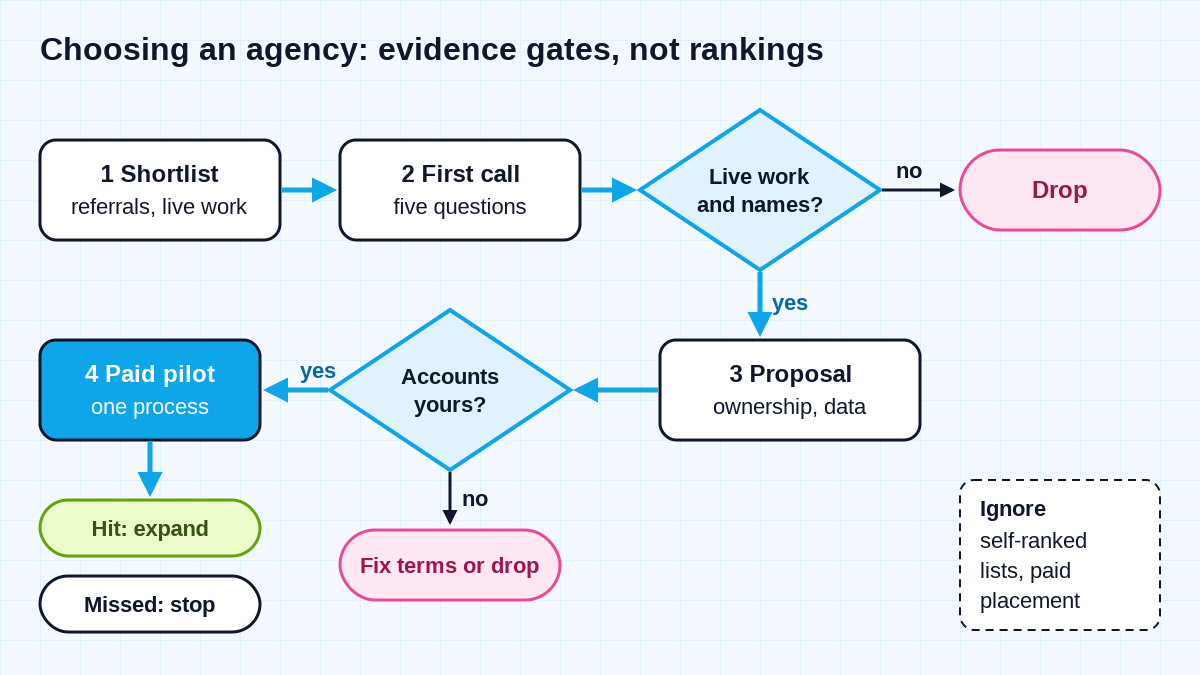
Look for evidence on five things: relevant work, who does it, ownership, quality control and how they scope. The table turns each into a question you can ask on the first call, with what a good and a weak answer sound like.
| Criterion | Question to ask | Good answer | Weak answer |
|---|---|---|---|
| Relevant work | "Show me a workflow like ours that you built and still maintain." | A live demo or a walkthrough of a real build, with what broke and how it was fixed | Logos, screenshots and a generic case study |
| Who does the work | "Who will build and support this, and are they employees or subcontractors?" | Named people you meet before signing | "Our team" with no names, or a sales lead only |
| Ownership | "Whose accounts, API keys and code will this run on?" | Yours, from day one, with documentation | The agency's accounts, with a fee to transfer |
| Quality control | "How do you test the AI steps, and how will we know when they fail?" | Test sets, logging, alerts and human review for risky actions | "The model is very accurate" |
| Scoping | "What would you build first, and what would you not automate?" | A small first step tied to one measurable process | A large platform proposal on the first call |
Ownership is the one most often overlooked, and the most expensive to fix later. I cover it in detail in who owns your automations: if the workflows live in the agency's account, you are renting your own process.
What are the red flags?
Red flags are signs that the agency is selling a product or a promise rather than solving your problem. Walk away, or at least slow down, if you see these:
- Guaranteed savings before discovery. Nobody can promise "40% cost reduction" before they have seen your process and data.
- No live examples. If every example is under NDA and nothing can be demonstrated, you cannot judge quality.
- Everything in their accounts. Workflows, AI keys and databases that stay with the agency after you pay for them.
- Autonomous agents on day one. Agents that send emails, change records or move money without approval. Security guidance such as OWASP's entry on prompt injection recommends restricting the model's privileges "to the minimum necessary" and adding human-in-the-loop controls for privileged operations.
- No plan for failure. No logging, no alerts and no named person who fixes things when an API changes.
- One tool for every problem. An agency that only sells one platform will fit every problem to it.
- Long lock-in before a pilot. A 12-month retainer before you have seen anything work.
How do you compare quotes fairly?
Compare quotes on the same scope, and ask each agency to split build, running and support costs. AI automation has three cost lines that are easy to blur:
- Build: discovery, workflow design, integrations, prompts and testing.
- Running: platform subscriptions and AI model usage, which you should pay directly on your own accounts.
- Support: monitoring, fixes when connected apps change, and improvements.
A low build price with an open-ended support retainer can cost more over a year than a higher fixed build. Ask what is included when a connected app changes its API, because that will happen. For a sense of what the platform side costs and how the tools differ, see n8n vs Zapier vs Make.
Agency, freelancer or in-house?
An agency is not the only option, and the right choice depends on the size of the work. Agencies suit multi-stream projects that need several people at once. A senior freelancer suits a well-defined process where you want one accountable builder. An in-house hire suits automation that will be a permanent, growing part of your operations. I compare the three in AI consultant vs agency vs freelancer.
Location matters less than it seems. Whether you are in London, Sydney, Singapore or Dubai, a local agency is not automatically better than a remote one, and a remote one is not automatically cheaper. What matters is a few shared working hours each day, written specs and handovers, and someone who can explain your data obligations in your jurisdiction, or who will tell you plainly when you need a local lawyer.
Whichever you choose, the checklist above applies. The questions about evidence, ownership and testing do not change with the size of the supplier.
Work with me
I build AI automations and agents as a senior freelancer, on your accounts, with tests, logging and handover documents. See workflow automation and AI agent development, or browse my work and book a scoping call.
Frequently asked
How do I find the best AI automation agency in my city?
Start with referrals from businesses like yours and with agencies that can demonstrate live work, rather than ranked lists. Then use the same five questions with each: relevant work, who builds it, who owns it, how it is tested and what they would build first. Location matters less than overlap in working hours and clear communication.
Are Clutch and other directory rankings reliable?
They are useful for finding names and reading reviews, but treat the order with care. Clutch, for example, places sponsors above non-sponsors on its directory pages, while saying sponsorship does not affect its Leaders Matrix. Read the reviews, then verify claims yourself on a call.
What should an AI automation agency include in a proposal?
A proposal should state the process being automated, the measure of success, what is out of scope, whose accounts everything runs on, how the AI steps are tested and monitored, and separate prices for build, running costs and support. If any of these are missing, ask for them before signing.
How much should a first AI automation project cost?
It depends on the process, the systems involved and how much testing the AI steps need, so be wary of any fixed figure quoted before discovery. A small, paid pilot on one process is the safest way to learn both the cost and the agency's quality before committing to more.
Sources
Related services
Building something like this?
Naman Gundaniya takes on full-stack and AI projects: fixed quote after a free 30-minute scoping call, replies within 24 hours.
Get in touch