 By Naman Gundaniya
SR&ED for AI Projects: What Counts as Eligible Work
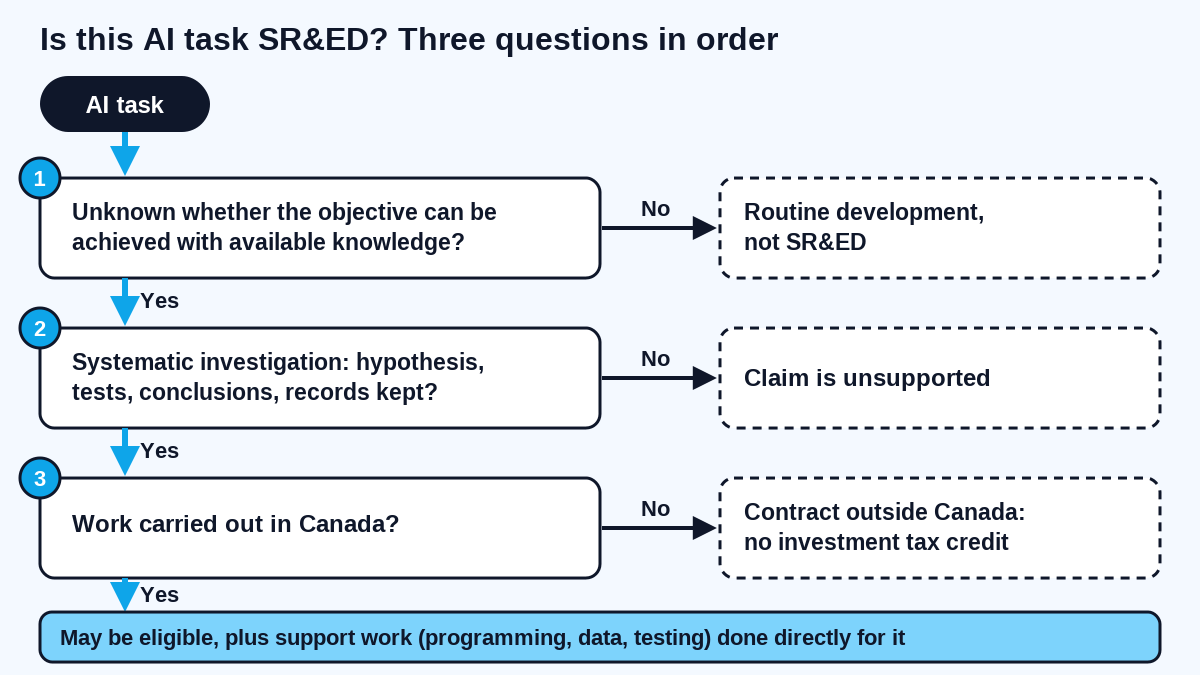
AI work is eligible for Canada's SR&ED tax incentives only when it tries to resolve a scientific or technological uncertainty through systematic investigation, with hypotheses, tests and records, and is carried out in Canada. Calling a model API, tuning prompts and wiring integrations with known methods is usually routine development and does not meet that test. Work done by contractors outside Canada earns no credit.
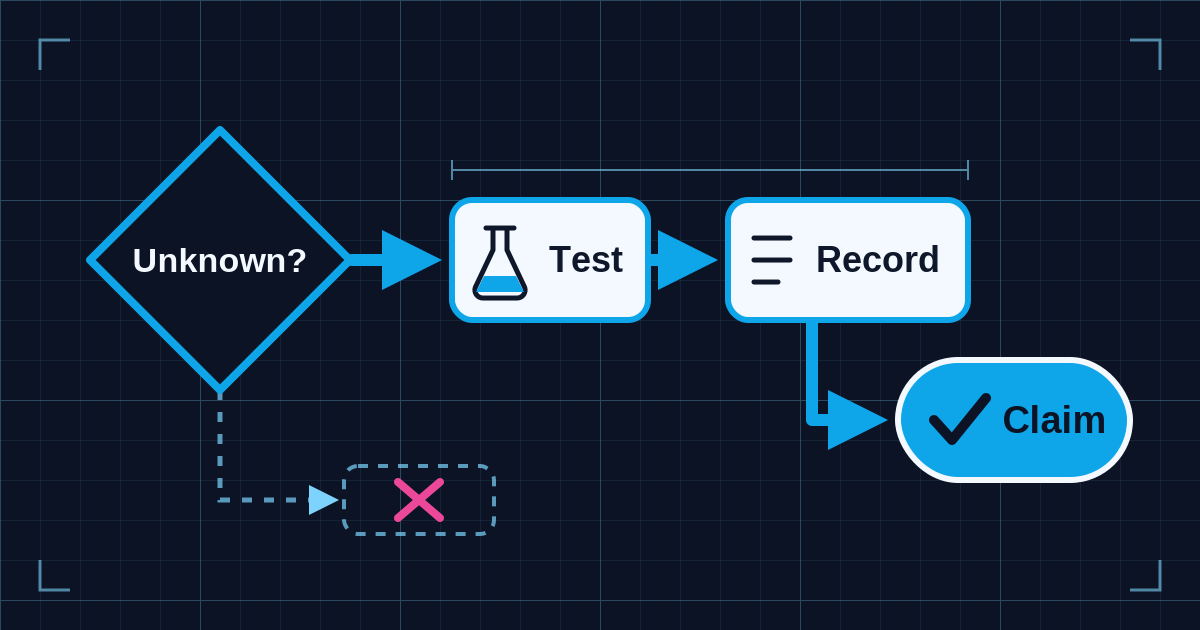
Canadian founders often ask me whether the AI feature we are scoping "is SR&ED". The answer depends on what is unknown at the start, not on whether the product contains AI. This post walks through the Canada Revenue Agency (CRA) tests as published on canada.ca as of late 2026, and how I read them for AI projects. It is general information, not tax advice; an SR&ED claim should be prepared with a qualified adviser.
I should also be plain about my own position: I work from India, and as the contractor section explains, work I do there does not qualify for a Canadian client's SR&ED claim.
What does the CRA test for when it assesses SR&ED?
The CRA tests two things: why the work was done and how it was done, and both must be met. The CRA's guidelines on the eligibility of work for SR&ED tax incentives, dated 13 August 2021, frame the definition in the Income Tax Act that way.
- Why. The work must be for "the generation or discovery of knowledge that advances the understanding of science or technology". The trigger is a scientific or technological uncertainty, which exists when "it is unknown (or uncertain) whether a given result or objective can be achieved" on the basis of available knowledge.
- How. The work must be a "systematic investigation or search" carried out by experiment or analysis: forming an idea consistent with known facts (a hypothesis), testing it, drawing logical conclusions from the results, and keeping evidence as the work progresses.
Several details in the guidelines matter for software teams:
- Available knowledge includes the combined knowledge of the people in your business plus what is reasonably available publicly. If the answer is already in that pool of knowledge, there is no uncertainty to resolve.
- If you get around a problem "with a workaround using available knowledge, then the work will not be eligible".
- Acquiring knowledge by buying proprietary knowledge does not meet the requirement.
- Cost targets "on their own do not create technological uncertainty", though trying to meet them might.
- Working systematically is not enough by itself, since businesses follow known methods and standards as a matter of course.
- Whether you succeeded or failed is not relevant to the why requirement.
The definition also excludes some work outright, including market research or sales promotion, quality control or routine testing, routine data collection, and commercial production.
Which AI work can meet the test, and which usually fails?
AI work can meet the test when the team does not know, and cannot find out from available knowledge, whether a technical objective is achievable, and it usually fails when known tools are applied in a known way to a new business problem. The CRA guidelines do not mention AI or machine learning by name, so the table below is my reading of the tests, not a CRA list. An adviser should confirm any real case.
| AI work | Likely outcome | Reasoning against the guidelines |
|---|---|---|
| Calling a hosted model API and building the product around it | Usually fails | The capability is available knowledge; the uncertainty is commercial, not technological |
| Prompt tuning until outputs look right | Usually fails | No hypothesis and no knowledge gained beyond the product |
| Standard retrieval over documents with an off-the-shelf vector store | Usually fails | Known design method followed as documented |
| Fine-tuning with a documented recipe on your own data | Usually fails | Routine application, unless the data or constraints make the result uncertain |
| Routine evaluation runs and bug fixing | Excluded | Quality control or routine testing |
| Collecting and labelling data for normal operations | Excluded | Routine data collection |
| A new method to hit an accuracy, latency or memory target that published techniques cannot reach | May qualify | Unknown whether the objective can be achieved; needs hypotheses and tests |
| Experiments on why existing techniques fail on your data type, leading to a new approach | May qualify | Generates knowledge that advances the understanding of the technology |
Two patterns explain most of the "usually fails" rows. First, the hard part of most AI products is product work: choosing the workflow, cleaning data, designing the interface, deciding when a human reviews. That is valuable, and it is not SR&ED. Second, trial and error with prompts feels like experimenting, but without a stated hypothesis and a conclusion that adds to what is known, it does not meet the how requirement.
Routine work is not always lost. The guidelines recognize support work, including computer programming, data collection and testing, when it is "commensurate with the needs" and "directly in support" of eligible work performed in Canada. They also state that "support work is not SR&ED on its own". So the data pipeline built to run an eligible experiment may be included; the same pipeline built for the product may not.
If you are deciding between approaches, my comparison of RAG and fine-tuning covers the engineering trade-offs separately from the tax question.
Do contractors and work outside Canada count?
Contract work counts toward SR&ED only when the SR&ED is performed in Canada, and work performed outside Canada by a contractor earns no investment tax credit. The CRA's contract expenditures policy, dated 30 March 2022, sets out the rules:
- The claimant must show that the work "was carried out in Canada and was related to their business".
- For an arm's length contract, "only 80% of the expenditure related to SR&ED contracts is allowable as a qualified SR&ED expenditure", and the performer must be a taxable supplier.
- The claimant, not the performer, must show that the contracted work was SR&ED.
- For SR&ED performed outside Canada, "no portion of the contract amount is allowed as an SR&ED expenditure". A contract that mixes work in and outside Canada must be split on a reasonable basis.
There is a narrow exception for a company's own staff. Under the CRA's salary or wages policy, dated 28 January 2025, salary for SR&ED carried on outside Canada can be claimed only where the work was done directly by an employee who was resident in Canada, "not performed by a contractor", and was an integral part of and solely in support of SR&ED carried on in Canada. Even then the amount is limited to 10% of the salary or wages for SR&ED carried on in Canada.
The practical consequence for teams that use offshore developers, including me: keep the experimental core with employees or contractors in Canada if you plan to claim it, and use offshore capacity for the product build around it. Split the contracts so the two are not mixed. The contract policy notes that its content is under review after the 2026 legislative changes, so check the current page before relying on details.
What rates and limits apply as of late 2026?
The basic SR&ED investment tax credit rate is 15%, and Canadian-controlled private corporations (CCPCs) can earn an enhanced rate of 35% on qualified expenditures up to an annual limit. The CRA's investment tax credit policy, dated 7 October 2026, sets that limit at $6 million for tax years beginning after 15 December 2024, up from $3 million. The limit phases out as a CCPC's prior-year taxable capital employed in Canada rises from $15 million to $75 million.
The CRA's SR&ED news and updates page records that these changes came through Bill C-15, which received Royal Assent on 26 March 2026. The same measures give eligible Canadian public corporations access to the enhanced credit and allow SR&ED capital expenditures made after 15 December 2024 to be claimed again. Refundability depends on the type of claimant and expenditure; the policy has the table. Provinces run their own research credits with their own rules, which I have not covered here.
What records and deadlines does a claim depend on?
A claim depends on evidence produced while the work was happening and on filing by a deadline the CRA cannot extend. The eligibility guidelines ask claimants to keep "evidence that is generated as the work progresses". For an AI project, the records I would keep from day one are:
- a dated statement of the technical objective and why available knowledge does not settle it,
- each hypothesis, written before the test,
- experiment logs: data version, configuration, metrics, and the conclusion drawn,
- commit history and evaluation results tied to those experiments,
- time records showing who worked on the experimental work and who on the product.
Good evaluation practice produces most of this anyway; my post on evals for AI agents describes the setup.
On timing, the CRA's filing requirements policy, dated 28 January 2025, puts the reporting deadline for corporations at 18 months after the tax year end, using Form T661 and Schedule T2SCH31. It states that "the CRA cannot by law allow any additional time to provide the prescribed information", and advises filing at least 90 days before the deadline so the CRA has time to review the claim and flag gaps.
One newer option: the CRA's news page describes an optional pre-claim approval process, launched on 1 April 2026, that helps eligible businesses find out whether their projects qualify, with determinations expected within eight weeks. For an AI project where eligibility is uncertain, asking before spending on a claim looks sensible. SR&ED is also not the only program; I cover a grant route in using NRC IRAP AI Assist to fund an AI pilot.
Work with me
I build AI features and agents for Canadian teams from India, which means my hours are product work and not part of your SR&ED claim. I say so up front so you can plan which work stays in Canada. See AI integration and AI agent development, read how I work with Canadian clients, or browse my work and book a scoping call.
Frequently asked
Does building an app on top of an LLM API qualify for SR&ED?
Usually not. Using a hosted model as documented applies available knowledge, and the CRA guidelines require an uncertainty about whether a result can be achieved at all. Parts of such a project could qualify if the team had to develop and test a new technical approach because known methods could not meet a requirement.
Is fine-tuning a model SR&ED?
Fine-tuning by a documented recipe is standard practice. It may qualify where it is unknown whether the objective can be reached with available techniques and the team runs a systematic investigation to find out. The claim rests on the uncertainty and the records, not on the word fine-tuning.
Can I claim SR&ED for an offshore AI developer?
Not for a contractor working outside Canada. The CRA's contract policy says no portion of a contract amount for SR&ED performed outside Canada is allowed as an SR&ED expenditure. A limited exception exists for employees resident in Canada who do supporting work abroad, capped at 10% of Canadian SR&ED salary.
Does a failed AI experiment still count?
Yes, if the tests are otherwise met. The guidelines say success or failure in meeting objectives is not relevant to the why requirement. A well-documented experiment showing that an approach does not work can still be part of a systematic investigation.
Sources
Related services
Building something like this?
Naman Gundaniya takes on full-stack and AI projects: fixed quote after a free 30-minute scoping call, replies within 24 hours.
Get in touch