 By Naman Gundaniya
GPT-6.2 Astra vs Sol: Which One Should You Ship?
Ship GPT-6.2 Sol as the default and escalate to Astra only when a check fails. As of late November 2026, Sol lists at $2 input and $10 output per million tokens against Astra's $8 and $40, and OpenAI reports Sol within 0.5 points of Astra on FrontierCode 2.0 at about a fifth of the cost. Astra earns its price on the hardest, longest tasks.
OpenAI released both models on 17 November 2026, the date of its developer community announcement. Most teams I talk to will not pick one model for everything. They will pick a default, an escalation path and a budget. This post gives you the numbers to set all three, using only OpenAI's own launch post, pricing page and model pages.
What is the difference between GPT-6.2 Astra and Sol?
GPT-6.2 Astra is OpenAI's higher-priced model for hard, long-horizon work, and GPT-6.2 Sol is the cheaper model for everyday coding, writing and agent steps. In the launch post, OpenAI positions Astra for your hardest projects and Sol for routine work, and ships both in ChatGPT Work, Codex and the API under the IDs gpt-6.2-astra and gpt-6.2-sol.
On paper the two share the same envelope. The Astra model page and the Sol model page both list a 1,050,000-token context window, 922,000 maximum input tokens and 128,000 maximum output tokens, with the same endpoints (Chat Completions, Responses, Batch) and the same features, including structured outputs, function calling and prompt caching. Neither accepts reasoning effort set to none. The knowledge cutoffs differ slightly: 18 May 2026 for Astra and 1 June 2026 for Sol.
| GPT-6.2 Astra | GPT-6.2 Sol | |
|---|---|---|
| Input, per 1M tokens | $8.00 | $2.00 |
| Cached input, per 1M tokens | $0.40 | $0.10 |
| Output, per 1M tokens | $40.00 | $10.00 |
| Batch | 50% of standard | 50% of standard |
| Long context (over 272K input) | Input and cache doubled, output 1.5x | Input and cache doubled, output 1.5x |
| Context window | 1,050,000 tokens | 1,050,000 tokens |
| Max output | 128,000 tokens | 128,000 tokens |
Prices are from OpenAI's API pricing page as of late November 2026. Astra's input and output prices are 20% below GPT-6 Astra, and Sol keeps GPT-6.1 Sol's prices, according to the launch post.
How close is Sol to Astra on real work?
OpenAI's own figure is that Sol comes within 0.5 points of Astra on FrontierCode 2.0, Cognition's benchmark of whether code changes to real repositories would be accepted, at about one-fifth of the cost, with both models at max effort. That claim is in the launch post, and it is vendor-reported: I have not seen an independent rerun.
Two things are worth reading into it. First, Sol's list price is a quarter of Astra's, yet OpenAI quotes a fifth of the cost, which suggests Sol used somewhat fewer tokens on that benchmark. Second, the gap is narrow on one coding benchmark, not on everything. Most of the post's other results compare Astra with GPT-6 Astra and Claude Fable 5.2 rather than with Sol, so they give no direct Sol-versus-Astra gap. Where both appear, on the AA-3D human-preference test, Astra scores 1,318 Elo against Sol's 1,259. The post also quotes customers reporting that Astra used fewer tokens and review rounds on their own tasks. Those are customer and vendor numbers, so treat them as reasons to test, not as results.
My working reading: on well-specified coding tasks with tests, Sol is close enough that Astra must prove itself case by case. On long, ambiguous tasks where a wrong turn costs hours, Astra's better first attempt can be cheaper overall.
What does each model cost per task?
Cost per task is what you actually pay, and it depends on how many tokens a task reads, how much of that is cached, and how much the model writes. Here is a worked example for a typical agent step in a coding or support workflow: 60,000 input tokens, of which 50,000 are a cached prefix (system prompt, tool definitions, earlier turns), plus 8,000 output tokens including reasoning.
| Line item | GPT-6.2 Sol | GPT-6.2 Astra |
|---|---|---|
| 10,000 uncached input tokens | $0.020 | $0.080 |
| 50,000 cached input tokens | $0.005 | $0.020 |
| 8,000 output tokens | $0.080 | $0.320 |
| Total per step | $0.105 | $0.420 |
Three details change this math in practice:
- Cache writes are billed. The model pages list cache writes at $2.50 per million tokens for Sol and $10 for Astra with 30-minute retention, and $5 and $20 for a 12-hour cache write on short-context requests. The first request that stores a prefix pays this; later hits pay the cached rate.
- Output dominates. In the example, output is about three quarters of the bill on both models. A model that writes less, or reasons less, saves more than any input trick.
- Long context is a cliff. Above 272,000 input tokens, OpenAI's pricing page doubles input and cache rates and charges output at 1.5x for the whole request. Keep agent context under that line unless you truly need more.
If your workload can wait, the Batch tier is half price on both models, and OpenAI lists background discounts of 30% for a 2-hour window and 40% for an 8-hour window on eligible requests.
How should you route between Sol and Astra?
The pattern I use on client projects is simple: send every task to Sol first, run an automatic check, and escalate to Astra only when the check fails or the task is flagged as hard up front.
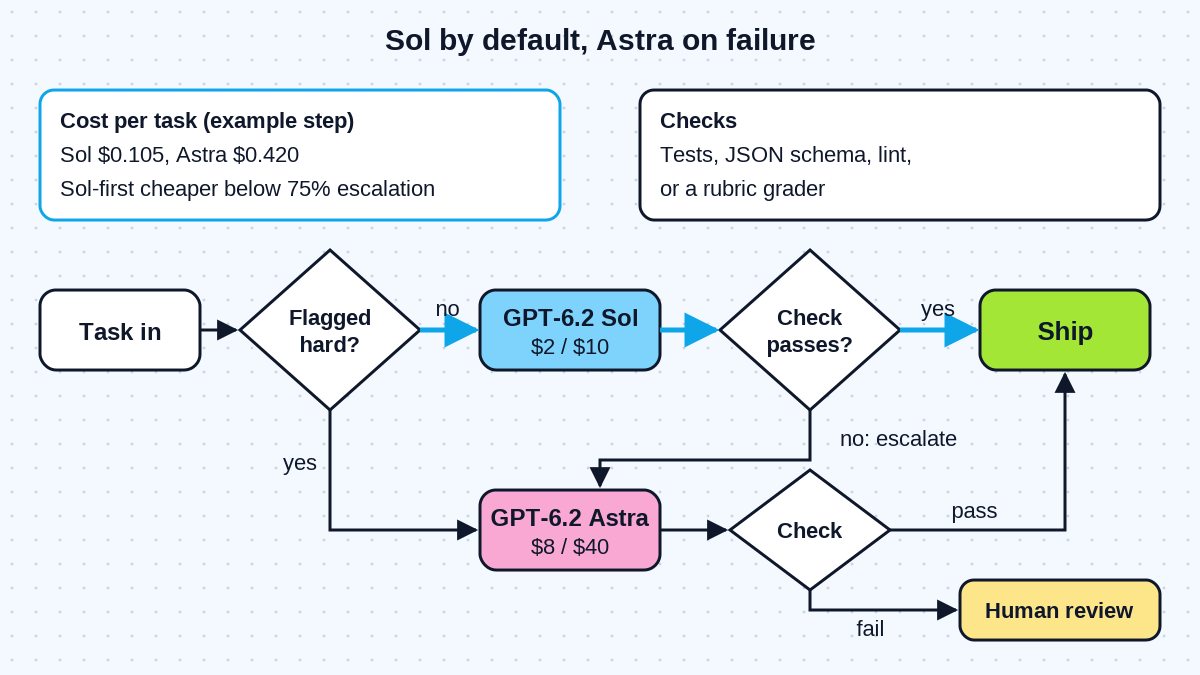
- Define the check before the routing. Unit tests, a JSON schema, a lint pass or an LLM grader with a rubric. Without a check, you cannot tell when to escalate. My post on giving agents a way to check their work covers how to build one.
- Flag known-hard work. Large refactors, multi-repo changes and tasks that already failed once go straight to Astra.
- Run Sol, then the check. If it passes, ship.
- Escalate on failure. Send the same task, plus the failed attempt and the check output, to Astra.
- Log both paths. Record model, tokens, cost and pass or fail per task, so you can tune the flag rules with data.
The cost math for the pattern is straightforward. If a share p of Sol attempts fail and escalate, the expected cost per task is the Sol cost plus p times the Astra cost, because the failed Sol attempt is still billed. With the example above and a 20% escalation rate, that is $0.105 + 0.2 x $0.420 = $0.189 per task, against $0.420 for Astra alone. Sol-first stays cheaper until p reaches 75%, the point where $0.105 + p x $0.420 equals $0.420. If three in four tasks fail on Sol, you are on the wrong default.
Plan for each model to keep its own warm cache: a prefix cached while calling Sol should not be counted on when the same request goes to Astra, so budget for cache writes on both paths. For a wider view of routing, caching and smaller models, see cutting LLM app costs.
When should you ship Astra by default?
Astra should be the default only when your measured escalation rate is high, when a failed first attempt is expensive to detect, or when there is no automatic check at all. Examples from the kinds of work I build:
- Long-horizon agents that plan, edit many files and run for a long time, where an early wrong decision wastes the whole run.
- High-stakes outputs with human review, where reviewer time costs far more than tokens and fewer review rounds matter.
- Tasks without a cheap check, such as open-ended research or strategy drafts, where you cannot catch a weak Sol answer automatically.
Even then, keep Sol for the cheap steps inside the same system: classification, extraction, summarising tool output and drafting messages. Most agent pipelines have many more of those steps than hard ones. If you are also weighing OpenAI against Anthropic, my comparison of the Claude API and the OpenAI API covers the platform differences that matter in production.
Work with me
I build AI agents and integrations that route between models, measure cost per task and escalate only when checks fail. See AI integration and AI agent development, or look at my work and book a scoping call.
Frequently asked
Is GPT-6.2 Sol good enough for production coding agents?
On OpenAI's own FrontierCode 2.0 numbers, Sol lands within 0.5 points of Astra at max effort, so for well-specified coding tasks with tests it is a sensible default. Run it on a sample of your real tasks with your own checks before you commit, because one vendor benchmark does not cover your codebase.
Does GPT-6.2 Astra cost exactly four times as much as Sol?
At list price, yes: input, cached input and output are all four times Sol's rates as of late November 2026. Cost per task can differ from four times, because the two models may use different numbers of tokens on the same task. OpenAI quotes about a fifth of Astra's cost for Sol on FrontierCode 2.0.
Can I use Batch or background mode with both models?
Yes. OpenAI's pricing page lists Batch at 50% of standard rates for both, and background discounts of 30% or 40% depending on the window for eligible requests. Use them for evaluation runs, back-office processing and anything a user is not waiting on.
What happens to cost above 272,000 input tokens?
Both models switch to long-context pricing for the entire request: input and cache rates double and output is charged at 1.5 times the short-context rate. Trimming context, summarising earlier turns or retrieving only the relevant files keeps you below the threshold.
Sources
Related services
Building something like this?
Naman Gundaniya takes on full-stack and AI projects: fixed quote after a free 30-minute scoping call, replies within 24 hours.
Get in touch