 By Naman Gundaniya
Claude API vs OpenAI API: Which to Ship in Production
Neither API wins outright in production. Claude and OpenAI now match on the basics: schema-constrained outputs, tool calling, batch discounts and prompt caching. The choice comes down to how each model scores on your own test set, cost per task after caching and tokenisation, rate-limit headroom, and which cloud you already buy from. Build so you can switch.
Most comparison pages rank the two on benchmarks or vibes. Neither helps much once a feature is live and you are paying for every token. This comparison sticks to what matters after launch, using the providers' own documentation and pricing pages as of late 2026. Prices and model names change often, so treat every figure here as a snapshot and check the linked pages when you plan.
How do Claude and OpenAI compare on the criteria that matter in production?
On features, they are closer than most people assume; the differences are in the details of pricing, caching and limits. Here is the summary, with detail in the sections below.
| Criterion | Claude API (Anthropic) | OpenAI API |
|---|---|---|
| Structured output | JSON schema via output_config.format, plus strict tool use (docs) | JSON schema with strict: true (docs) |
| Prompt caching | Opt-in with cache_control, automatic or explicit breakpoints; 5-minute default, 1-hour option (docs) | On by default for supported models; 30-minute default lifetime on GPT-5.6 and later (docs) |
| Batch discount | 50% on input and output (pricing) | Batch rates are half of standard (pricing) |
| Rate limits | RPM, input and output tokens per minute; cached reads do not count toward input limits (docs) | RPM, RPD, TPM, TPD and more, by usage tier (docs) |
| Data use | Zero data retention available for eligible commercial organisations (docs) | Not used for training by default; zero data retention needs approval (docs) |
Quality: the only benchmark that counts is yours
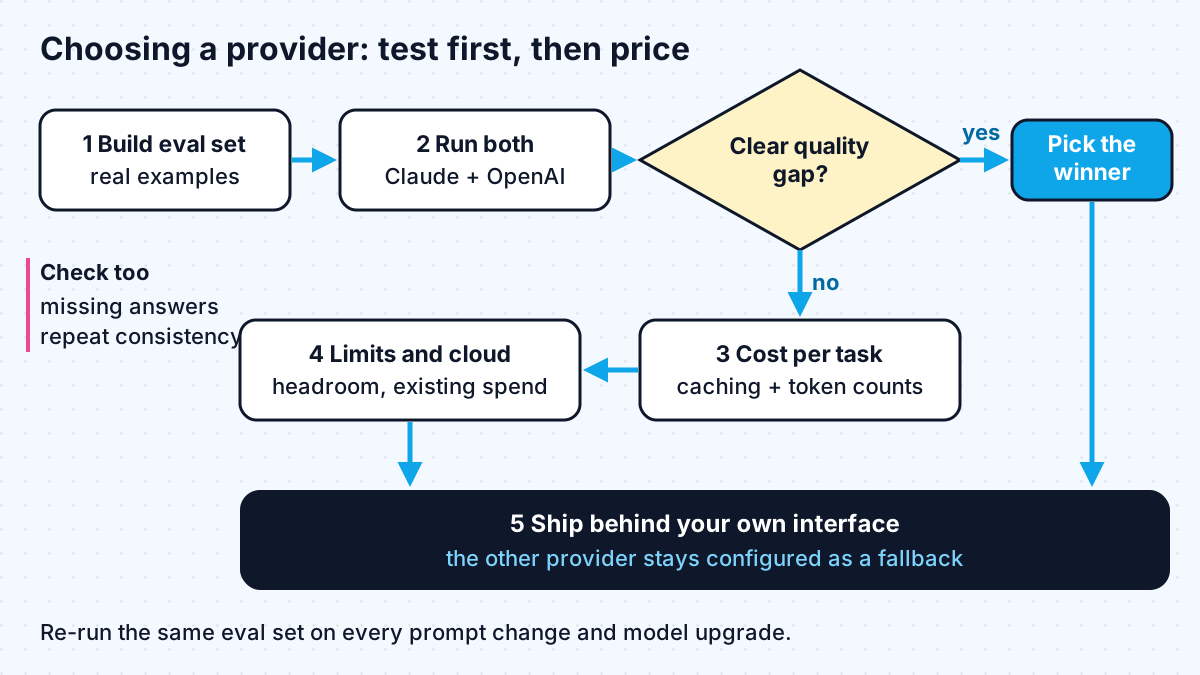
Which model is "better" depends on your task, your prompts and your data, so the deciding test is an evaluation set built from your own examples. Public leaderboards measure general skills; your feature needs one specific skill done reliably.
On client projects I build a few dozen real examples with expected outcomes before choosing a model, then run every candidate model through the same harness. The score usually separates the options more clearly than any general ranking, and the harness keeps paying off afterwards, because every prompt change and model upgrade gets the same test. If you have never built one, my guide to AI agent evaluation walks through it.
Two things to check beyond accuracy: how each model behaves when the answer is not in the context (does it say so, or invent one?), and how consistent it is across repeated runs of the same input.
Tool use and structured outputs
Both APIs can now constrain outputs to a JSON schema, which removes a whole class of production bugs. Anthropic's documentation says structured outputs make responses "always valid" with "guaranteed field types and required fields", and pairs JSON outputs with strict tool use that validates tool names and inputs. OpenAI's guide says Structured Outputs ensure "the model will always generate responses that adhere to your supplied JSON Schema", and distinguishes it from older JSON mode, which only guarantees valid syntax.
Both have edge cases. Anthropic notes outputs may not match the schema when the model refuses or hits the token limit; OpenAI returns refusals in a separate field. Your code should handle both paths either way. Keep validating outputs in your own code too, since a schema guarantees shape, not truth.
If your product uses tools across several AI clients, look at MCP, which both ecosystems support. I explain it in building an AI agent with MCP and Claude.
Pricing: compare cost per task, not price per token
List prices look similar at each tier, but per-token prices are not directly comparable, because the two providers count tokens differently. As of late 2026 the providers' pricing pages list, per million tokens:
| Tier | Claude model (input / output) | OpenAI model (input / output) |
|---|---|---|
| Top | Claude Opus 5.5: $4 / $20 | gpt-6-astra: $10 / $50 |
| Mid | Claude Sonnet 5.5: $2 / $10 | gpt-6.1-sol: $2 / $10 |
| Small | Claude Haiku 5.5: $0.10 / $0.50 (prompts up to 100,000 tokens) | gpt-6-luna: $0.10 / $0.50 |
Sources: Anthropic pricing, OpenAI pricing. Tiers are my grouping by price, not a claim that the models are equivalent.
The catch is tokenisation. Anthropic's pricing page notes that Claude 4.7 and later models use a newer tokenizer that "produces approximately 30% more tokens for the same text". OpenAI also prices long prompts higher: its table defines short context as up to 272K input tokens and charges more above that. So the only fair comparison is to run the same requests through both and divide the bill by completed tasks. Your evaluation harness can log token usage per request, which gives you the number for free.
Prompt caching: different defaults, both worth using
Caching is usually the biggest cost lever for production apps with long, stable system prompts, and the two providers approach it differently.
- OpenAI caches automatically. Its guide says caching "is enabled by default for supported OpenAI models", with a minimum cacheable prompt of 1,024 tokens for GPT-5.6 and later and a default 30-minute lifetime. Cached input is "discounted up to 95%".
- Claude caches when you ask. You add
cache_controlto the request, either once at the top level for automatic placement or on specific blocks. The default lifetime is 5 minutes, with a 1-hour option. Writes cost 1.25 times base input for 5 minutes or 2 times for 1 hour, and reads on Opus 5.5 and Sonnet 5.5 cost 0.05 times base input.
Claude's approach needs one more line of code, and in return you control exactly what is cached. It also has a side benefit described in the next section.
Rate limits and reliability
Rate limits decide whether your launch day goes smoothly, and they work differently on each side.
Anthropic measures requests per minute and input and output tokens per minute, and its rate-limit docs state that "Claude's default ITPM rate limits count only uncached input tokens", so a well-cached app gets far more effective throughput. Its Start, Build and Scale tiers carry monthly spend caps of $500, $1,000 and $200,000, and usage pauses until the next month at the cap unless you request a higher limit.
OpenAI's tiers depend on total credit purchases: Build at $5, Launch at $100 and Grow at $500, with monthly usage limits of $500, $5,000 and $200,000 respectively. It also warns that sudden traffic spikes can trigger errors even under your limits.
For reliability, both return HTTP 429 when you hit limits, and both can have bad days. The practical answer is architectural: put the model call behind your own interface, retry with backoff, and configure the other provider, or the same models on another cloud, as a fallback. Anthropic's models are also sold through Amazon Bedrock, Google Cloud and Microsoft Foundry according to its pricing page, which can matter if your company already has committed cloud spend. I go deeper on that layer in adding AI to an existing app.
So which should you ship?
Ship whichever wins your evaluation at an acceptable cost per task, and design the integration so switching is a configuration change. Often the right answer differs by feature within one product: a larger model for complex reasoning, a small model for classification, sometimes from different providers.
Work with me
I build production AI features on both Claude and OpenAI, with evaluation harnesses, caching and fallbacks set up from day one. See AI integration and AI agent development, or browse my work and book a scoping call.
Frequently asked
Is the Claude API cheaper than the OpenAI API?
It depends on the model tier and your workload. As of late 2026 the mid-tier list prices are the same per token, but Claude's newer tokenizer produces more tokens for the same text, and caching and batch discounts change the totals. Measure cost per completed task on your own requests.
Which API is better for tool use and agents?
Both support tool calling with strict schema validation and both work with MCP. Choose on how reliably each model completes your agent's actual tasks in an evaluation, not on feature lists, which are now very similar.
Can I use both the Claude and OpenAI APIs in one app?
Yes, and it is a sensible default. Put model calls behind one internal interface, store prompts per provider, and use your evaluation set to decide which model handles which feature. It also gives you a fallback during outages.
Do Claude and OpenAI train on my API data?
OpenAI's documentation says data sent to its API is not used to train its models unless you opt in. Anthropic documents its retention policies and offers zero data retention for eligible commercial organisations. Read both providers' current terms before sending personal or regulated data.
Sources
Related services
Building something like this?
Naman Gundaniya takes on full-stack and AI projects fixed quote after a free 30-minute scoping call, replies within 24 hours.
Get in touch