 By Naman Gundaniya
Claude Fable 5.2 and Mythos 5.2: What Builders Get
Anthropic released Claude Fable 5.2 on 9 November 2026 as claude-fable-5-2, at $8 input and $40 output per million tokens, with an optional fast mode at $16 and $80. Claude Mythos 5.2 is the same underlying model with fewer safeguards, open only to organisations verified through Anthropic's programmes. On Fable, classifiers block some cyber and biology requests, which then get a response from an older model.
That last point is the one most launch recaps skip, and it matters if you put Fable inside a product. This post covers what Fable 5.2 costs and does, as of late November 2026, how Mythos differs, how refusals and fallbacks behave on the API, and where Fable sits against the cheaper Claude tiers.
What did Anthropic release on 9 November 2026?
Anthropic released two names for one model: Claude Fable 5.2, available to everyone, and Claude Mythos 5.2, available to vetted organisations. The launch page says it plainly: "Claude Fable and Claude Mythos are the same underlying model." Fable carries stronger cyber and biology safeguards, which is what lets Anthropic offer it to all users.
The specification, from the Fable 5.2 model page:
- Model ID:
claude-fable-5-2on the Claude API, Claude Platform on AWS, both Google Cloud options and Microsoft Foundry;global.anthropic.claude-fable-5-2on Amazon Bedrock. - Limits: 1M-token context window and 128K maximum output on the synchronous Messages API.
- Thinking: adaptive thinking, always on. You steer depth with the effort parameter, which defaults to
highon the API. The launch page says Claude apps and Claude Code default tomedium. - Knowledge cutoff: June 2026.
- Retention: Fable 5.2 requires 30-day data retention and is not available under zero data retention unless Anthropic expressly authorises it.
- API rules: forced tool use (
tool_choiceofanyortool) returns a 400 error, andtemperature,top_pandtop_kshould be left out.
The launch page also says Fable 5.2 and Mythos 5.2 "generate outputs up to 30% faster" than the 5.1 versions, which matters for agent loops where every step waits on the previous one. The always-on thinking cuts the other way: thinking tokens are billed as output, so effort is your main cost control, not an optional extra.
The retention point is the one that can block a deal. If a client's contract or security review assumes zero data retention, Fable 5.2 may not be usable for that workload without Anthropic's sign-off.
How much does Claude Fable 5.2 cost, and is fast mode worth it?
Claude Fable 5.2 costs $8 per million input tokens and $40 per million output tokens, 20% less than Fable 5.1. These rates come from Anthropic's pricing page:
| Fable 5.2 pricing (per million tokens) | Input | Output |
|---|---|---|
| Standard | $8 | $40 |
| Fast mode | $16 | $80 |
| Batch API (50% off) | $4 | $20 |
| Cache hit | $0.20 | n/a |
| Fable 5.1, for comparison | $10 | $50 |
Fast mode gives "up to 2.5x higher output tokens per second" at double the price, according to the pricing page, and it cannot be combined with the Batch API. I would use it only where a person is waiting on a long answer, such as an interactive coding session, and leave background agents on standard speed. Cache hits on Fable 5.2 cost 2.5% of the input price, so long agent sessions with a stable prefix get much cheaper with prompt caching switched on.
Anthropic's own efficiency claim is worth knowing, with the usual caveat that it is vendor-reported: the launch page says that at High effort, Fable 5.2 roughly matches Opus 5.5 at Max effort on FrontierCode 2.0 "for about half the cost per task". A higher price per token does not always mean a higher price per finished job.
What happens when Fable 5.2 blocks a request?
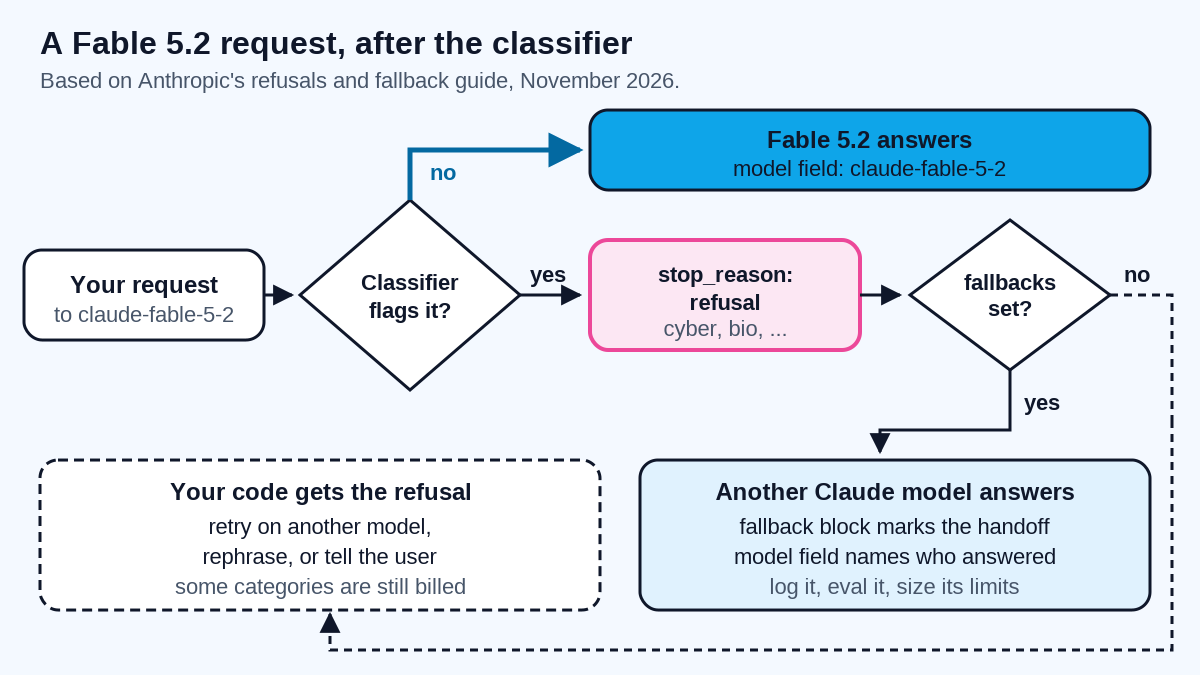
When Fable 5.2's classifiers block a request, the API returns a normal response with stop_reason: "refusal", not an error. The launch page says Fable's classifiers block high-risk cyber activity, such as penetration testing, exploit generation and binary-based vulnerability work, and most research biology tasks. In Anthropic's apps, "when a query is blocked, users will instead receive a response from Opus 4.8 for cybersecurity and Opus 5 for biology." Anthropic reports about 55% fewer blocks than Fable 5.1 in early testing.
On the API, Anthropic's refusals and fallback guide describes three ways to handle it:
- Server-side fallback (beta). Set
fallbacksto"default"and send theserver-side-fallback-2026-07-01header on the Claude API or Anthropic-managed Google Cloud. The API retries on the model Anthropic recommends for that refusal category. The guide says this routing "is not published for each model", so read the response'smodelfield to see who answered. - SDK middleware. Configure a fallback list once on the client and refused requests retry automatically, on any platform.
- Your own retry. Full control, with fallback credit so you do not pay to cache the conversation twice.
What does that fallback mean for a product built on Fable?
Fallback means the same product can answer one user with Fable and the next with an older, weaker model, so you have to design for it. These are the points I would build in before going live, all drawn from the refusals guide:
- Log the serving model on every response. The top-level
modelfield and thefallbackcontent block show when a handoff happened. Without this, a quality complaint is impossible to diagnose. - Evaluate the fallback model too. If your users do security or life-sciences work, a share of their traffic will be answered by another model. Run your evals against that model, not only against Fable.
- Size the fallback model's rate limits. If the fallback model is rate limited, the guide says the retry is skipped and the refusal comes back instead.
- Expect some refusals to be billed. Refusals before any output are billed when the category is
"bio","frontier_llm"or"reasoning_extraction", according to the guide. Cyber refusals before output are not. - Do not ask for reasoning in the output. Prompts that ask the model to write its thinking into a
<thinking>tag or areasoningJSON field can trigger areasoning_extractionrefusal, which has no fallback. Use summarised thinking blocks instead. - Expect sticky routing. After a fallback, later turns of that conversation can go straight to the fallback model for about an hour.
These sit alongside the usual guardrails for production agents; the difference is that this layer is Anthropic's, and you only control how your product reacts to it.
Which Claude tier should you use for which job?
Use Fable 5.2 for the hardest long-running work, and a cheaper tier for everything a cheaper tier passes in your evals. The prices and latency labels below come from the Fable 5.2 model page; the "use it for" column is my own starting point on client work, not Anthropic's guidance.
| Model | Price per million (in / out) | Latency | Use it for |
|---|---|---|---|
| Claude Haiku 5.5 | From $0.10 / $0.50 | Fastest | Classification, routing, high-volume extraction |
| Claude Sonnet 5.5 | $2 / $10 | Fast | Most production agents, chat, everyday coding |
| Claude Opus 5.5 | $4 / $20 | Moderate | Hard reasoning steps, reviews, planning |
| Claude Fable 5.2 | $8 / $40 | Moderate | Hours-long agent runs, deep research, finished documents |
| Claude Mythos 5.2 | $8 / $40 | Moderate | Verified security and life-sciences teams only |
The model page describes Fable 5.2's typical uses as "agent sessions that run for hours, multistep deep research, and analysis carried through to a finished document, spreadsheet, or deck." That matches where I would reach for it: the planner or the long-running worker in an agent, with Sonnet or Haiku handling the many small calls around it. If you are still on an older Sonnet, sort that first; my guide to the Claude Sonnet 4.5 retirement covers the API changes, and two of them, dropping forced tool choice and sampling parameters, apply to Fable as well.
Work with me
I design and build Claude-based agents for teams abroad from India, including model routing, fallback handling and the evals that tell you which tier each step needs. See AI agent development or AI integration to talk through where Fable fits in your product.
Frequently asked
How do I get access to Claude Mythos 5.2?
Apply to the Anthropic verification programme that covers your use case, such as the Cyber Verification Program or the Life Sciences Verification Program, or ask your account team. The launch page also says Claude Enterprise customers can use Claude Security, which runs Mythos 5.2, without Cyber Verification.
Can I turn off thinking on Claude Fable 5.2?
No. The model page says adaptive thinking is always on and cannot be turned off. You control how much it thinks with the effort parameter, from low to max, and thinking tokens are billed as output.
Is Claude Fable 5.2 available on AWS and Google Cloud?
Yes. The model page lists Amazon Bedrock, Claude Platform on AWS, Claude Models on Google Cloud (both Google-managed and Anthropic-managed) and Microsoft Foundry. Server-side fallback is only available on the Claude API and Anthropic-managed Google Cloud, so on other platforms use the SDK middleware or your own retry.
When will Claude Fable 5.2 be retired?
Anthropic's model deprecations page lists Fable 5.2 as active with retirement not sooner than 9 November 2027. Anthropic commits to at least 60 days' notice before retiring a publicly released model.
Sources
Related services
Building something like this?
Naman Gundaniya takes on full-stack and AI projects: fixed quote after a free 30-minute scoping call, replies within 24 hours.
Get in touch