 By Naman Gundaniya
AI Consultant vs Agency vs Freelancer: A Decision Table
Hire an AI consultant when you do not yet know what to build, a freelance engineer when you know exactly what to build and it is small, a forward deployed engineer when you need one person to work out the right thing and ship it inside your systems, and an agency when the work needs a team running several streams at once.
I have already written a fair comparison of freelance AI engineers and agencies. This post adds the two options that comparison left out: the independent AI consultant, who mainly advises, and the forward deployed engineer, who sits between advice and delivery. Buyers often shortlist all four without noticing they sell different things.
What is the difference between an AI consultant, an agency and a freelancer?
The difference is which jobs each one takes on: deciding what to build, building it, supporting it, and being accountable when it breaks. Sagnik Bhattacharya's buyer guide uses exactly those four jobs as the test, because the labels blur in practice. Here is how the four options usually split them.
- AI consultant. Decides what is worth doing. Delivers a diagnosis, a plan and often a business case. May or may not build. AY Automate sums up the classic version: a consultant delivers advice, and the client's team usually builds it.
- Freelance engineer. Builds a defined thing well. You bring the specification and do most of the testing.
- Forward deployed engineer (FDE). Works out the problem with you and builds the solution inside your systems. Palantir, which popularised the title, describes the role as engineers who work directly with customers to understand their greatest problems and design and implement solutions. I cover the role in more depth in what is a forward deployed engineer.
- Agency. Supplies a team with project management, design and continuity. Built for work too big for one person.
The decision table
This is the table I would use if I were the buyer. It compares the four options on the things that decide whether an AI project ends in something working.
| AI consultant | Freelance engineer | Forward deployed engineer | Agency | |
|---|---|---|---|---|
| Main output | Plan, roadmap, business case | Working feature to your spec | Working system plus the scoping behind it | Delivered programme |
| Who decides what to build | Consultant, with you | You | FDE, with you | Agency and you, through a PM |
| Who builds | Usually your team or a third party | Freelancer | FDE | Agency team |
| Speed to first working result | Slow if nobody is lined up to build | Fast once spec is clear | Fast, discovery and build overlap | Slower start, then parallel streams |
| Technical depth | Varies widely | High in a narrow area | High, across the stack | High across roles, varies by person |
| Main risk | Plan stays on paper | Wrong thing built well | Single person dependency | Juniors doing work seniors sold |
| Typical pricing | Day rate or fixed discovery fee | Hourly or fixed project | Day rate, sprint or fixed pilot | Fixed project or monthly team fee |
| Best when | Direction is unclear, stakes are high | Scope is clear and small | Problem is real but the solution is not yet defined | Several systems, deadline needs a team |
When is an AI consultant the right choice?
An AI consultant is right when the direction is genuinely unclear and you already have people who can execute a plan. If you have an internal engineering team with capacity, paying someone experienced to tell them where to point that capacity is good value.
The failure mode is well documented. Bhattacharya describes a business that received a sharp 20-page plan that produced no change in six months because nobody had time to build it. Before you hire a consultant, name who will do the work afterwards. If the honest answer is "nobody yet", you need someone who builds.
For what this costs, see how much an AI consultant costs; day rates and fixed discovery fees are the usual models.
When is a forward deployed engineer the better hire?
A forward deployed engineer is the better hire when you have a real, specific problem but not a finished specification, and nobody internal can take a plan through to production. The FDE does the consultant's discovery and the engineer's build in one engagement, so the person who learned how your business works is the person who writes the code.
That is the model I work in. On client projects I start by sitting with the people who do the work today, mapping where time goes, and building the smallest version that proves value inside the client's real tools. Discovery and delivery overlap, which removes the hand-off where plans usually die.
The trade-offs are real:
- Breadth over parallelism. One FDE covers backend, AI, integration and frontend, but serially. If you need four streams at once, that is an agency or a team.
- Single person dependency. Mitigate it the way you would with any freelancer: your accounts, your repository, written handover notes, and documentation as a deliverable rather than an afterthought.
- Less formal strategy. You get a decision log and a working system rather than a polished board deck. If the board needs the deck, budget for one.
When does an agency win?
An agency wins when the work is too big or too important for one person. Kamyar Shah's comparison puts end-to-end agency implementations at $50,000 to $200,000 over 8 to 16 weeks, and Bhattacharya found every AI consulting firm on the first page of Clutch's directory listing a minimum project of at least $10,000. That is the price of a team, project management and continuity, and for multi-system, customer-facing programmes it is worth paying.
The agency risk to watch is staffing. The senior people who pitch are not always the people who deliver, so name the delivery team in the contract. My freelancer vs agency post goes deeper on cost structure and decision speed.
How do you decide in practice?
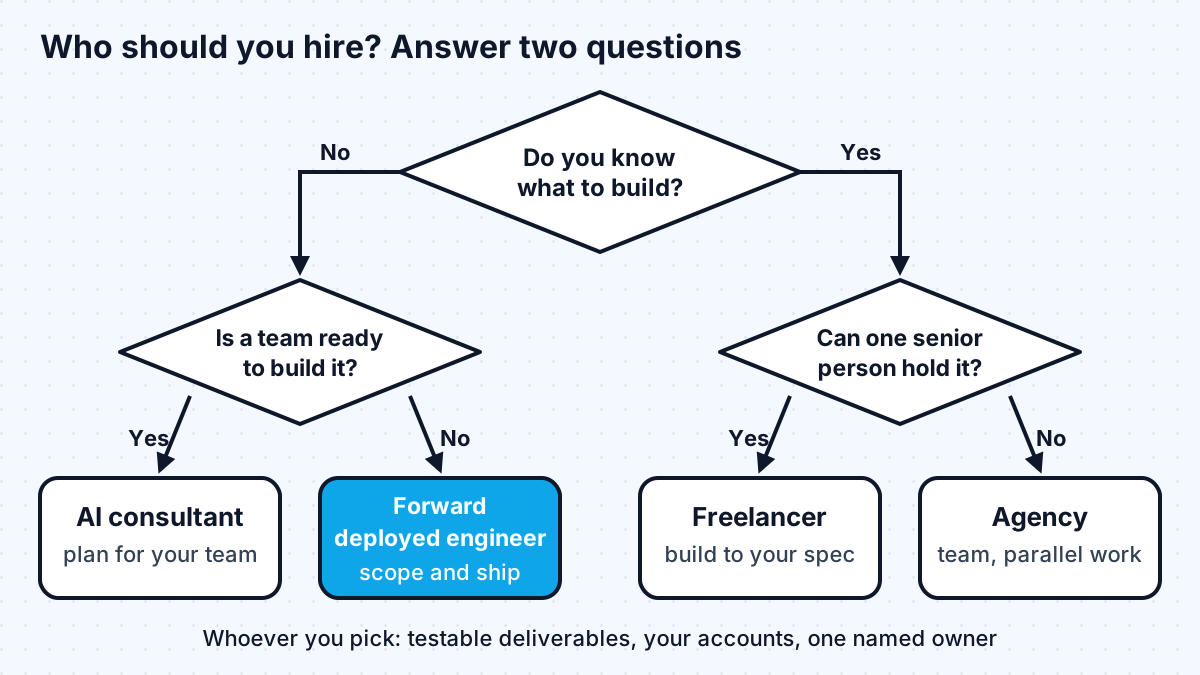
Answer three questions in order, and write the answers down before you speak to any supplier.
- Do we know exactly what to build? If yes, skip the consultant and go to a builder. If no, you are buying discovery, or you can run a first AI automation audit yourself.
- Who will build it? If you have an internal team with capacity, a consultant's plan can work. If not, buy discovery and build together from an FDE, or from a consultant who also builds.
- Can one senior person hold the whole job? If yes, a freelancer or FDE is faster and cheaper. If no, pay for an agency's structure.
Whichever you choose, make three things non-negotiable: deliverables you can test, accounts and code in your name, and a named person accountable when something breaks. If you are also weighing a permanent hire, my comparison of an AI freelancer and an in-house AI team covers that side.
Work with me
I work as a forward deployed engineer: scoping the problem with your team, then building and handing over the AI system myself. See AI integration and AI agent development, browse my work, and book a call to see which option fits your project.
Frequently asked
What is the difference between an AI consultant and an AI agency?
An AI consultant is usually one person or a small firm that diagnoses problems and recommends what to build, while an agency supplies a team that builds and delivers. Some consultants build and some agencies advise, so judge each supplier by who decides, who builds, who supports and who is accountable.
Is a forward deployed engineer the same as an AI consultant?
No. A consultant is judged on the quality of the advice, while a forward deployed engineer is judged on whether the system works in production. An FDE does discovery like a consultant but then writes and ships the code inside the client's systems.
Should a small business hire an AI consultant or a freelancer?
If you know exactly what you want automated and it is small, hire a freelancer. If you are not sure where AI would help, pay for a short discovery first, ideally from someone who can also build the first piece so the plan does not stall.
Is an AI agency worth the extra cost?
It is worth it when the work needs several people in parallel, formal procurement or guaranteed continuity. For a single feature, automation or pilot, the agency's overhead buys coordination you may not need, and a freelancer or forward deployed engineer is usually faster.
What should I put in the contract with any AI supplier?
Write testable deliverables, name the people doing the work, keep code and accounts in your name, and agree how changes are priced before work starts. Hold the final payment until handover documentation is delivered.
Sources
Related services
Building something like this?
Naman Gundaniya takes on full-stack and AI projects fixed quote after a free 30-minute scoping call, replies within 24 hours.
Get in touch