 By Naman Gundaniya
Fractional AI Engineer: Monthly Cost and How It Works
A fractional AI engineer is a senior engineer who works on your AI systems part-time for a monthly retainer, usually 8 to 20 hours a week over 3 to 12 months. One published 2026 guide prices that at $5,000 to $18,000 a month in the US. It fits steady AI work that is too small, or too uncertain, to justify a full-time hire.
"Fractional" is best known as a label for part-time executives, and it is now used for hands-on roles too. For AI work the idea is simple: you buy a fixed slice of a senior person's week instead of a whole salary or a one-off project. The label hides a lot of variation, though, so this post pins down the hours, the published prices and the cases where the model works or does not.
Every number is linked to the page I read it on, as of November 2026. Most public pricing for this role comes from firms that sell it, and I say so where that applies.
What does a fractional AI engineer actually do?
A fractional AI engineer builds and maintains production AI systems inside your team for a fixed number of hours each week. That is the definition in AY Automate's fractional AI engineer guide, published on June 15, 2026, which sets it against contractors paid for an output, agencies paid for fixed deliverables, and full-time hires.
In practice the weekly hours go on a mix of:
- Building. New AI features, agents, retrieval pipelines and the integrations they need.
- Keeping things working. Model version changes, failing evaluations, cost spikes, broken connectors.
- Deciding. Which model, which vendor, build or buy, what to test before launch.
- Raising the team's level. Code review, pairing, and documentation so the work does not live in one person's head.
The role is easy to confuse with two neighbors. A fractional head of AI or CTO is a leadership seat, bought for direction more than code. A forward deployed engineer is embedded with one customer or business unit to get a specific deployment into production, which I cover in fractional FDE vs full-time hire. A fractional AI engineer sits between them: hands on the keyboard, on your own product, for the long run.
How many hours is fractional, and what do they buy?
Fractional usually means 8 to 20 hours a week on a monthly retainer, for engagements of about 3 to 12 months, according to the AY Automate guide. In calendar terms that is one to two and a half working days a week.
What fits in those hours is the part buyers misjudge most. As a rough guide from my own client work, not from a dataset:
| Weekly hours | Roughly | What it realistically supports |
|---|---|---|
| 8 | One day | Maintaining one live AI feature, reviews, a small improvement each sprint |
| 12 | A day and a half | One feature in active development plus upkeep of what is already live |
| 20 | Half the week | Leading a build end to end, or running two workstreams with your developers |
Two things matter more than the hour count. First, when the hours fall: one fixed day suits planned work, while spread-out hours suit teams that need quick answers. Second, response time outside those hours. If an AI feature breaks on a Tuesday and your engineer's day is Thursday, you need an agreed rule for what happens. For teams working across time zones, I describe the overlap pattern in remote FDE from India for US teams.
How much does a fractional AI engineer cost per month?
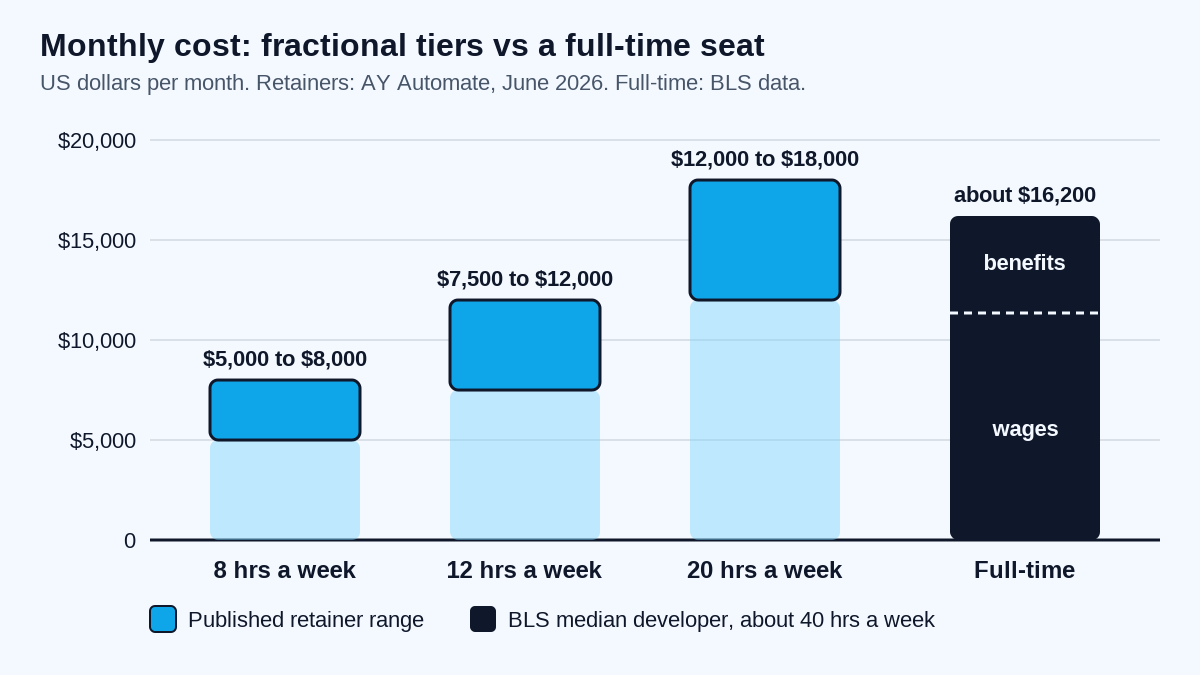
Published US pricing for a fractional AI engineer runs from $5,000 to $18,000 a month, depending on weekly hours. The AY Automate guide breaks that down by tier:
| Commitment | Monthly retainer (AY Automate, June 2026) | Implied hourly rate |
|---|---|---|
| 8 hours a week | $5,000 to $8,000 | about $144 to $231 |
| 12 hours a week | $7,500 to $12,000 | about $144 to $231 |
| 20 hours a week | $12,000 to $18,000 | about $139 to $208 |
The implied hourly rates are my arithmetic, using 4.33 weeks per month. AY Automate sells engineering services, so read its numbers as one seller's view of the market, not a survey.
Two other published price lists sit close by, for roles one step up in seniority:
- A.Team's fractional CTO guide, dated June 3, 2026, lists $4,000 to $10,000 a month for an advisory fractional CTO at 10 to 15 hours a month, and $10,000 to $25,000 a month for an active one at 20 to 40 hours a month.
- KORE1's fractional head of AI guide, last updated July 22, 2026, describes that role as usually 8 to 32 hours a month at $4,000 to $20,000 monthly.
Notice the unit. The leadership roles are quoted in hours per month, the engineering role in hours per week. A fractional head of AI at $8,000 a month and a fractional AI engineer at $8,000 a month are buying very different amounts of time.
For a lower reference point, Arc says freelance AI developers on its network typically charge $60 to $100 or more per hour. A retainer can price above a plain hourly rate because it reserves capacity whether or not you use it.
Is a fractional AI engineer cheaper than a full-time hire?
A fractional AI engineer costs less per month than a full-time engineer but more per hour, so it is cheaper only when you do not need full-time hours. The comparison needs a full-time figure that includes benefits.
Here is one built from official data. The Bureau of Labor Statistics puts the median annual wage for US software developers at $135,980 in May 2025. The BLS Employer Costs for Employee Compensation release for June 2026 shows benefits at 30.0 percent of total compensation costs for private industry workers. Applying that ratio, a median-wage developer costs an employer about $194,000 a year, or roughly $16,200 a month.
That is a floor, for two reasons. The ratio is an all-industry average, and the median covers developers of every specialty and level. For a senior US AI engineer, the AY Automate guide's own estimate is $220,000 to $320,000 in base salary, and $340,000 to $470,000 all-in for the first year once benefits, recruiting fees and ramp-up time are counted. Treat that as a seller's estimate, but the direction is right: hiring has costs that never show up in the salary.
So the honest summary is this. At 12 hours a week, the published retainer range works out to $90,000 to $144,000 a year. That is well below a full-time senior hire, and it buys about 30 percent of the hours. If you have 40 hours of real AI work every week, the full-time hire is the better deal. If you have 10, it is not. My longer comparison is in AI freelancer vs in-house AI team.
Should you choose a retainer or a fixed project?
A retainer suits ongoing, changing work, and a fixed project suits a deliverable you can describe on one page. The two are often used in sequence.
| Fixed-scope project | Fractional retainer | |
|---|---|---|
| You are buying | A defined deliverable | A reserved share of someone's week |
| Best when | Scope is clear and stable | Priorities shift month to month |
| Budget | Known total | Known monthly amount |
| Risk sits with | The engineer, if the estimate is wrong | You, if the hours are not used well |
| Ends when | The thing ships | Either side gives notice |
A pattern that works well: start with a fixed project to ship the first feature, then move to a small retainer to keep it healthy and add to it. You find out whether the working relationship is good before committing to months of it.
Whichever you choose, write these into the agreement:
- Hours per week, when they happen, and whether unused hours roll over.
- Response time for production problems outside those hours.
- A named backlog owner on your side who sets priorities each week.
- Ownership of code, prompts, evaluation sets and accounts. I go through the details in who owns your automations.
- Notice period, and a handover step when the engagement ends.
When is a fractional AI engineer the wrong choice?
A fractional AI engineer is the wrong choice when the work needs someone available all day, or when nobody on your side can direct the hours. Specifically:
- AI is the product. If the model's behavior is your core differentiator, you need that knowledge on the payroll.
- On-call is required. A part-time engineer cannot be your only line of defense for a system that must be fixed within the hour.
- There is no backlog owner. Without someone to set priorities, part-time hours drift into meetings and status updates.
- The work is one clear deliverable. A fixed project is simpler and puts the estimating risk on the engineer.
- You want a team, not a person. Several parallel workstreams call for an agency or in-house hires.
Work with me
I work with US teams remotely from India on fixed-scope AI builds and on ongoing part-time engagements after the first feature ships. See AI integration and AI agent development, read how I work with US teams, or browse my work and book a scoping call to talk through the hours your backlog needs.
Frequently asked
How is a fractional AI engineer different from a freelancer?
A freelancer is usually hired for a task or project and paid for the output or the hours worked. A fractional engineer holds a recurring slot in your week on a monthly retainer and acts as part of the team, joining planning and owning systems over time. The same person can work either way, so the difference is the contract, not the skill.
What is the minimum commitment?
The AY Automate guide describes engagements of about 3 to 12 months at 8 to 20 hours a week. Shorter or lighter arrangements exist, but below roughly a day a week it is hard for anyone to hold enough context to do more than answer questions.
Can a fractional AI engineer work from another country?
Yes, when the work can be done remotely, which most AI engineering can. What you need to settle is the overlap in working hours, how production problems are handled outside them, and any data-handling limits that apply to your industry.
Do fractional retainers include model and hosting costs?
Normally not. The retainer pays for the engineer's time. Model usage, hosting and third-party tools are separate, and I recommend those accounts sit in your company's name so the bills and the access stay with you.
Sources
Related services
Building something like this?
Naman Gundaniya takes on full-stack and AI projects: fixed quote after a free 30-minute scoping call, replies within 24 hours.
Get in touch