 By Naman Gundaniya
What an AI Agent Costs to Run Each Month
An AI agent's monthly running cost is tasks per month, multiplied by model calls per task, multiplied by the tokens each call reads and writes, priced at the model's rate, plus tool fees and hosting. At November 2026 list prices, a support agent handling 3,000 conversations a month costs roughly 15 to 600 US dollars in model fees, depending almost entirely on the model.
Most cost surprises with agents come from one misunderstanding: an agent is billed per model call, not per task, and one task is many calls. This post shows the arithmetic using the public price pages of Anthropic, OpenAI and Google as they stood in mid-November 2026, then works one example through four scenarios. All prices are in US dollars and exclude tax. Prices change often, so check the linked pages before you budget.
What is the formula for an AI agent's running cost?
The running cost of an AI agent is the sum, over every model call, of input tokens times the input price plus output tokens times the output price, with tool fees and infrastructure added on top. For planning, five numbers are enough:
- Tasks per month: conversations, tickets, documents or runs.
- Model calls per task: how many times the agent loop goes round.
- Input tokens per call: system prompt, tool definitions, history and tool results.
- Output tokens per call: the tool request or the final answer.
- Price per million tokens: separate rates for input, cached input and output.
Input usually dominates. An agent re-reads its instructions, its tool definitions and the whole conversation so far on every call, while it writes only a short tool request or reply. Anthropic's pricing documentation spells out that tool use is billed on the total input tokens sent, including the tools parameter, plus the output tokens generated.
What do the models cost per million tokens in late 2026?
Model list prices in late 2026 differ by a factor of forty within a single provider's range: Claude Haiku 5.5 input costs $0.10 per million tokens and Claude Opus 5.5 input costs $4.00. These are standard list prices per million tokens, taken from each provider's own page in mid-November 2026:
| Model | Input | Cached input | Output |
|---|---|---|---|
| Claude Opus 5.5 | $4.00 | $0.20 | $20.00 |
| Claude Sonnet 5.5 | $2.00 | $0.10 | $10.00 |
| Claude Haiku 5.5 (prompts up to 100,000 tokens) | $0.10 | $0.01 | $0.50 |
| OpenAI gpt-6.1-sol | $2.00 | $0.10 | $10.00 |
| OpenAI gpt-6.1-terra | $1.00 | $0.05 | $5.00 |
| OpenAI gpt-6-luna | $0.10 | $0.01 | $0.50 |
| Gemini 4 Hydrogen | $1.50 | $0.075 | $7.50 |
| Gemini 3.5 Flash-Lite | $0.30 | $0.03 | $2.50 |
Sources: Anthropic, OpenAI and Google. Three caveats from those pages matter for budgeting:
- Token counts are not identical across models. Anthropic notes that its newer tokenizer produces approximately 30% more tokens for the same text than the one used by Claude Sonnet 4.6 and earlier.
- Some prices are scheduled to move. Google's page lists Gemini 4 Carbon at $2.00 input and $10.00 output through 30 November 2026, and $4.00 and $20.00 from 1 December 2026.
- Thinking tokens are billed as output. Google's page says so in each table, so a model that reasons at length costs more than its visible answer suggests.
How do agent loops multiply the bill?
Agent loops multiply the bill because every step is a new model call that re-sends everything before it. A chatbot that answers in one call pays for its context once. An agent that takes six steps pays for its system prompt and tool definitions six times, and each step also carries the tool results from the steps before.
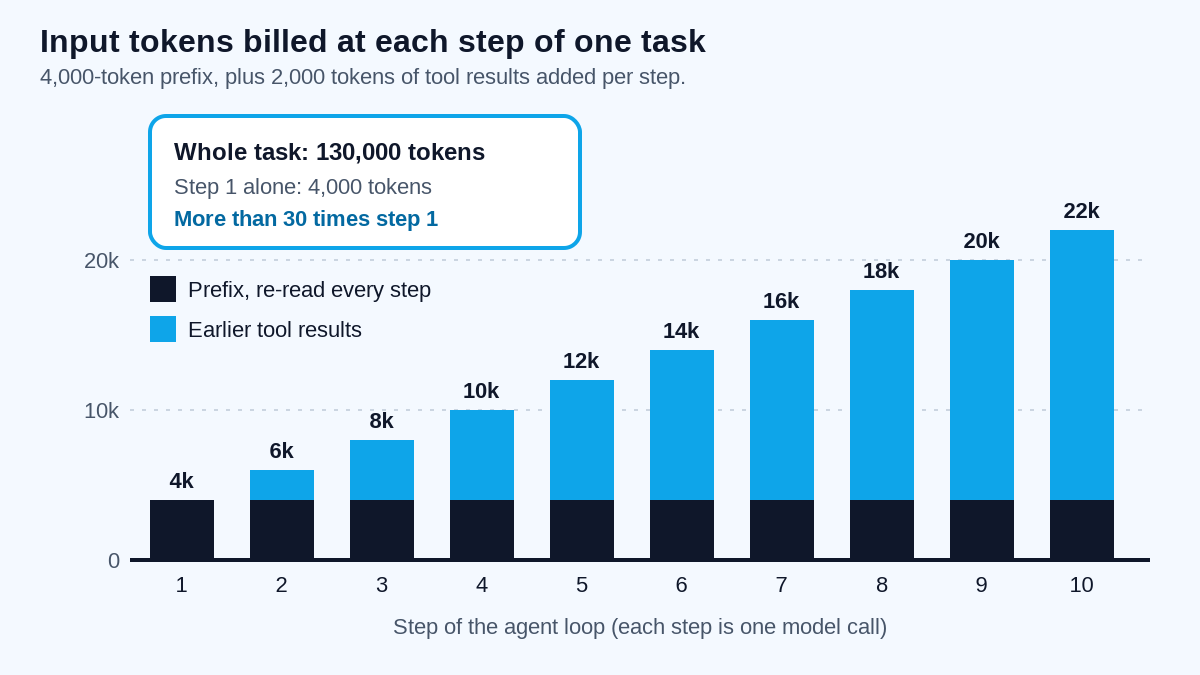
A small illustration with round numbers: take a 4,000-token prefix (instructions plus tools) and suppose each step adds 2,000 tokens of tool results. Step one reads 4,000 tokens, step two 6,000, step ten 22,000. The ten steps together read 130,000 input tokens. Cost grows faster than the number of steps, which is why a step limit is a budget control as much as a safety control.
What does a worked monthly example look like?
A worked example makes the spread visible. Take a customer support agent with these assumptions, which are illustrative and not measurements from a client system:
- 3,000 conversations a month.
- 6 model calls per conversation.
- 7,000 input tokens per call on average: a 4,000-token prefix of instructions and tool definitions, plus 3,000 tokens of history and tool results.
- 300 output tokens per call.
That is 126 million input tokens and 5.4 million output tokens a month. At the list prices above:
| Scenario | Input cost | Output cost | Monthly model cost |
|---|---|---|---|
| Claude Opus 5.5 | $504.00 | $108.00 | $612.00 |
| Claude Sonnet 5.5 | $252.00 | $54.00 | $306.00 |
| Claude Sonnet 5.5 with the prefix cached | $144.00 | $54.00 | $198.00 |
| Claude Haiku 5.5 | $12.60 | $2.70 | $15.30 |
| 80% Haiku 5.5, 20% Sonnet 5.5 | $60.48 | $12.96 | $73.44 |
The cached row assumes the first call of each conversation writes the 4,000-token prefix to the cache at Anthropic's 1.25 times write rate ($30 a month) and the other five calls read it at the cache-hit rate ($6 a month), with the remaining 54 million tokens at the normal input price ($108).
For comparison, the same 3,000 conversations answered in a single call each would cost about $51 on Claude Sonnet 5.5. The agent version costs six times more because it makes six calls.
What do tools and infrastructure add?
Tools and infrastructure add per-use fees and fixed monthly costs on top of tokens. The provider-hosted tools have published prices as of late 2026:
- Web search: Anthropic charges $10 per 1,000 searches plus the tokens of the results. OpenAI lists the same $10 per 1,000 calls. Google includes 5,000 grounded search requests a month across Gemini 3 and newer models, then charges $14 per 1,000.
- Code execution: Anthropic gives each organisation 1,550 free hours a month, then bills $0.05 per hour per container, and waives the charge when code execution is used with its current web search or web fetch tools. OpenAI prices a 1 GB container at $0.03 per 20-minute session.
- File search: OpenAI charges $2.50 per 1,000 tool calls and $0.10 per GB of storage per day after the first free GB.
If one conversation in three in the example ran a web search, that would be 1,000 searches and about $10 a month, plus the tokens for the search results, which are billed as input.
The other lines depend on your stack, so I will not put numbers on them here: application hosting, a database and possibly a vector store, logging and tracing, and channel fees for telephony, SMS or WhatsApp. For most text agents I have built, these are steady and predictable. Tokens are the part that moves with usage. The one cost people forget is human time: someone has to review flagged conversations, update prompts and re-run evaluations when a model version changes.
Which levers cut the monthly cost?
Five levers cut the monthly cost, and they stack. In rough order of effort against return:
- Cache the stable prefix. Anthropic prices cache reads at 0.1 times the input rate on most models, and 0.05 times on Claude Opus 5.5 and Sonnet 5.5. In the example that took $108 off a $306 bill. See prompt caching explained.
- Route by difficulty. Send routine requests to a small model and escalate the hard ones. The 80/20 split above cut the bill by about three quarters. My post on cutting LLM costs covers routing in detail.
- Trim what each call reads. Fewer tools, shorter tool results, summarised history. Every token removed is removed from every later step.
- Cap the loop. A turn limit and a per-user budget stop the rare runaway task that costs more than a hundred normal ones. See capping LLM costs per user.
- Batch what is not urgent. Anthropic's Batch API gives a 50 percent discount on input and output tokens, and OpenAI's batch table lists half the standard rate for its current models.
Measure before you optimise. Log input, cached and output tokens per call from the usage data every provider returns, and work out cost per completed task. That one number tells you whether the agent pays for itself. If you are still deciding whether to build one, my post on what an AI agent costs a small business covers the build side.
Work with me
I build agents with cost per task measured from the first prototype, and I audit existing agents whose bills have grown faster than their usage. See AI agent development and AI integration, or browse my work and book a scoping call for an estimate based on your own volumes.
Frequently asked
How much does it cost to run an AI agent 24/7?
An agent is not billed for being available, only for the model calls it makes. Cost follows the number of tasks and the steps per task, not the hours it is switched on. The fixed part is hosting, which runs all day whether or not anyone uses the agent.
Why is my agent more expensive than the token price suggests?
Usually because of the loop. Each step re-sends the instructions, tool definitions and all earlier tool results, so one task can read hundreds of thousands of input tokens. Long tool outputs and reasoning tokens, which are billed as output, add to it.
Is a cheaper model always the right choice?
No. A small model that fails a task and needs a retry or a human can cost more than a larger model that succeeds first time. Measure cost per successfully completed task on your own evaluation set, then route the easy cases to the cheaper model.
Do subscriptions like ChatGPT or Claude plans cover agents I build?
No. Consumer and team subscriptions cover the provider's own apps. Agents you build call the API, which is billed separately per token and per tool use at the rates on the provider's API pricing page.
Sources
Related services
Building something like this?
Naman Gundaniya takes on full-stack and AI projects: fixed quote after a free 30-minute scoping call, replies within 24 hours.
Get in touch