 By Naman Gundaniya
Hiring a Remote AI Engineer for a Singapore Team
A remote AI engineer can work well for a Singapore team if you settle four things first: a daily overlap window (India is 2.5 hours behind Singapore, with no daylight saving on either side), PDPA-compliant handling when personal data reaches the engineer or a model provider, a contract that assigns all AI assets to you, and vetting on production evidence rather than demos.
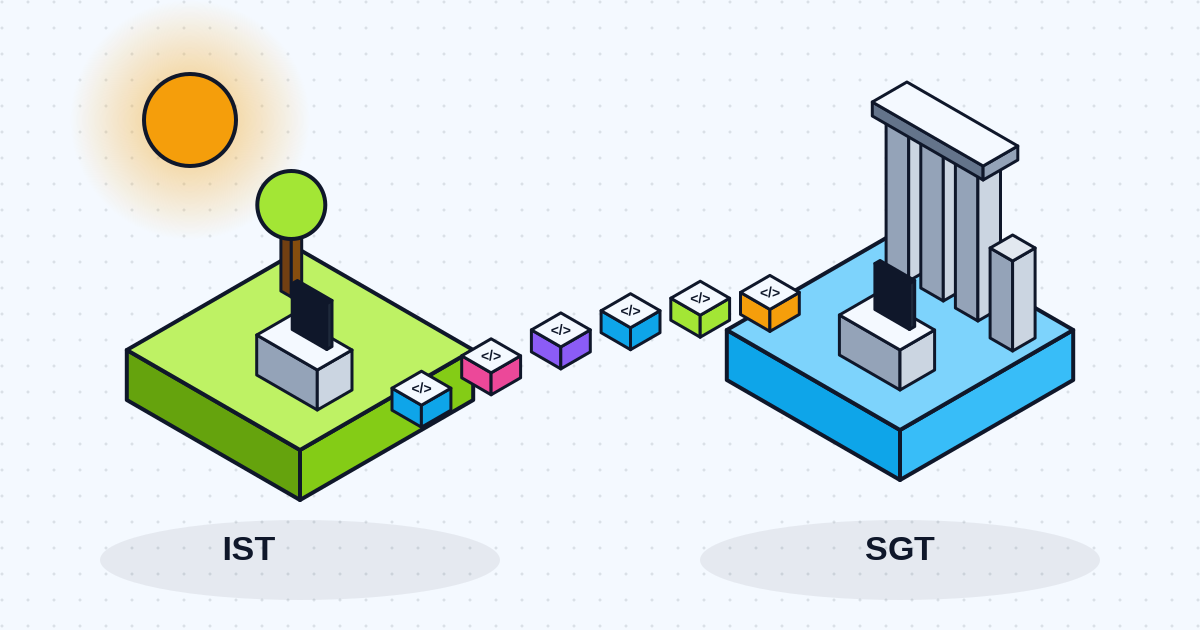
Singapore teams that look beyond the local market for AI engineering usually do it for availability or budget. I work remotely from India for clients in several countries, and the Singapore case is one of the easiest on time zones and one of the more specific on data rules. This guide covers what I would want a client to sort out before engaging me or anyone else. It is general information, not legal advice.
How much working-day overlap do you actually get?
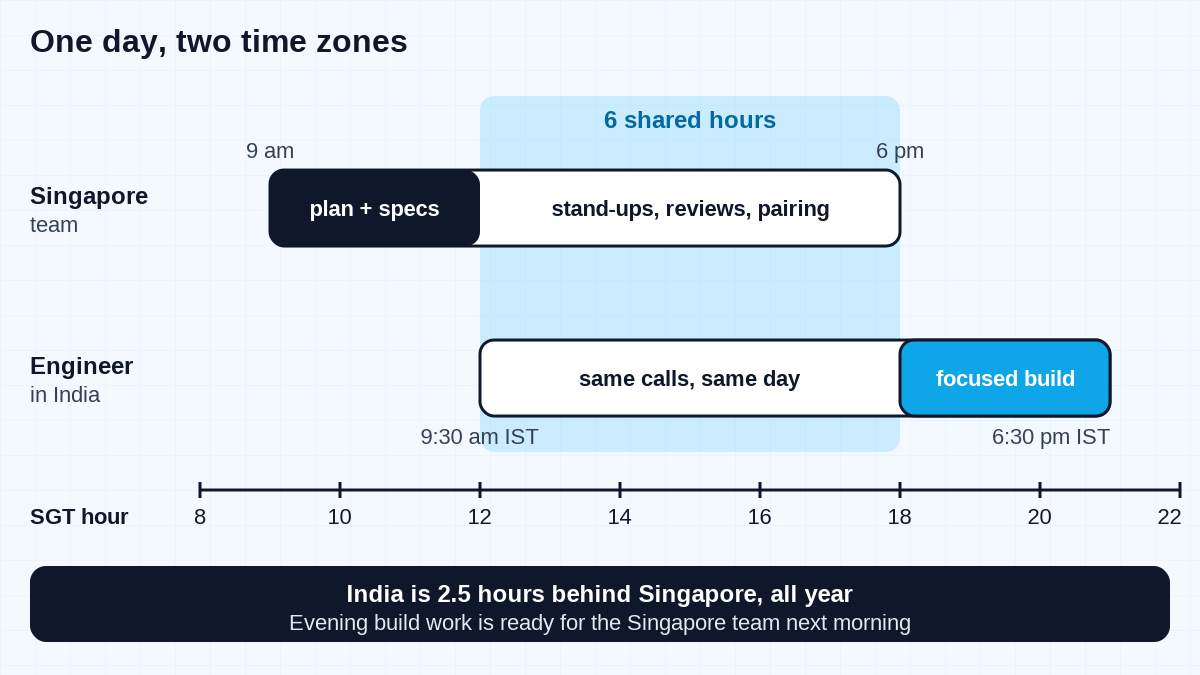
Most of a normal day. Singapore Standard Time is UTC+08:00 with no daylight saving, and India Standard Time is UTC+05:30 with no daylight saving, so the gap is a steady two and a half hours all year. There are no clock changes to plan around, unlike US or European teams.
| Engineer's hours (IST) | Same time in Singapore (SGT) | Overlap with a 9 am to 6 pm SGT day |
|---|---|---|
| 9:30 am to 6:30 pm | 12:00 pm to 9:00 pm | 6 hours (12 pm to 6 pm) |
| 8:00 am to 5:00 pm | 10:30 am to 7:30 pm | 7.5 hours (10:30 am to 6 pm) |
| 6:30 am to 3:30 pm | 9:00 am to 6:00 pm | Full day |
In practice I agree a core window with each client, usually their late morning and afternoon, and keep stand-ups, reviews and pairing inside it. Deep work fits in the hours either side. Compare that with US teams, where the overlap is two to three hours on a good day; for Singapore, real-time collaboration is the default rather than the exception.
What does PDPA mean when data reaches a remote engineer or an LLM?
If personal data leaves Singapore, the PDPA's Transfer Limitation Obligation applies, and AI projects move data in two directions: to the engineer, and to the model provider. The PDPC's advisory guidelines on key concepts.pdf) (2017 revision) explain that section 26 bars transferring personal data outside Singapore except under prescribed requirements that ensure "a standard of protection to personal data so transferred that is comparable to the protection under the PDPA". The recipient must be bound by legally enforceable obligations, such as a contract that requires comparable protection and specifies the countries the data may go to. Check the PDPC site for the current version of these guidelines.
For an AI engagement, that leads to a simple design rule: the engineer should not need production personal data to do the job. In practice:
- Build on synthetic or masked data. Most development, prompt work and evaluation can run on realistic fake records.
- Keep production data in your cloud. The engineer deploys into your accounts; personal data stays in your region and under your access controls.
- Grant access only when necessary, time-limited and logged, for tasks like debugging a production issue, and cover it in the contract.
- Check the model provider separately. Where is data processed, what is retained, and what do your terms say? That is a transfer question too, independent of where the engineer sits.
There is also a role question. The PDPC's 2024 guidelines on personal data in AI recommendation and decision systems note, as Rajah & Tann summarise, that third-party developers of bespoke AI systems "may occupy the role of data intermediaries". Ask your adviser how your engineer and your model provider should be classed and what that means for the contract.
What should the contract cover for AI work?
The usual contractor terms, plus the assets that make an AI system work. I recommend clients cover these explicitly:
- IP assignment for code and for prompts, evaluation datasets, agent configurations, tool definitions and infrastructure-as-code.
- Data protection clauses that meet the transfer requirements above: what data, where it may go, how it is protected, and deletion at the end.
- Accounts owned by you. Repositories, cloud accounts, model provider keys and monitoring tools live in your organisation from day one; who owns your automations when the freelancer leaves explains why.
- Handover terms: documentation, a walkthrough and a defined support period.
- Confidentiality and security: device security, no client data on personal accounts, and how incidents are reported.
Whether the engineer is a contractor or something else, and what tax or employment rules apply in each country, are questions for your accountant or lawyer. I am not the right person to answer them for you.
How do you vet a remote AI engineer?
The same way you would vet a local one: on what they have shipped and how they reason about failure. Demos are easy; production AI is about evaluation, data access, cost and safety. Ask for:
- a walk through a system they built, including what went wrong and what they changed,
- how they test model output before and after launch,
- how they would control running cost per user,
- how they keep personal data out of prompts, logs and eval sets,
- what the handover pack looks like.
I list fifteen questions, with good answers and red flags, in questions to ask before you hire an AI developer. A short paid trial on a real but bounded task tells you more than any interview.
What about cost and grants?
Rates vary widely by experience, scope and engagement model, so compare like with like: a fixed-scope build, a monthly retainer and a fractional arrangement are different products. I break down market ranges, with sources, in how much it costs to hire an AI developer, and it is worth deciding early whether you need one engineer or a team.
If you plan to use Enterprise Singapore's EDGE grant, check the vendor rules for your activity before choosing anyone. The EDGE FAQ says some activities require a pre-approved vendor, and that consultants can be sourced from anywhere if they meet the activity's qualifications. A grant should follow the project choice, not drive it.
Work with me
I build AI agents and full-stack AI products remotely from India, inside your cloud accounts, with Singapore-friendly hours. See AI agent development and full-stack development, browse my work, and book a scoping call to discuss scope and cost.
Frequently asked
Can a remote engineer in India work Singapore hours?
Largely, yes. India is a constant 2.5 hours behind Singapore, with no daylight saving in either country, so a normal Indian working day overlaps about six hours with a Singapore one. Shifting the engineer's day earlier gives a near-full overlap.
Does PDPA allow sending customer data to an overseas developer?
It allows overseas transfers when the recipient is bound by legally enforceable obligations to give the data protection comparable to the PDPA, for example through a contract. The safer design is to avoid the transfer: develop on synthetic data and keep production data in your own cloud.
Does PDPA consent apply when I feed customer data to an LLM?
The PDPA's consent, purpose and transfer rules apply to personal data whatever tool processes it, and sending it to a model provider outside Singapore is a transfer. Minimise what goes into prompts, check where the provider processes and retains data, and ask your data protection adviser whether your notices and consents cover the use.
Is a remote AI engineer cheaper than a local hire?
Often, but cost depends on scope and engagement model more than location. Compare total cost for the same deliverable, including your management time and handover, rather than headline rates.
Sources
Related services
Building something like this?
Naman Gundaniya takes on full-stack and AI projects: fixed quote after a free 30-minute scoping call, replies within 24 hours.
Get in touch