 By Naman Gundaniya
Is PIPEDA Enough for an AI Chatbot? A Builder's Checklist
PIPEDA is the baseline for an AI chatbot that stores customer data in Canada, and following it takes more than a privacy policy. As of late 2026, a builder has to turn its ten fair information principles into consent wording, data limits, safeguards, vendor contracts and breach records. Quebec, Alberta and British Columbia apply their own private-sector laws inside their borders.
When a Canadian client asks me whether their chatbot is "PIPEDA compliant", the useful answer is a list of things the product does, not a yes or no. This post is that list, with each item tied to a page from the Office of the Privacy Commissioner of Canada (OPC). It is general information, not legal advice; your counsel decides what your situation requires.
For the wider picture of AI rules in Canada, including the privacy bill before Parliament, see my post on AI in Canada after AIDA. I will not repeat it here.
Does PIPEDA apply to an AI chatbot?
PIPEDA applies to a chatbot whenever a private-sector organization uses it to collect, use or disclose personal information in the course of commercial activity. The OPC's PIPEDA in brief defines personal information as "any factual or subjective information, recorded or not, about an identifiable individual". A chat transcript with a name, an order number, an email address or a description of someone's problem fits that definition easily.
Three provinces change the picture. The OPC lists Alberta, British Columbia and Quebec as having private-sector laws deemed substantially similar to PIPEDA, and says organizations subject to such a law "are generally exempt from PIPEDA" for personal information handled within that province. PIPEDA still covers information that crosses provincial or national borders and federally regulated businesses such as banks and telecommunications companies. The same page warns that "determining which law applies must be done on a case-by-case basis". A chatbot on a national website will usually touch more than one regime.
What do PIPEDA's ten principles require from a chatbot?
PIPEDA's ten fair information principles each map to something concrete in a chatbot build. The left column is the OPC's list; the right column is how I translate it into engineering work.
| Principle | What it means for a chatbot |
|---|---|
| 1. Accountability | A named person owns privacy for the bot; vendor contracts cover the model provider and hosting |
| 2. Identifying purposes | The bot states why it collects information before or when it asks |
| 3. Consent | Knowledge and consent for collection, use and disclosure, matched to how sensitive the data is |
| 4. Limiting collection | The bot asks only for what the task needs; the prompt carries only the needed fields |
| 5. Limiting use, disclosure and retention | Transcripts are not reused for other purposes; a retention schedule deletes them |
| 6. Accuracy | Answers about a customer come from the system of record, not from the model's memory |
| 7. Safeguards | Security relative to the sensitivity of the information: access control, encryption, redacted logs |
| 8. Openness | The privacy notice describes the bot, the provider and where data is processed |
| 9. Individual access | A person can ask what the bot holds about them and get it corrected |
| 10. Challenging compliance | A working contact route for privacy complaints |
What do the regulators' generative AI principles add?
Canada's federal, provincial and territorial privacy regulators published principles for responsible, trustworthy and privacy-protective generative AI on 7 December 2023, and they spell out how the regulators read existing privacy law for systems like chatbots. They are guidance, not a new statute, but they are the clearest statement of what an investigator would look for.
The points I treat as build requirements:
- Say it is AI. Organizations should "ensure that individuals interacting with the tool are aware that they are interacting with a generative AI tool".
- Do not keep or reuse prompts by default. "Unless otherwise required, prompts should not be retained, used for secondary purposes, or disclosed."
- Keep consent specific. "Consent should be as specific as possible, and deceptive design patterns should be avoided."
- Public does not mean free to use. The regulators ask all parties to recognize "that the public accessibility of data does not mean that it can be indiscriminately collected or used".
- Accountability stays with you. For decisions, "accountability for decisions rests with the organization, and not with any kind of automated system".
- Plan for AI-specific attacks. The safeguards principle names prompt injection, model inversion and jailbreaking as threats to design against.
The document also singles out children as being at particularly high risk of significant negative impact from AI technologies. If minors can reach your bot, that changes the consent and content design.
What consent does a chatbot need under PIPEDA?
A chatbot needs meaningful consent, which under the OPC's guidelines for obtaining meaningful consent means putting four elements in front of the person: what personal information is being collected, with which parties it is being shared, for what purposes, and the risk of harm and other consequences. A link to a long policy does not do that on its own.
The guidelines say that "while consent should generally be express, it can be implied in strictly defined circumstances". Express consent is generally expected when the information is sensitive, when the use falls outside what the person would reasonably expect, or when there is a meaningful residual risk of significant harm. The OPC also takes the position that, in all but exceptional circumstances, anyone under 13 cannot give meaningful consent, so a parent or guardian must.
In a chat interface I build this as:
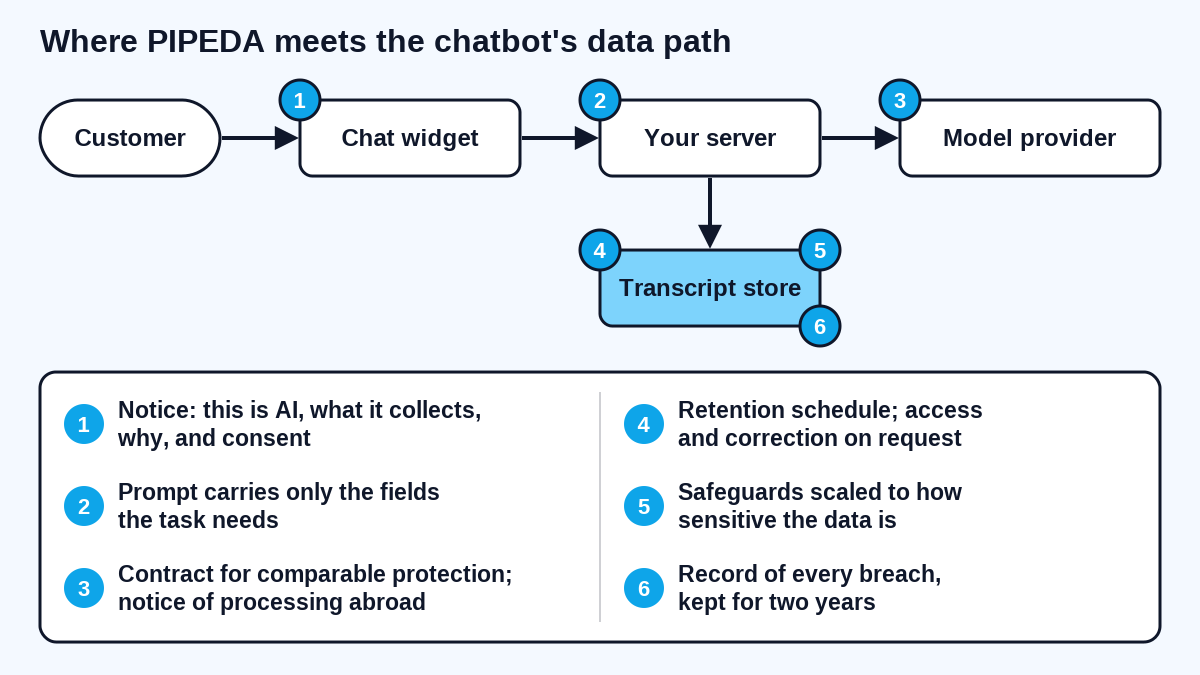
- A short notice before the first message: this is an AI assistant, what it collects, why, and who processes it.
- A separate, unticked choice for anything beyond answering the question, such as using transcripts to improve the product.
- A just-in-time prompt before the bot asks for anything sensitive, with a way to continue through a human channel instead.
- A record of which notice version each conversation saw.
Can the model provider process the data outside Canada?
PIPEDA does not stop a Canadian organization from sending chat data to a model provider in another country, but the organization stays responsible for it. The OPC's guidelines for processing personal data across borders, dated January 2009, state that "PIPEDA does not prohibit organizations in Canada from transferring personal information" and that "a transfer for processing is a 'use' of the information; it is not a disclosure". If the information is used for the purpose it was collected for, additional consent for the transfer is not required.
Two duties come with that freedom. The transferring organization remains accountable and must use "contractual or other means to provide a comparable level of protection". It must also make plain to individuals that their information may be processed in a foreign country and may be accessible to law enforcement and national security authorities there.
For a chatbot, that means reading the provider's data processing terms before choosing a model, checking the retention and training settings, picking a processing region deliberately, and naming the countries in the privacy notice. If the bot serves people in Quebec, the province adds a privacy impact assessment before information leaves Quebec; I cover that in a separate post on Quebec's Law 25. My guide to securing LLM apps in the cloud covers the access and secrets side.
What safeguards and breach records does PIPEDA expect?
PIPEDA expects security in proportion to the sensitivity of the information, and a written record of every breach. The safeguards principle asks for protection "by appropriate security relative to the sensitivity of the information", so a bot that books appointments at a clinic needs more than a bot that answers shipping questions.
On breaches, the OPC's guidance on breach reporting says an organization must report to the OPC and notify affected individuals when it is reasonable to believe a breach of security safeguards "creates a real risk of significant harm", with notification to individuals "as soon as feasible". It must also keep a record of every breach of security safeguards involving personal information under its control, whether or not the breach meets that threshold, for two years. Where a processor such as a hosting or model provider has the breach, the guidance treats the principal organization as generally responsible for reporting and expects contracts that make the processor tell you.
In practice: keep personal information out of application logs, restrict who can read transcripts, test the bot against prompt injection, and put a breach log and an escalation contact in place before launch, not after the first incident.
The builder's checklist
Before a PIPEDA-governed chatbot goes live, I want to be able to tick every line:
- A named person is accountable for the bot's handling of personal information.
- The first screen says the user is talking to AI, what is collected and why.
- Consent matches sensitivity, with a separate opt-in for secondary uses.
- Prompts carry only the fields the task needs.
- Prompts and transcripts are not reused for other purposes, and a retention schedule deletes them.
- The model provider contract gives comparable protection, and the notice names foreign processing.
- A person can request, see and correct what the bot holds about them.
- Safeguards fit the sensitivity of the data, including defences against prompt injection.
- A breach log exists and someone knows the reporting test.
- Provincial law has been checked for Quebec, Alberta and British Columbia users.
The general build steps, apart from privacy, are in my guide to building an AI chatbot for a website.
Work with me
I build chatbots for Canadian teams with the notices, data limits, logging and review paths described here, working remotely from India. See AI chatbot development and AI integration, read how I work with Canadian clients, or browse my work and book a scoping call. Your legal advisers decide what the law requires; I build it into the product.
Frequently asked
Is PIPEDA enough for an AI chatbot that stores customer data?
PIPEDA is the federal baseline, and meeting it covers most private-sector chatbots outside Quebec, Alberta and British Columbia. Inside those provinces the provincial private-sector law generally applies to information handled within the province, and Quebec's is stricter in several places. Health information and federally regulated sectors have further rules.
Do I have to tell users they are talking to an AI?
The regulators' December 2023 generative AI principles say organizations should ensure people interacting with a generative AI tool are aware of it. The principles are guidance on how existing law applies, so I treat a clear AI label at the start of the conversation as a requirement in every build.
Can I use chat transcripts to train or fine-tune a model?
Only with a purpose the user was told about and consented to. The regulators' principles say prompts should not be retained or used for secondary purposes unless otherwise required, and they name further training on prompts as a use that must be disclosed. Build it as a separate opt-in, and check your provider's own training settings.
Does chat data have to stay in Canada?
PIPEDA does not require Canadian storage. The OPC's cross-border guidelines allow transfers for processing if the organization stays accountable, uses contractual or other means for comparable protection, and tells people their information may be processed abroad. Some public-sector and sector-specific rules are stricter, so check the contracts you sell under.
Sources
Related services
Building something like this?
Naman Gundaniya takes on full-stack and AI projects: fixed quote after a free 30-minute scoping call, replies within 24 hours.
Get in touch