 By Naman Gundaniya
Colorado's AI Law (SB 26-189): What to Build and Log
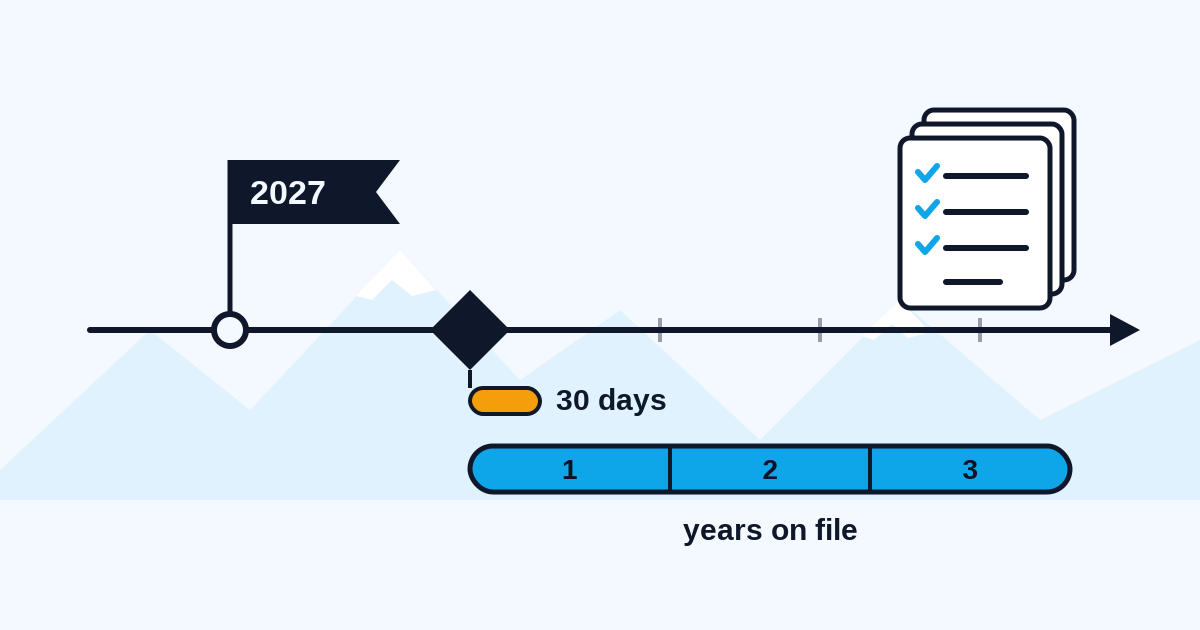
Colorado's SB 26-189 applies to consequential decisions made on or after January 1, 2027. If your software scores, ranks or recommends in a way that materially influences decisions about jobs, housing, credit, insurance, health care, education or public benefits, you need a pre-use notice, an adverse-outcome disclosure within 30 days, a correction and human-review path, and records kept for at least three years.
I wrote about this law alongside Texas and California in US state AI laws for startups. This post goes one level down, to the question an engineering team actually has: what do we build, and what do we store, so that we can show we complied?
I worked from the text of the act itself, the session law published by the Colorado General Assembly, and I cite its section numbers so your counsel can check each point. This is general information as of November 2026, not legal advice.
Does SB 26-189 apply to your product?
SB 26-189 applies when automated decision-making technology is used to materially influence a consequential decision about a consumer, which the act calls a "covered ADMT." Three definitions in section 6-1-1701 do the work.
ADMT is technology that processes personal data and uses computation to generate output, including predictions, recommendations, classifications, rankings or scores, used to make, guide or assist a decision about an individual.
Consequential decision means a decision about a consumer's access to, eligibility for, selection for or compensation for a covered domain: education, employment, residential real estate in Colorado, financial or lending services, insurance, health-care services, and essential government services and public benefits.
Materially influence means the output is a non-de minimis factor used in making the decision and affects the outcome, including by constraining, ranking, scoring, recommending or classifying. Incidental, trivial or clerical uses are excluded.
The exclusions matter as much as the definitions. The act says ADMT does not include:
- A tool used by an individual solely to summarize, organize, translate, draft, route or present information for human review of administrative processing.
- A natural-language assistant that gives consumers information or answers questions, if it is not contracted, marketed, configured or intended for use in a consequential decision and is subject to an acceptable use policy prohibiting that use.
And a consequential decision does not include routine scheduling, administrative routing, customer service triage, advertising, search, content moderation, or cybersecurity and fraud prevention activities.
So a resume summarizer that a recruiter reads is probably outside the law, and a tool that ranks candidates and decides who advances is probably inside it. Constangy's analysis, published July 30, 2026, draws the same line for employers. The practical test I use: does the system output a score, rank, recommendation or classification about a person, and does a human or a rule act on it?
Two roles carry duties. A developer is a person doing business in Colorado that develops, sells, licenses or otherwise makes a covered ADMT commercially available, builds a component designed or contracted to be part of one, or intentionally and substantially modifies an ADMT so that it becomes one. A deployer is a person doing business in Colorado that deploys a covered ADMT. A company that builds its own tool only for internal use, without making it available to anyone else, is not a developer under the act, but it is still a deployer if it uses that tool to materially influence consequential decisions.
What must a deployer build before January 1, 2027?
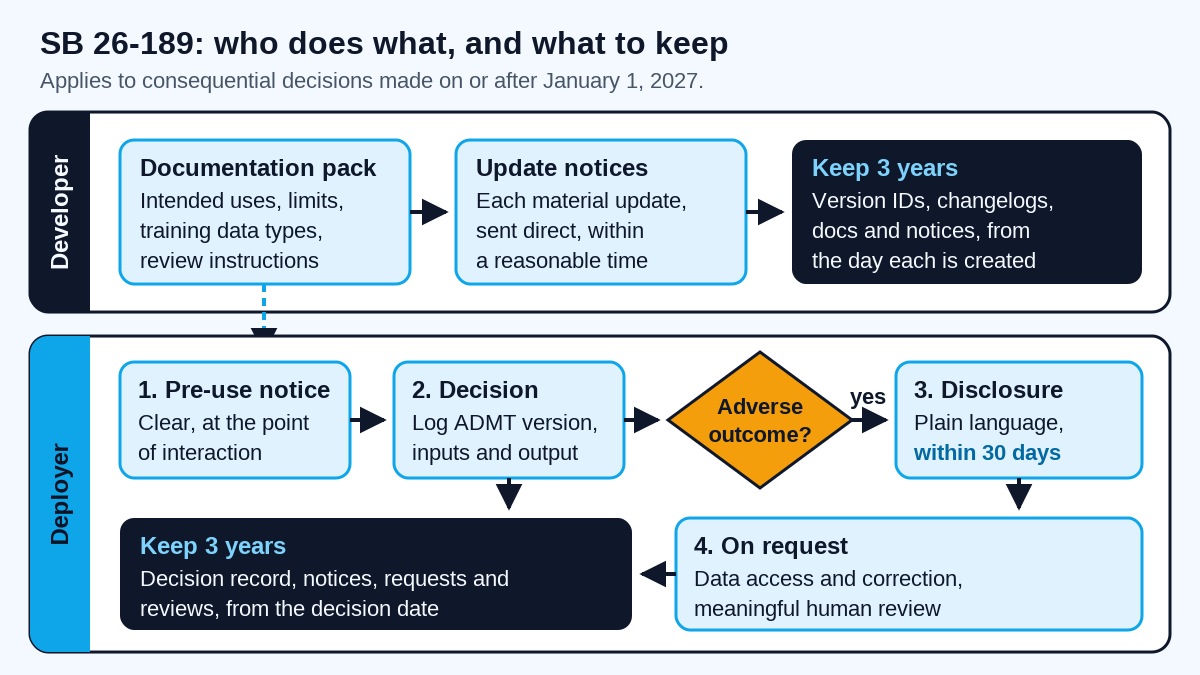
A deployer must build four things: a notice shown before the technology is used, a disclosure sent after an adverse outcome, a way for people to get and correct their data, and a human review path. The duties sit in sections 6-1-1704 and 6-1-1705.
- Pre-use notice. Before using a covered ADMT to materially influence a consequential decision, give the consumer a clear and conspicuous notice that it was or will be used, with instructions for getting more information. The act says a prominent public notice that is reasonably accessible at the point of interaction satisfies this, including a link close to the transaction. In product terms: a visible line and link on the application form, not a paragraph buried in the terms.
- Adverse-outcome disclosure within 30 days. If the decision results in an adverse outcome, send within thirty days: a plain-language description of the decision and the role the ADMT played; a simple process to request more information, including the ADMT's name, version number and developer and the types, categories and sources of personal data used; and an explanation of the consumer's rights and how to use them.
- Data access and correction. On request after an adverse outcome, provide instructions for requesting personal data and correcting factually incorrect or materially inaccurate data used in the decision. The act does not require correcting opinions, predictions or scores.
- Meaningful human review. On request, offer human review and reconsideration, to the extent commercially reasonable. The act defines the reviewer: someone with authority to approve, modify or override the decision, who is trained, considers the relevant primary evidence, does not default to the system output, and has enough information to understand the output's intended use, limitations, input categories and principal factors.
An "adverse outcome" is wider than a rejection. It includes a decision that denies, terminates or materially reduces access, and also one that results in materially less favorable pricing or terms than similarly situated consumers receive.
The review step is a product feature, not a mailbox. I describe queue design, reviewer context and override logging in human-in-the-loop approvals for AI agents.
What must a developer provide to deployers?
A developer must give each deployer a documentation pack and notices of material updates, starting January 1, 2027. Section 6-1-1702 lists the contents:
- A general statement of the intended uses and the known harmful or inappropriate uses.
- The categories of data, including personal data, used to train the system, to the extent known.
- Known limitations, including known risks and circumstances in which it should not be used.
- Instructions for appropriate use, monitoring and meaningful human review.
- Information reasonably necessary for the deployer to make its own disclosures. If the developer withholds something, it must say so.
The developer must also notify each deployer of material updates, intentional and substantial modifications, and changes to intended use, limitations or risk mitigation, "within a reasonable time." The act gives no number of days. Public release notes count only if the developer also gives direct notice of the release to each deployer.
A material update is an update, patch, release or new version, including changes to model parameters, default settings or documentation, that the developer knows or should know is likely to materially affect outputs or performance relevant to the intended use. Routine maintenance, cosmetic changes and bug fixes that do not have that effect are excluded.
For anyone building on a hosted LLM, this has a direct consequence. Swapping the underlying model version, or changing a scoring prompt or threshold, can change outputs in a way relevant to the intended use. Treat those as candidate material updates: version them, test them against a fixed evaluation set, and record whether you judged the change material and why.
What records do you need to keep, and for how long?
Both developers and deployers must keep records reasonably necessary to demonstrate compliance for at least three years. The clock starts at different points:
| Role | Section | Retention period | Records the act names |
|---|---|---|---|
| Developer | 6-1-1702(4) | Not less than three years after the record is created | System version identifiers, changelogs, documentation, notices of material updates sent to deployers |
| Deployer | 6-1-1703 | Not less than three years after the date of the consequential decision | Covered ADMT version identifiers, changelogs, documentation of material mitigation changes |
Both periods run longer if another state or federal law requires it. The act names examples of records, not a full schema, so the rest is engineering judgment. This is the decision record I would store for a deployer. It is my suggestion for meeting "reasonably necessary to demonstrate compliance," not a list from the statute:
| Field | Why it is there |
|---|---|
| Decision ID, timestamp, covered domain | Starts the three-year clock and the 30-day clock |
| Consumer reference | Links the decision to later requests |
| ADMT name, version and developer | Named in the adverse-outcome disclosure |
| Types, categories and sources of personal data used | Named in the adverse-outcome disclosure |
| System output (score, rank, recommendation) | Shows what the technology contributed |
| Final decision, who or what made it, adverse or not | Shows the ADMT's role and triggers the disclosure |
| Pre-use notice version and when it was shown | Proves the notice duty |
| Adverse-outcome disclosure: content version, sent date | Proves the 30-day duty |
| Requests received: data, correction, human review | Proves the rights were honored |
| Reviewer, evidence considered, outcome, date | Proves the review was meaningful |
| Retention expiry date | Decision date plus three years, or longer |
Keep the record append-only and separate from debug logs, which usually have short retention and too much raw personal data. My post on LLM observability covers how to trace model calls without logging everything.
How is the law enforced, and who is exempt?
The Colorado Attorney General enforces SB 26-189 exclusively, a violation is a deceptive trade practice under the Colorado Consumer Protection Act, and there is no new private right of action. Under section 6-1-1706, before an enforcement action the Attorney General must issue a notice of violation if a cure is deemed possible, and may sue if the violation is not cured within sixty days. That cure provision is repealed on January 1, 2030, and it does not apply to knowing or repeated violations.
The act also sets how fault is shared in discrimination claims under existing Colorado law. Under section 6-1-1707 a developer is liable only to the extent its covered ADMT was used as intended, documented, marketed, configured or contracted for. Contract clauses that indemnify a party for its own discriminatory acts are void. That makes the "intended uses" statement a document worth writing carefully.
Section 6-1-1708 carves out several groups. Most of the act does not apply to HIPAA covered entities and their business associates for services to a covered entity, except for employment decisions, though covered entities must give patients a general notice about advanced technologies. Insurers subject to Colorado's existing insurance algorithm statute are deemed compliant in the practice of insurance. FDA-regulated medical devices are excluded. Creditors that already send federal adverse action notices can rely on them, provided those notices also meet this act's disclosure requirements.
Robinson and Cole's summary, published May 28, 2026, describes the rewritten law as narrower and more operational than the 2024 Colorado AI Act it replaced.
One open item. The act directs the Attorney General to adopt rules on the adverse-outcome disclosures and on correction and human review on or before January 1, 2027. I could not confirm the status of those rules from a primary source while writing this in November 2026, so check the Attorney General's rulemaking page before you finalize notice wording.
Work with me
I build AI features with the notice, logging and human-review layers designed in from the start, working with your counsel on what the law requires. See AI integration and AI agent development, read how I work with US teams, or browse my work and book a scoping call.
Frequently asked
When does Colorado SB 26-189 take effect?
The act takes effect on January 1, 2027 and applies to consequential decisions made on or after that date, according to section 5 of the session law. Governor Polis approved it on May 14, 2026. It repealed and reenacted the part of Colorado law created by the 2024 Colorado AI Act, SB 24-205.
Does the law apply to a company outside Colorado?
It can. Developers and deployers are defined as persons "doing business in Colorado," and "consumer" includes a job applicant who is a Colorado resident and any individual whose opportunity in Colorado is evaluated by a person doing business there. Ask counsel how that applies to your footprint.
Is a chatbot covered by SB 26-189?
Usually not, if all it does is answer questions. The act excludes natural-language technology that provides information or recommendations when it is not intended or marketed for consequential decisions and is subject to an acceptable use policy that prohibits that use. A chatbot that screens applicants or decides eligibility is a different matter.
Does SB 26-189 require impact assessments or a risk management program?
The duties in the act are documentation, notices, disclosures, consumer rights and recordkeeping. Constangy's analysis notes that the 2024 act would have required deployers to run risk-management programs and impact assessments, and that the replacement narrows the focus to transparency, notice, recordkeeping and human review.
Sources
Related services
Building something like this?
Naman Gundaniya takes on full-stack and AI projects: fixed quote after a free 30-minute scoping call, replies within 24 hours.
Get in touch