 By Naman Gundaniya
Quebec Law 25 and AI: Automated Decision Duties
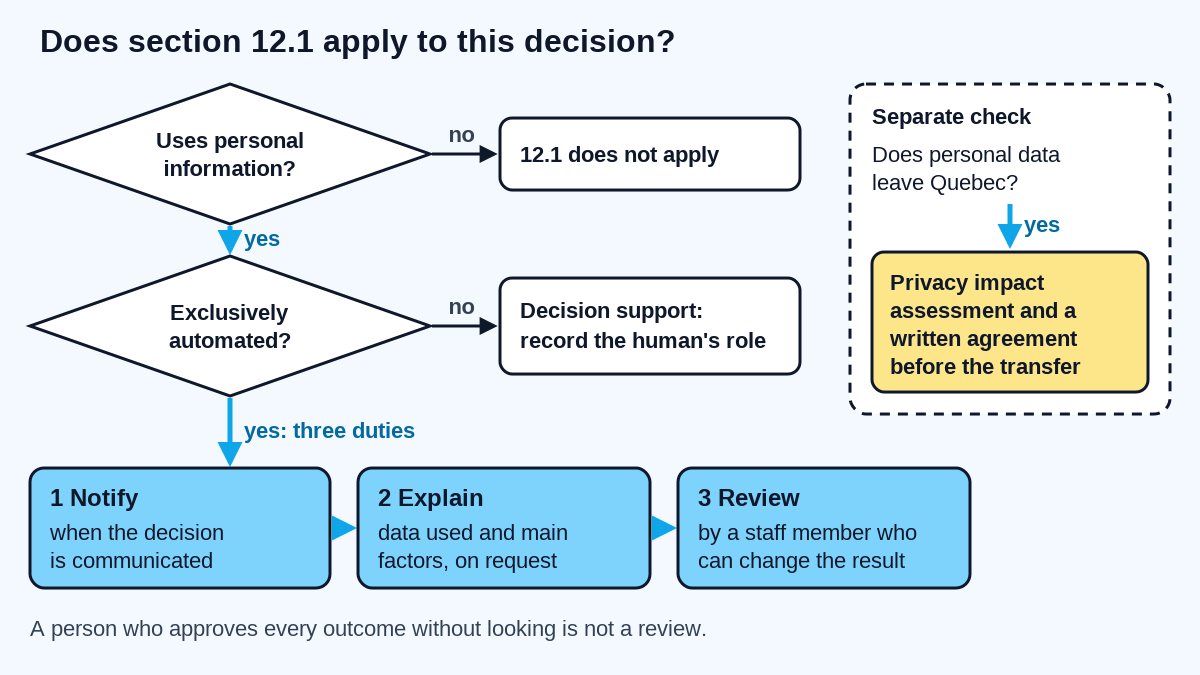
Quebec's Law 25 added section 12.1 to the province's private-sector privacy act. When a business uses personal information to make a decision based exclusively on automated processing, it must tell the person no later than when it communicates the decision, explain the main factors on request, and give the person a chance to put their case to a staff member who can review it.
Most writing on Law 25 is about consent banners and privacy officers. The part that changes how an AI system is built is shorter and more specific: three duties on automated decisions, an assessment before personal information leaves Quebec, and penalties large enough to get a board's attention. This post covers those, as of late 2026, from the regulator's own pages. It is general information, not legal advice.
A note on sources. Quebec's privacy regulator, the Commission d'accès à l'information (CAI), publishes in French, so the English wording below is my translation. The CAI says its summaries have no force of law and the statute prevails, and the same goes for this post.
What does section 12.1 require for automated decisions?
Section 12.1 sets three duties for any business that uses personal information to render a decision based exclusively on automated processing. The CAI's page for businesses on using and communicating personal information describes them as transparency obligations and a right of review, and the CAI's administrative version of the Act gives the text and marks the new provisions as in force from 22 September 2023.
| Duty | When | What the system needs |
|---|---|---|
| Inform the person that the decision was automated | No later than when the decision is communicated | Notice text in the decision message itself |
| Tell the person which personal information was used, the reasons and the main factors and parameters behind the decision, and that they can have the information corrected | On request | A stored record of inputs and factors for each decision |
| Give the person the opportunity to submit observations to a staff member able to review the decision | For every such decision | A contact route and an internal review queue with authority to change the outcome |
The CAI gives granting credit, assessing a request for financial support and prioritizing a request as examples of decisions businesses automate, "notably thanks to artificial intelligence". The duty attaches to the decision, not to the technology, so a rules engine and a large language model are treated the same way.
When is a decision "based exclusively on automated processing"?
A decision is based exclusively on automated processing when it is made, in the CAI's words, without human intervention. The CAI's business page does not go further into how much human involvement is enough, and I have not found a CAI decision that settles it for private companies.
The closest official reading is the Quebec government's guidance for public bodies, which interprets the parallel rule in the public-sector access law. That guidance treats a decision as exclusively automated when no natural person exercised meaningful control over it, and says a minor human step with no real effect on the outcome does not take the decision out of scope. A decision-support tool is different: where a staff member must make the decision, the tool makes none. The same guidance says the explanation duty never requires handing over the algorithm, and that "main" factors need not be an exhaustive list.
That guidance binds public bodies, not businesses, so treat it as an analogy and ask counsel. But it matches how I would design a system anyway:
- A reviewer who approves every outcome without looking is not a human decision. If the person cannot or does not change results, assume section 12.1 applies.
- A model that drafts a recommendation which a trained person accepts, edits or rejects is decision support. Keep evidence that the person does all three.
- Partial automation counts decision by decision. Auto-approving the easy cases and sending the rest to a person means the auto-approved ones are exclusively automated.
I go into designing review steps that people use in human-in-the-loop approvals for AI agents.
Does Law 25 apply to a company outside Quebec?
Quebec's private-sector act applies to anyone operating an enterprise in Quebec, and the CAI says an organization located outside Quebec is subject to the Act when it collects, holds, uses or communicates personal information in the course of its activities in Quebec. The CAI's scope page defines personal information as information that makes it possible to identify a natural person, directly or indirectly, and says the Act applies whatever the format and whether the business or a third party holds the information.
For a software company elsewhere in Canada, or abroad, with customers in Quebec, the safe assumption is that automated decisions about those customers fall under section 12.1. Whether your activities amount to operating an enterprise in Quebec is a legal question worth one conversation with a Quebec privacy lawyer.
What must happen before personal information leaves Quebec?
Before communicating personal information outside Quebec, a business must carry out a privacy impact assessment, and the transfer can go ahead only if the assessment shows the information would receive adequate protection. Section 17 of the Act, as set out in the CAI's administrative version, lists what the assessment must take into account:
- the sensitivity of the information,
- the purpose of its use,
- the protection measures, including contractual ones, that would apply to it,
- the legal regime of the place where it would be communicated, including the personal information protection principles that apply there.
The transfer must then be covered by a written agreement that takes the assessment's results into account. The same rule applies when a business entrusts someone outside Quebec with collecting, using, communicating or keeping the information on its behalf, and the CAI's business page says "outside Quebec" includes other Canadian provinces as well as other countries.
This is the provision AI projects run into first. Calling a model API hosted in another province or country with a Quebec resident's data in the prompt, storing embeddings in a cloud region outside Quebec, or giving a developer abroad access to production records are all communications outside Quebec. I work from India, so for Quebec clients I expect this assessment to exist before I see real data, and I prefer to build against synthetic or masked data so that the assessment is short.
Section 3.3 adds a related duty: a privacy impact assessment for any project to acquire, develop or overhaul an information system that involves personal information, proportionate to the sensitivity, purpose, quantity, distribution and medium of the information. A new AI feature is such a project.
Two more provisions matter for AI products. Under section 8.1, a business that collects personal information using technology that can identify, locate or profile a person must first tell the person about the technology and how to activate those functions; the CAI's summary of Law 25 changes says such functions cannot be on by default. Under section 9.1, a technological product or service offered to the public must have its privacy settings at the highest level by default.
What are the penalties under Law 25?
Law 25 has two penalty tracks, and a missed automated-decision notice is named in the first. Failing to inform a person about an exclusively automated decision, or failing to give them the opportunity to submit observations, appears in the Act's list of grounds for an administrative monetary penalty.
| Track | Maximum for a business | Maximum for an individual | Source |
|---|---|---|---|
| Administrative monetary penalty, imposed by the CAI | $10,000,000 or 2% of worldwide turnover for the preceding fiscal year, whichever is greater | $50,000 | Section 90.12, CAI administrative version |
| Penal fine, imposed by a court | $15,000 to $25,000,000, or 4% of worldwide turnover for the preceding fiscal year if greater | $5,000 to $100,000 | CAI sanctions page |
The CAI's sanctions page adds that fines are doubled for a repeat offence and that a prosecution can be brought within five years of the offence. Separately, section 93.1 provides for punitive damages of at least $1,000 where an unlawful infringement of a right under the Act causes injury and is intentional or results from gross fault. All amounts are in Canadian dollars.
How do you build section 12.1 into an AI system?
Building for section 12.1 means treating each automated decision as a record with an owner, not as a model output. The steps I follow on a project with Quebec users:
- Inventory decisions. List every place the product decides something about a person: approvals, eligibility, pricing, ranking, prioritization, screening.
- Classify each one. Mark which run with no person able to change the outcome. Those are the section 12.1 decisions.
- Log the inputs. For each decision, store the personal information used and the main factors and parameters, in a form a non-engineer can read back to the person.
- Write the notice. Put the automated-decision notice in the message that communicates the decision, with the route for questions and observations.
- Build the review queue. Route observations to a staff member with the authority and the tools to change the result, and record what they decided.
- Run the assessments. Complete the privacy impact assessment for the project, and the transfer assessment for anything processed outside Quebec, before real data flows.
With a language model in the loop, step 3 needs care. A model's free-text rationale is not a reliable account of why it produced an output. I prefer designs where the decision comes from explicit, logged criteria, and the model's job is to extract or summarize the inputs to those criteria.
The same notice, explanation and review pattern shows up in other countries' laws; I compare the UK version in my guide to UK automated decisions. For the federal baseline that applies alongside Quebec's rules, see the PIPEDA checklist for AI chatbots and AI in Canada after AIDA.
Work with me
I build AI features with decision logs, notices and human review queues designed in from the start, working remotely from India with masked data wherever the project allows. See AI integration and AI agent development, read how I work with Canadian clients, or browse my work and book a scoping call.
Frequently asked
Does Law 25 ban automated decisions?
No. Section 12.1 does not prohibit decisions based exclusively on automated processing. It requires telling the person, explaining the information used and the main factors on request, and offering a chance to submit observations to a staff member who can review the decision.
Does an AI chatbot fall under section 12.1?
Only when it makes a decision about a person using their personal information without human intervention, such as refusing a refund or approving an application. A chatbot that answers questions or drafts a recommendation for a staff member to decide is not making that kind of decision, though the rest of the Act still applies to the data it handles.
Do I have to disclose my model or algorithm?
The Act asks for the personal information used and the reasons and main factors and parameters that led to the decision. Quebec's guidance for public bodies, on the parallel public-sector rule, says the duty does not require providing the algorithm. That guidance is not binding on businesses, so confirm the scope with counsel.
Is sending data to a US or Indian AI provider allowed under Law 25?
It can be, after a privacy impact assessment shows the information would receive adequate protection and a written agreement is in place. The assessment must consider the sensitivity of the information, the purpose, the protection measures and the legal regime of the destination. The rule also covers transfers to other Canadian provinces.
Sources
Related services
Building something like this?
Naman Gundaniya takes on full-stack and AI projects: fixed quote after a free 30-minute scoping call, replies within 24 hours.
Get in touch