 By Naman Gundaniya
Article 22A: Automated Decisions Under the UK Data Act
Since 5 February 2026, UK law allows solely automated decisions with legal or similarly significant effects, outside special category data, as long as safeguards are in place: tell people about the decision, let them make representations, let them obtain human intervention and let them contest it. For AI builders, those four safeguards are product features you design, build and log.
The Data (Use and Access) Act 2025 replaced the old Article 22 of the UK GDPR, which was close to a general prohibition, with a safeguards-based regime. Most coverage explains the legal shift. This post is about what it means for the people writing the code: which features need the safeguards, what each one looks like in a product, and what the regulator has said about human review.
This is general information, not legal advice. If your product makes decisions about people at scale, have a data protection specialist review your design.
What changed for automated decisions on 5 February 2026?
The change is that the default flipped from "not allowed unless" to "allowed with safeguards". DLA Piper reports that the main data protection provisions, including the ADM changes, came into force on 5 February 2026 under the Act's Commencement No. 6 Regulations, and that the reforms remove the requirement to establish a qualifying lawful basis before carrying out ADM, "except where special category data is used".
Wiggin's summary lists the four safeguards that must be in place for a significant decision based solely on automated processing:
- providing the person with information about the decision reached,
- enabling them to make representations,
- enabling them to obtain human intervention from the controller, and
- enabling them to contest the decision.
The ICO's draft guidance defines the scope by reference to the new Article 22A: decisions "based solely on automated processing", including profiling, with a legal or similarly significant effect, where there is no meaningful human involvement.
What do Articles 22A to 22D each do?
Articles 22A to 22D split the old Article 22 into four jobs: scope, restrictions, safeguards and further provision. As of late 2026, this is how the ICO's draft guidance uses each one.
- Article 22A sets the scope. The ICO's page on what the UK GDPR says about ADM uses it to cover decisions that are solely automated and significant, and explains that "solely" means "no meaningful human involvement in the taking of the decision".
- Article 22B holds the restrictions. The ICO's special category page cites it for the three conditions: explicit consent, contract, or required or authorised by law, the last two alongside a substantial public interest condition. Its page on carrying out ADM lawfully adds that you "can't base these decisions entirely or partly on the recognised legitimate interest lawful basis".
- Article 22C lists the safeguards. The ICO's safeguards page quotes the four measures: information about the decision, representations, human intervention and a way to contest.
- Article 22D makes further provision, including a power to make regulations. The same safeguards page quotes Article 22C as working alongside "any regulations under Article 22D(3)".
For a builder, 22A decides whether a feature is in scope, 22B decides which data and lawful bases you can use, and 22C is the feature list. I keep 22D on a watch list, because regulations made under it can change the detail.
When is a decision "solely automated"?
A decision is solely automated when no human has real influence over it before it takes effect. The clearest statement so far comes from the ICO's March 2026 report on recruitment tools. As DLA Piper summarises it, the test is whether a person can exercise "real influence over a decision before it is applied", with the authority, discretion and competence to change it. Human involvement must be "meaningful and active" and "cannot be a token gesture or a rubber stamp of an automated outcome".
The same report found that most employers believed their tools were decision support, yet many were in practice making solely automated decisions without meaningful human involvement. That gap between how a team describes a feature and what the code does is the thing to check first.
In code terms, I ask four questions about any review step:
- Does the reviewer see the inputs and reasons, or only the model's verdict?
- Can they change the outcome in the same screen, without a workaround?
- Does the decision wait for them, or does it apply first and wait for complaints?
- How often do they actually override it? An override rate near zero across thousands of cases deserves a hard look.
If the honest answer is that the review is a formality, treat the feature as solely automated and build the safeguards. That is often simpler than pretending otherwise. My guide to human-in-the-loop approvals for AI agents covers how to design review steps that carry weight.
How do the four safeguards translate into product features?
Each safeguard maps to something a user can see and something your system has to record. This is how I would scope them on a client project:
| Safeguard | What the user sees | What the system needs |
|---|---|---|
| Information about the decision | A plain-language message saying a decision was made automatically, what it was and the main factors | Decision record with model or rule version and the key inputs |
| Representations | A form or reply channel to add context ("my income changed last month") | Case linked to the original decision, with the new information attached |
| Human intervention | A clear way to ask for a person to look again | Review queue, assigned reviewer, ability to change the outcome |
| Contest | A route to challenge the outcome, with a timeline | Status tracking, final outcome and reasons stored with the case |
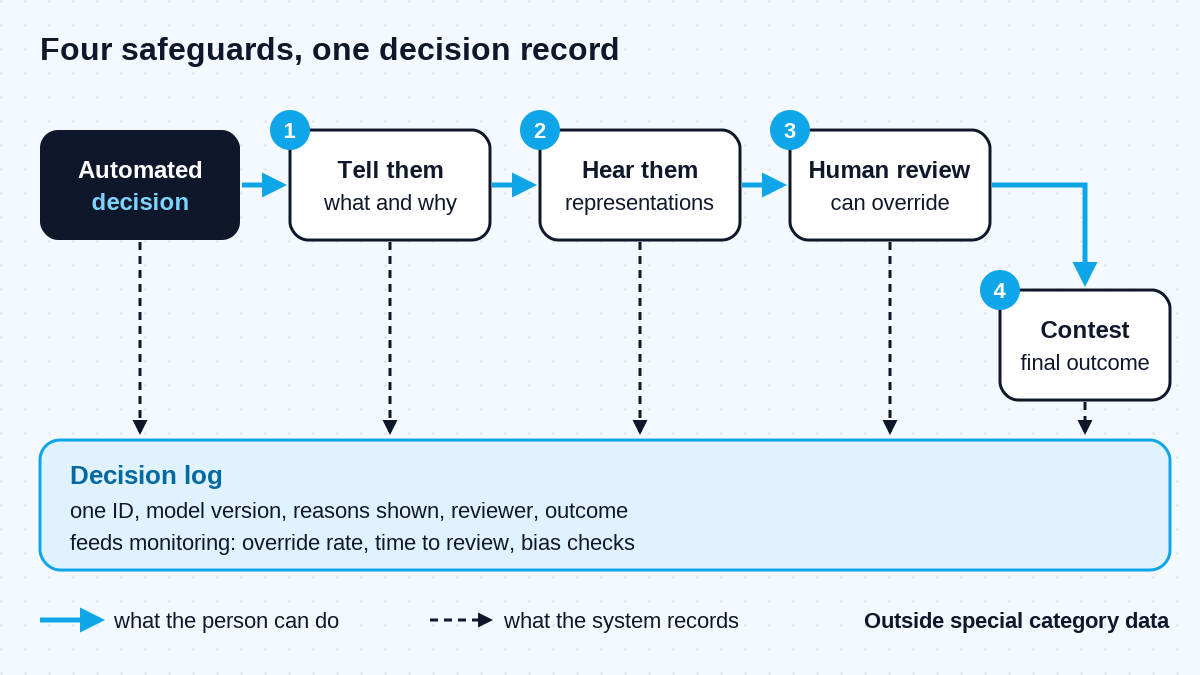
Three build details make this hold up in practice:
- One decision ID across everything. The notice, the representations, the review and the contest all hang off the same record. Without it, a support team cannot reconstruct what happened.
- Store reasons, not just scores. "Declined, score 0.41" helps nobody. Store the factors the user is told about, in the words they were told, so the reviewer and the notice agree.
- Monitor the review queue. Volume, time to review and override rate are the signals that show whether human intervention is real. The LLM observability setup I use for agents works here too.
The ICO's recruitment findings, as reported by DLA Piper, also expect transparency at the right time, not only a brief mention in a general privacy notice, plus bias testing, ongoing monitoring and a data protection impact assessment with enough detail.
What about special category data?
Special category data, such as health, ethnicity or biometric data, keeps a stricter regime. Both DLA Piper and Wiggin note that the relaxation does not extend to it. The ICO's guidance page lists three conditions for using special category data in solely automated significant decisions: explicit consent, contract, and where it is required or authorised by law.
For builders, the practical step is to know whether special category data, or a close proxy for it, reaches the decision at all. LLMs make this harder than classic scoring models, because free-text inputs such as support messages or CVs can carry health or religious information nobody planned for. I usually add a filter or classification step before the decision model, and keep the decision inputs to named, structured fields where I can. The same minimisation thinking appears in my post on GDPR-safe LLM integration.
What is still in draft in the ICO's ADM guidance?
All of it, as of late 2026: the ICO's updated ADM guidance is still a draft. The ICO's ADM page, last updated on 31 March 2026, calls it "this draft guidance" and keeps the previous version available until the update is finalised after consultation. The draft has seven chapters: what ADM is, what the UK GDPR says, how to carry out ADM lawfully, special category data, the safeguards, people's rights, and other considerations.
The consultation ran from 31 March to 29 May 2026 and is closed. The ICO says responses will help it "provide any further clarity needed in the final guidance update", and that it will update its shorter in-brief guidance on ADM rights and its public guidance on decisions made without human involvement "in due course". The ADM page also says the guidance will inform a statutory code of practice on AI and ADM that the ICO will develop. No dates are given for any of these.
In practice I build to the draft, because it is the regulator's clearest reading of Articles 22A to 22D, and I check the ICO page for the final version before a design is locked. Notice wording and the description of meaningful human involvement are the parts I expect to need a second look.
What is still unsettled?
Beyond the ICO's guidance, two points are worth tracking. DLA Piper notes the ICO has indicated it may prioritise enforcement where ADM systems lack transparency or fail to offer meaningful human intervention. DLA Piper also notes that the Secretary of State can designate new special categories of data, so the line you design around can move. Build the safeguards and the special category filter as configurable features rather than one-off screens.
Work with me
I build AI features with the review queues, decision logs and user-facing notices that this regime expects, and work with your legal adviser on the wording. See AI integration and AI agent development, or look at my work and book a scoping call. I work remotely from India, with most of the UK working day overlapped.
Frequently asked
What is Article 22A of the UK GDPR?
Article 22A is the scope provision for automated decision-making added by the Data (Use and Access) Act 2025. It covers significant decisions based solely on automated processing, meaning there is no meaningful human involvement. Articles 22B to 22D then set the restrictions, the safeguards and further provision.
Can UK companies now use fully automated decisions?
Generally yes, for decisions that do not use special category data, provided the four safeguards are in place: information about the decision, representations, human intervention and a way to contest. Special category data still needs explicit consent, contract or a legal requirement or authorisation.
Does having a human click "approve" make the decision not automated?
Not if the click is a formality. The ICO's recruitment report says human involvement must be meaningful and active, with the authority, discretion and competence to change the decision. A reviewer who only sees the model's verdict and never overrides it is unlikely to count.
Do I need a DPIA for an AI decision feature?
It is likely. The ICO's draft guidance asks organisations to consider whether a data protection impact assessment is needed, and its recruitment report found many existing DPIAs lacked detail. For any feature making significant decisions about people, I plan for one from the start.
When was Article 22 replaced?
The Data (Use and Access) Act 2025 replaced UK GDPR Article 22 with new Articles 22A to 22D. The ADM changes came into force on 5 February 2026, alongside most of the Act's data protection provisions.
Sources
- DLA Piper reports (privacymatters.dlapiper.com)
- Wiggin's summary (wiggin.co.uk)
- ICO's draft guidance (ico.org.uk)
- what the UK GDPR says about ADM (ico.org.uk)
- special category page (ico.org.uk)
- carrying out ADM lawfully (ico.org.uk)
- safeguards page (ico.org.uk)
- DLA Piper summarises it (privacymatters.dlapiper.com)
- consultation (ico.org.uk)
Related services
Building something like this?
Naman Gundaniya takes on full-stack and AI projects: fixed quote after a free 30-minute scoping call, replies within 24 hours.
Get in touch