 By Naman Gundaniya
Canada AI Regulation After AIDA: What Applies in 2026
Canada has no AI-specific federal law in force as of November 2026: AIDA died with Bill C-27 in January 2025. AI products still answer to PIPEDA for personal information, to Quebec's Law 25 for automated decisions, to privacy regulators' generative AI principles, and to courts that hold deployers liable for what their chatbots say. A replacement privacy bill is before Parliament.
When Canadian clients ask what the AI rules are, the short answer "there is no AI law" is accurate and unhelpful. The rules that apply to an AI feature today are the ones that apply to personal information, automated decisions and customer communication generally. This post maps them for people who build and ship AI products, as general information rather than legal advice.
What happened to AIDA?
AIDA never became law. As Lexpert summarises, "Bill C-27, which housed the AIDA, died in Parliament in January 2025 without ever becoming law." In October 2025, AI Minister Evan Solomon told BetaKit the government would not revive AIDA as it was, while considering some of its elements for future legislation, and described his preferred approach as "light, tight, right".
What has moved is privacy law. Bill C-36, the Protecting Privacy and Consumer Data Act, had first reading on 15 June 2026 and was at second reading in the House of Commons when I checked in November 2026. Its long title amends PIPEDA. Lexpert reports that it would add rules for automated decisions, including disclosure, an explanation on request and a path to human review. It is a bill, not law, and its text can change before it passes.
What did the June 2026 national AI strategy change?
It did not bring back an AI act. Prime Minister Mark Carney launched AI for All, Canada's national AI strategy, on 4 June 2026, as a five-year plan built on building trust, creating opportunities and reinforcing sovereignty. The strategy itself describes a "tradition of pragmatic regulation that can govern AI responsibly without smothering innovation" and does not name a new AI-specific statute. Its promises are narrower: to "modernize consumer privacy legislation", to bring in "online safety laws", to "ensure that interactions with chatbots are safe", and to invest $50 million in the Canadian AI Safety Institute.
Two bills before Parliament carry those promises as of late 2026. Bill C-36 is the privacy bill above. Bill C-34, the Safe Social Media Act, had first reading on 10 June 2026 and was in committee in the House of Commons when I checked LEGISinfo in November 2026. It would enact a Digital Safety Act. The government's highlights say regulated AI chatbot services would have to reduce the risk of the bot posing as a human or as a licensed professional giving advice, and interrupt a conversation when a user expresses suicidal thoughts or intent to self-harm, pointing them to human support.
Both are bills, not law. For builders, the change is that chatbot safety now sits on the federal agenda next to privacy.
Which rules apply to an AI product in Canada today?
Four layers apply now, and most products touch at least two of them.
| Layer | What it covers | Status (Nov 2026) | Source |
|---|---|---|---|
| PIPEDA | Collection, use and disclosure of personal information in commercial activity | In force | Lexpert |
| Quebec Law 25 | Decisions based exclusively on automated processing, plus Quebec's wider privacy regime | In force since September 2023 | Lexpert |
| Privacy regulators' generative AI principles | Nine principles for developers and deployers | Guidance, December 2023 | OPC |
| Common law | Liability for what an AI system tells customers | Applied in *Moffatt v. Air Canada* (2024) | Lexpert |
| Bill C-36 | Would replace PIPEDA's rules and add automated-decision duties | Second reading, not law | LEGISinfo |
| Bill C-34 | Would enact a Digital Safety Act covering social media and certain AI chatbot services | In committee, not law | LEGISinfo |
Public-sector bodies have their own rules too. Lexpert notes Ontario's Bill 194, which governs AI use by public institutions, and Manitoba's public-sector AI and cybersecurity governance act. If you sell to government, ask the buyer which apply.
PIPEDA and the regulators' principles: the everyday baseline
For most private-sector AI features, PIPEDA is the rule that bites, because almost every useful feature processes personal information somewhere. Canada's federal, provincial and territorial privacy regulators published principles for responsible generative AI in December 2023, and they read like a design brief. Among the nine: legal authority and consent, appropriate purposes, necessity and proportionality, openness, accountability and safeguards.
Two lines are worth pinning to the wall. On consent: "Consent should be as specific as possible, and deceptive design patterns should be avoided." On collection, the principles warn that "the public accessibility of data does not mean that it can be indiscriminately collected or used", which matters for any feature that scrapes or enriches.
What that means in code:
- send the model only the fields the task needs, not the whole customer record,
- say plainly in the interface and the privacy notice that an AI system processes the data, and for what,
- check your model provider's retention terms and where the data is processed,
- keep personal information out of logs and evaluation sets unless you have a reason and a safeguard.
I apply the same habits for European clients; GDPR-safe LLM integration goes deeper on the mechanics, and most of it carries over.
Quebec Law 25: automated decisions need a human path
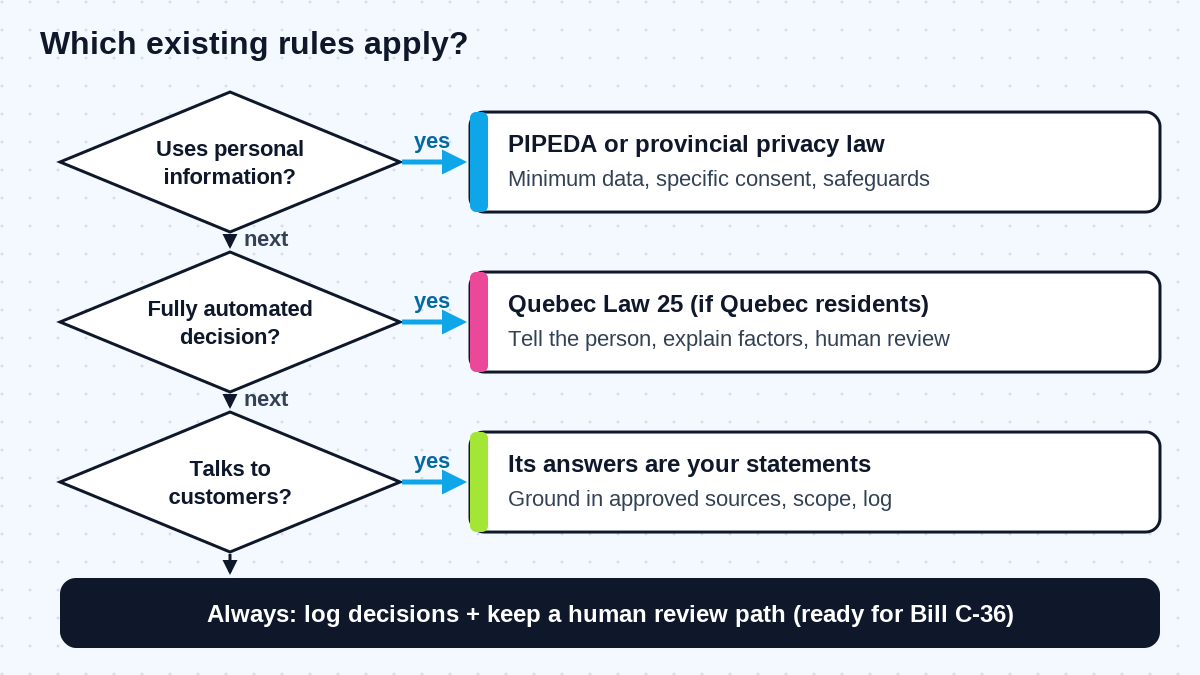
If your product makes decisions about people in Quebec without meaningful human involvement, Law 25 already asks for what Bill C-36 would extend nationally. Per Lexpert's summary, organisations must inform individuals about purely automated decisions, explain the factors on request, and offer review by a person, with penalties reaching up to $25 million or 4 percent of worldwide turnover.
The engineering work is concrete:
- Inventory every place the product decides something about a person: approvals, eligibility, pricing, ranking, screening.
- Flag which of those run without a person reviewing the outcome.
- Record the inputs and main factors for each automated decision, so you can explain it later.
- Build a review path: a way for the person to ask, and an internal queue where a human can change the outcome.
- Write the notice text with your counsel and show it where the decision is communicated.
The review path has to be real. A person who rubber-stamps every outcome does not change what the system is. I cover how to design approval and review steps that people actually use in human-in-the-loop AI agents.
Chatbots: your bot's answers are your answers
The case most Canadian founders have heard of is *Moffatt v. Air Canada*, 2024 BCCRT 149, where, as Lexpert recounts, Air Canada was held liable for incorrect information from its chatbot. The lesson for builders is not about any AI statute; it is that a customer-facing bot speaks for the business.
For any chatbot I build, that means grounding answers in approved sources with citations, refusing questions outside the scope it was built for, routing policy and money questions to a person or a linked policy page, and logging conversations so mistakes can be found and fixed. Test it against the questions customers actually ask before launch, not only the ones in the demo.
What should a Canadian team do while Ottawa decides?
Build the controls that every proposal so far has asked for, because they are cheap now and expensive to retrofit. A practical list:
- a data map showing which AI features touch personal information and which provider sees it,
- minimum necessary prompts and redacted logs,
- a register of automated decisions with inputs, factors and outcomes,
- a working human review path for those decisions,
- clear disclosure that users are dealing with an AI system,
- an internal policy that says who may use which AI tools on what data; my guide to writing an AI policy has a template.
If Bill C-36 passes in something like its current form, a team with these in place is adjusting notice text, not rebuilding the product.
Work with me
I build AI features and chatbots with the logging, review paths and data controls described here. See AI integration and AI chatbot development, browse my work, and book a scoping call. Your legal advisers decide what the law requires; I build it into the product.
Frequently asked
What is Canada's AI regulation after AIDA in 2026?
As of late 2026 there is no stand-alone federal AI act. AI products answer to PIPEDA, provincial laws such as Quebec's Law 25, privacy regulators' guidance and the courts. The June 2026 national AI strategy pointed to privacy and online safety bills instead: C-36 on privacy and C-34 on online safety, including AI chatbots.
Does Canada have an AI law?
Not a general federal one as of November 2026. AIDA died with Bill C-27 in January 2025. AI products are governed by privacy law (PIPEDA and provincial laws such as Quebec's Law 25), sector rules, public-sector AI laws in some provinces, and the courts.
What happened to AIDA?
It was Part 3 of Bill C-27, which died when Parliament was prorogued in January 2025. The AI minister said in October 2025 it would not be revived as it was. A separate privacy bill, C-36, was tabled in June 2026 and includes automated-decision provisions.
Is PIPEDA enough for an AI chatbot that stores customer data?
PIPEDA applies, but "enough" depends on the build. You still need consent that matches the purpose, minimum necessary data, safeguards, retention limits and checks on where your model provider processes data. If you serve Quebec, Law 25 adds its own requirements.
Does Quebec's Law 25 apply to AI decisions?
Yes, where a decision about a person is based exclusively on automated processing. The organisation must inform the person, explain the factors on request and offer human review. Whether a given workflow counts as exclusively automated is a question for your counsel.
Sources
Related services
Building something like this?
Naman Gundaniya takes on full-stack and AI projects: fixed quote after a free 30-minute scoping call, replies within 24 hours.
Get in touch