 By Naman Gundaniya
Can an Offshore Developer Work on HIPAA Data?
Federal HIPAA rules do not ban an offshore developer from working with protected health information, as long as a business associate agreement and the required safeguards are in place. The limits that usually decide the question sit elsewhere: Medicare Advantage attestations, state Medicaid contracts, a few state laws and your own customer contracts. The safest setup keeps PHI out of the developer's reach altogether.
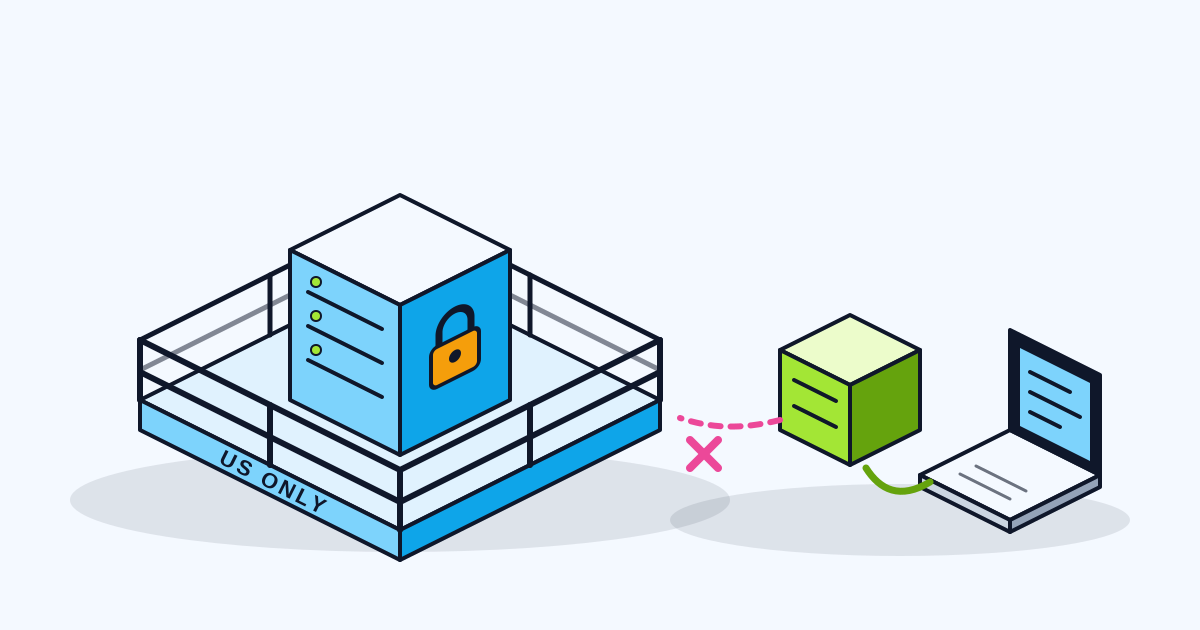
I work from India for clients abroad, so I am the offshore developer in this question. That is why I want US health teams to get it right before the first commit, not after a customer audit. The short version is that "is it legal under HIPAA?" is the wrong first question. The right one is "which of our contracts and programs say no?"
This post is general information as of November 2026, not legal advice. Your privacy officer and counsel decide what applies to you.
Does HIPAA itself prohibit offshore access to PHI?
HIPAA does not prohibit protected health information from being accessed or stored outside the United States. Two law firm analyses I read say so directly. Sheppard Mullin's August 2024 article says HIPAA does not explicitly prohibit offshoring patient data, and McDermott's July 2025 analysis states that HIPAA "doesn't prohibit PHI from being accessed or stored outside the US, despite the potential risks."
What HIPAA does require applies wherever the person sits:
- A business associate agreement. Under 45 CFR 164.502(e), a covered entity may disclose PHI to a business associate only if it obtains satisfactory assurance that the business associate will appropriately safeguard the information.
- The same terms for subcontractors. Under 45 CFR 164.504(e), the contract must make the business associate ensure that any subcontractors that create, receive, maintain or transmit PHI agree to the same restrictions and conditions. A freelance developer who can see PHI is in that chain.
- Minimum necessary. Section 164.502(b) requires reasonable efforts to limit PHI to the minimum necessary for the purpose.
The weak point is enforcement, not permission. A 2014 HHS Office of Inspector General report on state Medicaid agencies found that "there are no Federal regulations that prohibit the offshore outsourcing of Medicaid administrative functions," and warned that agencies or domestic contractors may have limited means of enforcing business associate agreement safeguards abroad. McDermott makes the same point about private contracts: recourse against a foreign vendor is limited unless the contract has strong international arbitration terms or the vendor has a substantial US presence.
Which rules restrict offshore access in practice?
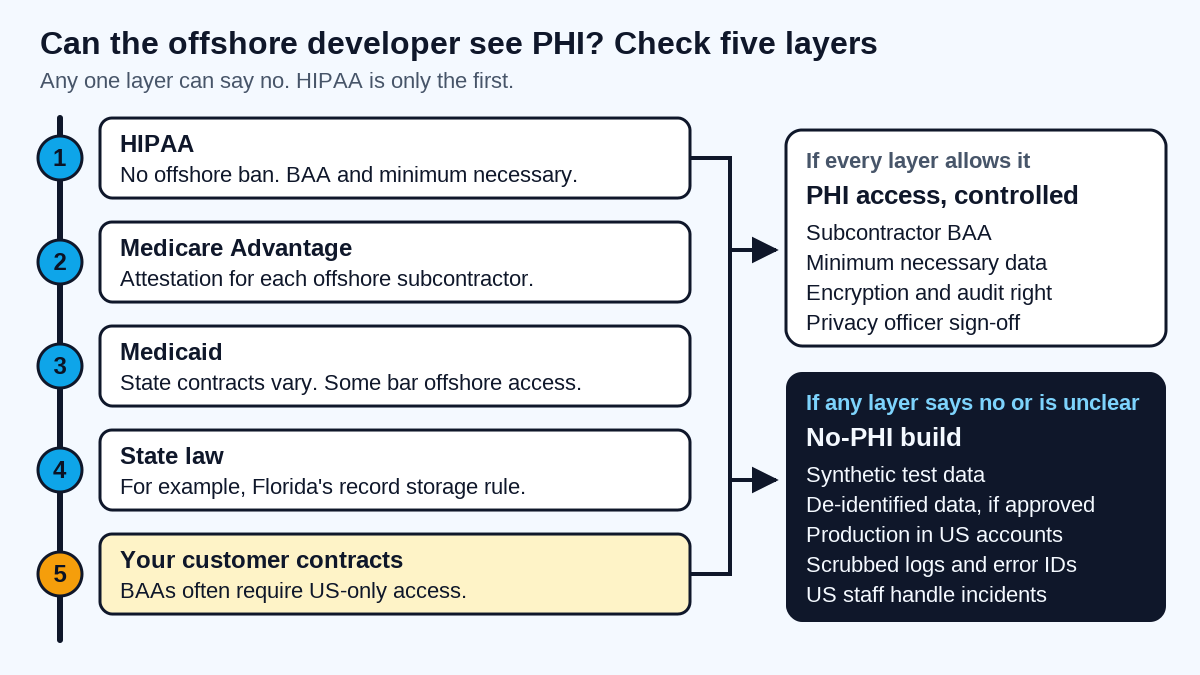
The rules that restrict offshore PHI access in practice come from payer programs, states and contracts, not from HIPAA. There are five layers to check, with Medicaid split into a federal and a state part, and any one of them can say no.
| Layer | What it says | Source |
|---|---|---|
| HIPAA | No offshore ban. Requires a BAA, safeguards and minimum necessary. | 45 CFR 164.502, 164.504 |
| Medicare Advantage and Part D | 2007 CMS guidance requires an attestation for each offshore subcontractor that handles beneficiary PHI, covering who it is, what PHI it can access and its safeguards, plus audits. Not a ban. | Sheppard Mullin |
| Medicaid, federal | Section 6505 of the Affordable Care Act bars states from paying for State Plan items or services to entities located outside the US. December 2010 CMS guidance clarified that administrative support tasks are not prohibited. | Sheppard Mullin |
| Medicaid, state | Varies. Texas's Uniform Managed Care contract terms bar moving HHSC confidential information outside the US and bar remote access to it from outside the US. | Sheppard Mullin |
| State law | Florida's Electronic Health Records Exchange Act bars certain providers from storing qualified electronic health records outside the US, its territories or Canada. | Sheppard Mullin, McDermott |
| Your contracts | Payer, provider and customer contracts often bar offshore access or storage even where the law allows it. | McDermott |
A few details are worth knowing.
Medicaid is a patchwork. The 2014 OIG report found that only 15 of 56 Medicaid agencies had a state-specific requirement on offshore outsourcing. Four of those prohibited it and 11 allowed it, and none of the 11 reported sending PHI offshore. That survey is more than a decade old, so treat it as history, not a current map. McDermott's 2025 analysis lists Wisconsin, Texas and Arizona among states with Medicaid-related restrictions and says Ohio, Missouri and New Jersey restrict offshoring through executive orders.
Florida's rule is about storage. McDermott reads the Florida act as permitting access from abroad if storage stays in the permitted locations. Sheppard Mullin flags the obvious risk: an offshore vendor with access to US-stored records could create copies that break the rule.
Contracts are the layer most often missed. McDermott notes that contract clauses often go beyond what the law requires. If your product sells to hospitals or health plans, your customer's BAA or security addendum may contain a US-only clause that binds you and everyone you hire.
How do you check whether your own contracts allow it?
You check by reading the documents that bind you, in order, and stopping at the first one that prohibits offshore access. In practice:
- List your data sources. Which customers, payers and programs does the PHI come from? Medicare Advantage, Medicaid and commercial data can sit in the same database under different rules.
- Search every BAA and master agreement for "offshore," "outside the United States," "data residency," "location" and "subcontractor." Note whether the clause covers storage, access or both.
- Check subcontractor terms. Many BAAs require written approval or notice before a new subcontractor gets PHI, wherever that person is.
- Check program rules. If you serve Medicare Advantage plans, ask whether an offshore attestation would be needed. If you serve Medicaid, read the state's managed care contract and manuals.
- Write the answer down. A one-page memo from your privacy officer saying what is and is not allowed is worth more than a verbal yes.
If the answer at any step is "no" or "we are not sure," do not look for a clever reading. Design the work so the developer never needs PHI.
How can an offshore developer build without touching PHI?
An offshore developer can build most of a health product without PHI by working in a separate environment with de-identified or synthetic data, while US-based staff handle production. These are the patterns I recommend, from least to most access:
| Pattern | What the developer sees | What it needs |
|---|---|---|
| Synthetic data | Invented records that match the real schema | Someone who knows the data to define realistic shapes and edge cases |
| De-identified data | Real records with identifiers removed under 45 CFR 164.514 | A determination by the covered entity, not by the developer |
| US-only production | Code, logs with PHI stripped, error IDs | US staff or automation for deploys and production debugging |
| Supervised session | A US employee's screen during a specific incident | A policy that treats viewing as access, and a record of the session |
De-identification has a legal definition. Under 45 CFR 164.514, health information is de-identified either when an expert with appropriate statistical knowledge makes a determination, or when 18 listed categories of identifiers are removed, covering names, geographic subdivisions smaller than a state, date elements other than year, phone numbers, email addresses, Social Security numbers, medical record numbers, device identifiers, IP addresses, biometric identifiers, full-face photos and any other unique identifying code. Section 164.502(d) treats information that meets that standard as not individually identifiable. Deleting the name column does not meet it. Free-text notes are the usual trap, because identifiers hide in sentences.
Synthetic data is my default. For building screens, APIs, integrations and most AI features, invented records in the real schema are enough. They also make better test fixtures, because you can write the awkward cases on purpose. If synthetic data is generated from real records, ask your privacy officer whether the method could leak them.
Production stays in US accounts. The developer's access ends at staging. Deploys run through a pipeline. Logs and error reports are scrubbed before they leave the production environment, so a stack trace never carries a patient's details across the border. I cover the access-control side in securing LLM apps in the cloud.
AI features need the same line. If the product sends text to a model, prompts, traces and evaluation sets are all places PHI can end up in front of a developer. My post on HIPAA-aware LLM app architecture covers how to keep PHI out of the prompt and the logs.
What should the contract with an offshore developer say?
The contract with an offshore developer should state plainly whether PHI access is allowed, and if it is not, it should say that the developer will not be given any. For a no-PHI engagement, I suggest writing down:
- The developer will not receive, view or store PHI, and will report it immediately if any reaches them by mistake.
- Which environments the developer can access, and that production is excluded.
- Who on the US side handles production incidents, and during which hours.
- That test data is synthetic or formally de-identified, and who approved it.
- That all cloud accounts, repositories and model provider accounts belong to the client.
If your privacy officer decides PHI access is permitted and needed, that is a different engagement. It needs a subcontractor BAA, minimum necessary access, device and network controls, breach reporting timelines and an audit right. McDermott's analysis recommends offshore-specific BAAs, encryption at rest and in transit, contractual retention limits and at least annual audits of offshore subcontractors.
For the wider picture of working with an engineer abroad, including time zones and IP terms, see hiring an AI engineer in India for US teams.
Work with me
I work from India with synthetic data and staging environments, so production and PHI stay in your US accounts and your compliance team sets the limits. See full-stack development and AI integration, read how I work with US teams, or browse my work and book a scoping call.
Frequently asked
Is it a HIPAA violation to send PHI overseas?
Not by itself. The analyses I read from Sheppard Mullin and McDermott both say HIPAA does not prohibit offshore access to or storage of PHI. A violation comes from missing safeguards, a missing business associate agreement, or disclosing more than the minimum necessary. Separate rules, such as state Medicaid contracts, may still prohibit it.
Does a business associate agreement work with a developer in another country?
A BAA can be signed with a party anywhere, and HIPAA requires one before a subcontractor handles PHI. The practical concern is enforcement. The HHS Office of Inspector General warned in 2014 that there may be limited means of enforcing BAA safeguards abroad, and McDermott notes that contracts often bar offshore access regardless.
Can an offshore developer debug a production problem in a HIPAA system?
Yes, without seeing PHI, if the system is built for it. Scrubbed logs, error identifiers and a reproduction in staging with synthetic data cover most problems. When they do not, a US-based engineer runs the query or the fix in production and shares only what is safe to share.
Is de-identified data still covered by HIPAA?
Information that meets the standard in 45 CFR 164.514 is treated as not individually identifiable under 45 CFR 164.502(d). The standard is strict: either an expert determination or removal of all 18 identifier categories. The covered entity makes that call, and your customer contracts may add their own limits on de-identified data.
Sources
Related services
Building something like this?
Naman Gundaniya takes on full-stack and AI projects: fixed quote after a free 30-minute scoping call, replies within 24 hours.
Get in touch