 By Naman Gundaniya
US State AI Laws for Startups: Colorado, Texas, California
For most US startups, the state AI laws that change product work in 2027 are Colorado's SB 26-189 and California's CCPA rules on automated decision-making, both live from 1 January 2027 for decisions about jobs, credit, housing, healthcare and similar. They require notices, a human review path and records. Texas mostly bans specific harmful uses, and California's frontier and content laws mainly reach larger companies.
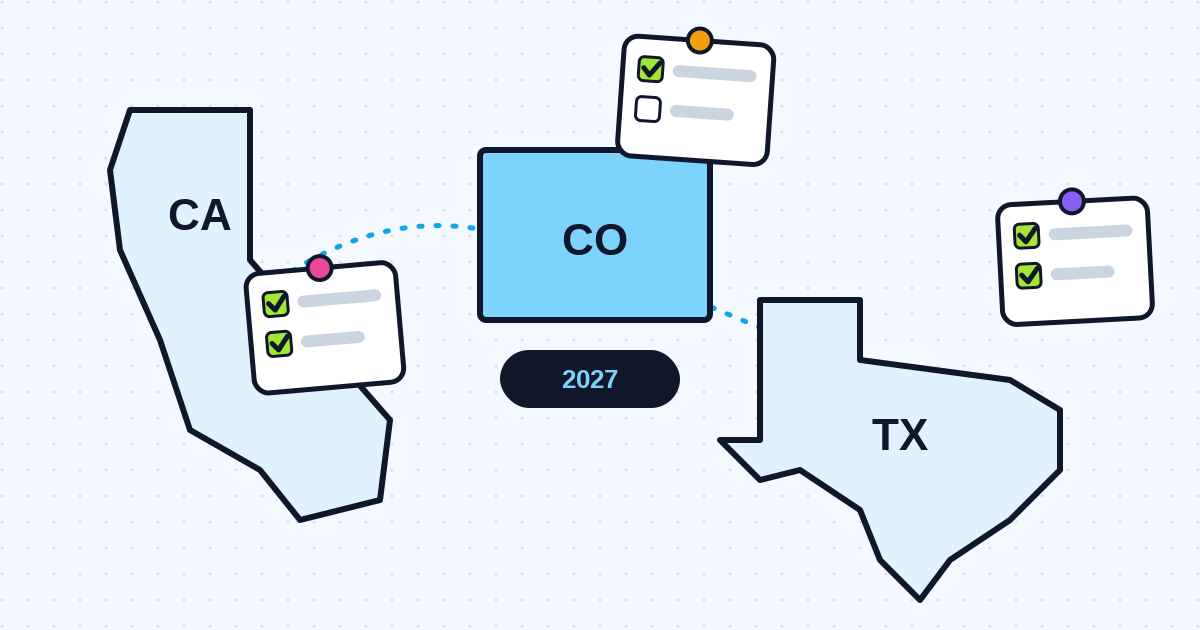
There is no single federal AI law for startups to follow, so the obligations come state by state. Most coverage is written by law firms for their clients. This post is for founders and engineers: which of these laws is likely to touch your product, and what to build so you are not scrambling in December.
This is general information, not legal advice, and it reflects what I could verify as of November 2026. State AI law is moving quickly; check the current position with counsel before you rely on any date.
Which state AI laws apply to a startup in 2027?
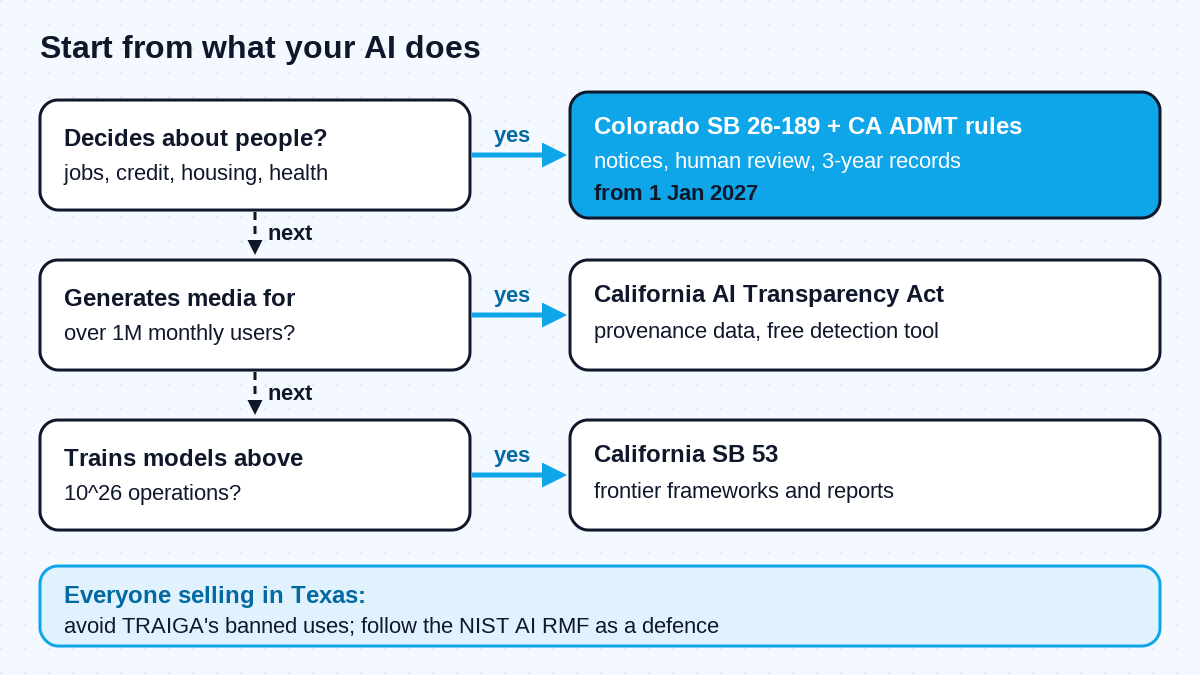
The answer depends on what your AI does, not how advanced it is. The table summarises the five rules worth knowing:
| Law | Who it reaches | What it asks for | Key date |
|---|---|---|---|
| Colorado SB 26-189 | Developers and deployers of tech that materially influences consequential decisions about Colorado consumers | Pre-use notice, adverse-outcome explanation, data correction, human review on request, 3-year records | 1 Jan 2027 |
| California CCPA ADMT regulations | Businesses covered by the CCPA using ADMT for significant decisions | Pre-use notice, opt-out (with exceptions), access to ADMT information | 1 Jan 2027 |
| Texas TRAIGA (HB 149) | Anyone doing business in Texas or developing or deploying AI there | Do not use AI for listed harmful purposes; government agencies must disclose AI | 1 Jan 2026 |
| California AI Transparency Act (SB 942, amended by AB 853) | Generative AI providers with more than one million monthly users | Hidden provenance data in AI images, video and audio, plus a free detection tool | 2 Aug 2026 |
| California SB 53 | Developers training models above 10^26 operations | Safety frameworks, transparency reports, incident reporting | Signed 29 Sep 2025 |
What does Colorado's new AI law require from 1 January 2027?
Colorado's law requires notices, a human review path and records whenever covered technology materially influences a consequential decision. SB 26-189 repealed and replaced the 2024 Colorado AI Act. Holland & Knight reports it was signed on 14 May 2026 (a Lathrop GPM alert gives 20 May) and takes effect on 1 January 2027. It dropped the 2024 law's duty of reasonable care, risk management programmes and annual impact assessments.
Consequential decisions cover education, employment, property leases or purchases, financial services, insurance, healthcare and essential government services. For deployers, Lathrop summarises the duties as:
- a clear notice before covered technology is used to materially influence such a decision,
- within 30 days of an adverse outcome, a plain-language description of the decision and the technology's role, and a simple way to ask for more information,
- the right to correct inaccurate personal data,
- on request, "meaningful human review and reconsideration, to the extent commercially reasonable", by a trained person with authority to approve, modify or override, who must "not default to system output",
- records kept for at least three years after the decision.
Developers selling into these uses must give deployers documentation on intended uses, known limitations and how to run human review, and tell them about material updates. Only the Colorado Attorney General enforces the law, with no private right of action and a 60-day cure period for most violations.
For a startup, the engineering work is a decision record per outcome, a notice in the flow, a review queue and a retention policy. The patterns in my guide to human-in-the-loop approvals cover the review side.
What do California's rules ask of a startup?
California has two rule sets most startups should check, and two that mostly reach larger companies. The one with the widest reach is the CCPA regulations on automated decision-making technology. Manatt reports that businesses using ADMT for significant decisions must comply from 1 January 2027. If the CCPA applies to your business, you will need a pre-use notice covering the purpose, the categories of personal information used, the outputs, how far humans are involved and consumers' rights. People can opt out, with exceptions, including where you offer a clear way to appeal to a human reviewer. They can also ask for information about the logic and how the output affected their decision.
The California AI Transparency Act became operative on 2 August 2026. Morgan Lewis explains that it covers generative AI providers with "more than one million monthly visitors or users", requires hidden provenance data in AI-generated images, video and audio, and a free public detection tool. It does not apply to AI-generated text. Penalties are $5,000 per violation, with each day counted separately.
SB 53 targets frontier developers. The Future of Privacy Forum explains it applies to models trained with more than 10^26 operations, with heavier duties for developers with annual revenue above $500 million. A startup calling a model through an API is not the obvious target, though FPF does not analyse that case directly.
What does Texas's TRAIGA mean for a startup?
Texas's law is mostly a list of things not to build. Greenberg Traurig's summary says TRAIGA took effect on 1 January 2026 and prohibits using AI to incite self-harm, crime or violence, to infringe constitutional rights, to unlawfully discriminate against a protected class (disparate impact alone is not enough to show intent), or to produce certain sexually explicit content, including deepfakes. The duty to disclose AI interactions falls on government agencies.
The Texas Attorney General enforces it, with a 60-day cure period. Penalties run from $10,000 to $12,000 per curable violation and $80,000 to $200,000 per uncurable one. There is a defence for substantially complying with the NIST AI Risk Management Framework, which makes that framework a sensible default for a startup's AI governance whether or not you sell in Texas.
What should a startup build before 1 January 2027?
One set of features covers most of what Colorado and the California ADMT rules ask for. I would build it once, behind configuration, rather than per state:
- Decision inventory. List every place your product makes or materially influences a decision about a person, and which category it falls in.
- Notices. A pre-use notice in the flow and an adverse-outcome message with the main reasons and a link to ask for more.
- Human review queue. A request button, a reviewer who sees inputs and reasons, and the ability to change the outcome.
- Decision records. Model or rule version, input field names, output, reviewer action, kept for at least three years. My post on LLM observability covers how to log without storing sensitive values in plain text.
- Data correction. A route for people to fix inaccurate data that fed a decision.
If you also sell into Europe or the UK, the same features go a long way towards the EU AI Act's 2027 obligations and the UK's safeguards for automated decisions.
Work with me
I build AI features for US startups with decision records, review queues and notices designed in from the start, so compliance is a configuration change rather than a rewrite. See AI integration and SaaS MVP development, or browse my work and book a scoping call.
Frequently asked
Do US state AI laws apply to my startup?
They apply if your product's AI materially influences decisions about consumers in areas such as employment, credit, housing, insurance, healthcare or education, in a state with such a law. Colorado's law and California's CCPA ADMT rules both start on 1 January 2027. Texas's TRAIGA applies to anyone doing business in Texas but mainly bans specific uses.
What does the Colorado AI law require?
From 1 January 2027, deployers must give notice before covered technology materially influences a consequential decision, explain adverse outcomes within 30 days, allow data correction, offer meaningful human review on request and keep records for three years. The Attorney General enforces it, with no private right of action.
Does California SB 53 apply to startups?
Probably not, if you use models rather than train them. It targets developers training models above 10^26 operations, with heavier duties for those with more than $500 million in annual revenue. Check the California ADMT rules and the AI Transparency Act instead.
Is there a federal AI law that overrides state laws?
I could not verify a federal law that replaces these state rules as of November 2026. Treat the state laws as applying, watch for federal developments, and ask counsel to confirm the position before launch.
Sources
Related services
Building something like this?
Naman Gundaniya takes on full-stack and AI projects: fixed quote after a free 30-minute scoping call, replies within 24 hours.
Get in touch