 By Naman Gundaniya
How to Become an AI Automation Engineer
To become an AI automation engineer, learn to map business processes, build them in a no-code tool such as n8n, Make or Zapier, then add code: APIs, webhooks, JavaScript or Python, and LLM calls with structured output. Finish with code-first agents and testing. Prove each stage with a small, real project and write up what it saved.
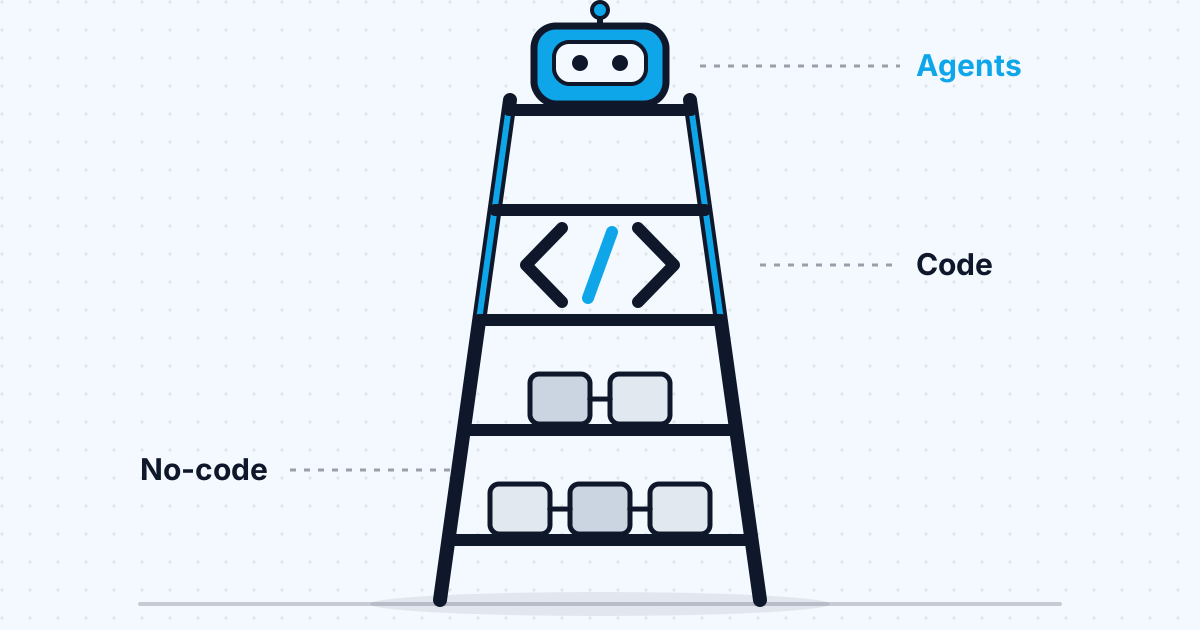
AI automation engineering sits between three older jobs: the integration developer who wires systems together, the RPA developer who automates clicks, and the AI engineer who builds with models. I compared those roles in AI automation engineer vs RPA developer. This post is the practical follow-up: if you want the job, what do you learn, in what order, and how do you get the first clients?
I do this work as a freelance Forward Deployed Engineer, so this is the path I would follow if I started again, not a course syllabus. It assumes you can already use a computer comfortably and are willing to learn some code. You do not need a computer science degree.
What does an AI automation engineer actually do?
An AI automation engineer takes a repetitive business process, decides which parts a model should handle and which should stay as fixed rules, builds the workflow, connects it to the client's systems and keeps it reliable. The AI is usually one step among several, not the whole system.
A typical week involves less model work than people expect. Most of the time goes on understanding the process, cleaning inputs, handling errors, asking who should approve what, and making sure the client can run the thing after you leave, which is what a proper handover checklist is for. The model call is often the easiest part to write and the hardest part to make dependable.
That shapes the learning path. Process and integration skills come first, because a clever prompt inside a fragile workflow still fails. The model skills matter too, but they sit on top of the plumbing, not in place of it. Clients rarely ask which model you used; they ask whether the thing still works on Monday morning and who to call when it does not.
What is the learning path, rung by rung?
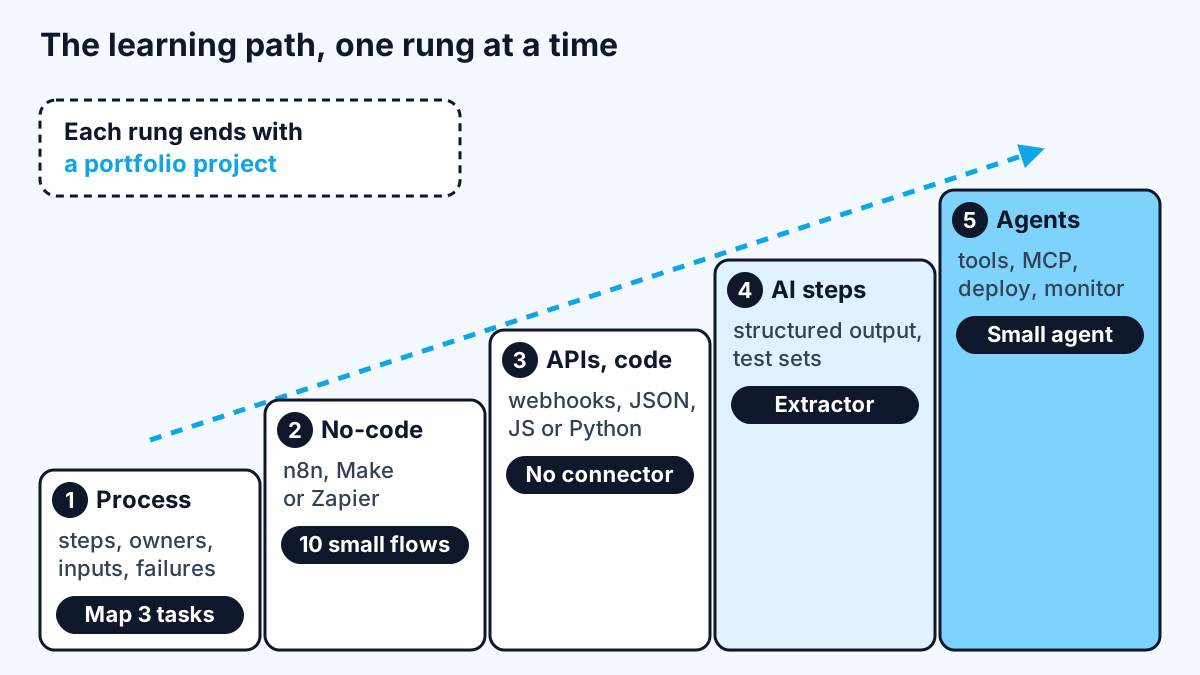
The path has five rungs. Each one builds on the last, and each has a project that proves you can do it.
Rung 1: process mapping
Before any tool, learn to write down a process: the trigger, every step, who does it, what data moves, and where it goes wrong. Pick a real task, your own invoicing or a friend's booking flow, and map it on paper. This is the skill clients pay for most and the one beginners skip. My AI automation audit is the method I use to find and score these tasks.
Rung 2: no-code workflows
Learn one workflow tool well. n8n, Make and Zapier all teach the same core ideas: triggers, actions, data mapping, filters, branches and error paths. I compared how they differ, especially on pricing, in n8n vs Zapier vs Make. If you plan to go further into AI work, n8n is a good choice because its AI documentation covers building workflows that "connect different LLM providers such as OpenAI, Anthropic, and Google", plus agents, tools, memory and vector databases inside the same tool.
Rung 3: APIs and code
No-code tools run out quickly without code. Learn what an HTTP request is, how webhooks work, how to read API documentation, and how to shape JSON. Then learn one language, JavaScript or Python, to the point where you can write a small function, call an API and handle an error. Most workflow tools have a code step, so you can practise inside the tool you already know.
Rung 4: AI steps
Now add models. Start with narrow, testable tasks: classify an email, extract fields from a document, summarise a ticket. Learn to ask for structured output so the next step can rely on it, and learn to test: keep a set of example inputs with expected outputs and rerun them every time you change the prompt. Testing is what separates someone who built a demo from someone a business can trust.
Rung 5: code-first agents
Finally, learn when a workflow should become an agent and when it should not. Anthropic's guide to building effective agents draws the line clearly: workflows are "systems where LLMs and tools are orchestrated through predefined code paths", while agents "dynamically direct their own processes and tool usage." It recommends "finding the simplest solution possible, and only increasing complexity when needed", and suggests developers "start by using LLM APIs directly" rather than reaching for a framework first. Build one small agent in code that calls two or three tools, deploy it, and log what it does. My walkthrough of building an AI agent with MCP and Claude is one way to start.
Which skills matter most at each stage?
The skills split into technical and client-facing, and the client-facing ones matter more than most roadmaps admit.
| Skill | Why it matters | How to practise |
|---|---|---|
| Process mapping | Most failed automations automate the wrong thing | Map three real processes end to end |
| One workflow tool | Fast delivery for simple jobs | Build ten small workflows in n8n, Make or Zapier |
| HTTP, webhooks, JSON | Every integration depends on them | Connect two apps without a built-in connector |
| JavaScript or Python | Handles the cases no-code cannot | Rewrite one workflow fully in code |
| Prompting with structured output | Makes AI steps reliable | Build an extractor with a fixed schema |
| Testing and evals | Proves the AI step works on real inputs | Keep a test set and rerun it after changes |
| Error handling and monitoring | Automations fail quietly | Add alerts and retries to every project |
| Scoping and handover | Clients pay for outcomes they can keep | Write a one-page handover for each project |
What portfolio projects prove you can do the job?
Good portfolio projects are small, real and measured. A client looking at your work wants to see a problem, what you built, and what changed. Three or four of these beat twenty tutorials.
- Inbox triage. Classify incoming emails, draft replies for review, and log them to a sheet or helpdesk. Shows rungs 2 to 4.
- Document extraction. Pull fields from invoices or forms into a spreadsheet, with low-confidence results flagged for a person. Shows structured output and review queues.
- Lead enrichment. Take a new form submission, research the company from public sources, and write a short brief for a salesperson. Shows APIs and careful prompting.
- A small agent in code. A booking or support assistant that calls two or three tools, with a test set and a log. Shows rung 5.
For each one, write a short case study: the process before, the workflow diagram, what went wrong during the build, and the result in plain numbers you actually measured. If you have not measured anything, say what you would measure instead. Honest write-ups read better than inflated ones.
Where do clients find AI automation engineers?
Clients mostly find automation engineers through freelance marketplaces, tool communities and referrals, and the engineers who win steady work usually have their own site with case studies too.
- Freelance marketplaces. Upwork and similar sites are where many small businesses post automation jobs. They reward a strong profile, fast replies and good reviews. My own freelance work runs through Upwork, where I am Top Rated Plus.
- Tool communities. The n8n, Make and Zapier community forums have people asking for help and posting jobs. Answering questions well is a slow but reliable way to be noticed.
- Vendor partner programmes. These exist, but they are often aimed at established teams. n8n's expert partner page describes a closed pilot that expects partners to have at least three active n8n customers and to work in specific regions, so treat these as a later step, not a starting point.
- Your own site. A portfolio with detailed case studies answers the questions a client would ask on a call. It also compounds over time in a way marketplace profiles do not.
- Referrals. After the first few projects, most good work comes from people you have already helped.
Work with me
If you are a business looking for someone who already does this work, see workflow automation and AI agent development, or browse my work, including the AI video automation pipeline. Book a scoping call and we can map your process together.
Frequently asked
How long does it take to become an AI automation engineer?
It depends on where you start. Someone already comfortable with no-code tools can reach paid AI automation work after building a few real projects with APIs and AI steps. Someone starting from zero should expect to work through all five rungs, with a project at each, before taking on client work.
Do AI automation engineers need to code?
Not on day one, but yes to go far. No-code tools handle simple workflows, but integrations without connectors, custom error handling, testing and code-first agents all need JavaScript or Python. Learning to code is what moves you from small jobs to the projects businesses depend on.
Is n8n, Make or Zapier best for learning AI automation?
Any of them teaches the core ideas of triggers, actions and data mapping. n8n is a good choice for AI work because its documentation covers agents, tools, memory and vector databases inside the same tool. Learn one well before trying the others.
What should an AI automation engineer portfolio include?
It should include three or four small, real projects, each with the problem, a workflow diagram, what you built and what changed. Good examples are inbox triage, document extraction with a review queue, lead enrichment and a small agent written in code with a test set.
Is AI automation engineering a good career?
It is a practical one, because nearly every business has repetitive processes and few have people who can both map them and build reliable AI steps. The engineers who last are the ones who learn to code, test their AI steps and hand over work the client can maintain.
Sources
Related services
Building something like this?
Naman Gundaniya takes on full-stack and AI projects fixed quote after a free 30-minute scoping call, replies within 24 hours.
Get in touch