 By Naman Gundaniya
AI Automation Engineer vs RPA Developer vs AI Engineer
An RPA developer automates fixed, rule-based steps by having software robots repeat what a person does on screen. An AI engineer builds products and features around models. An AI automation engineer sits between them: they connect your existing systems through APIs and workflow tools, then add a model only at the steps that need judgement, such as reading an email or classifying a document.
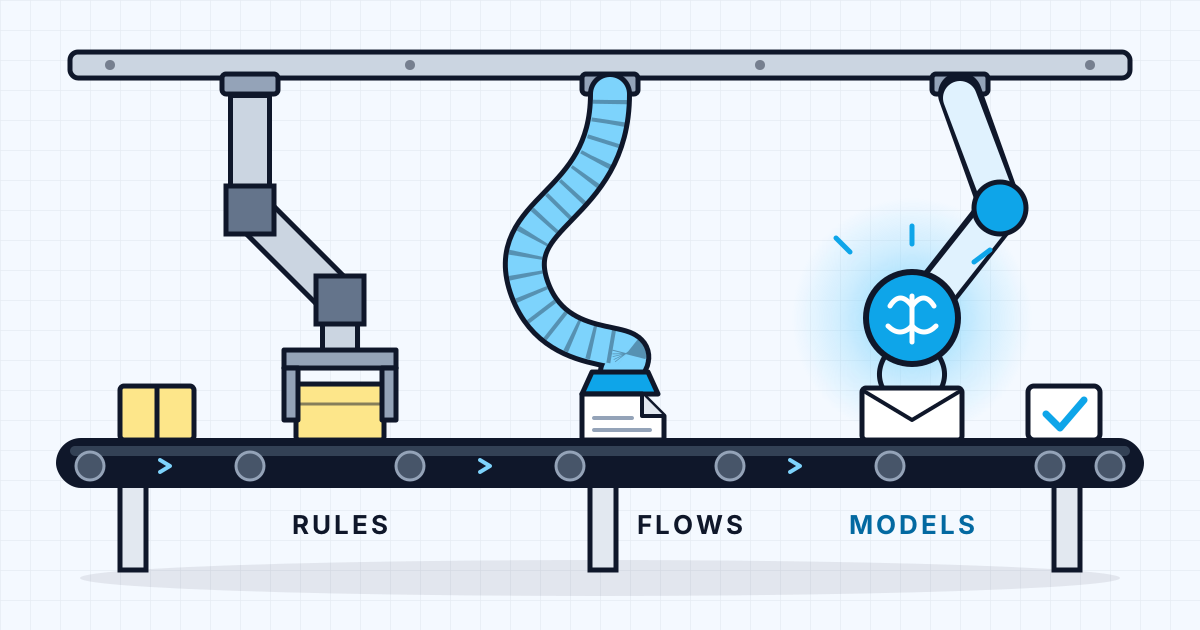
The titles overlap, job boards use them loosely, and a lot of the search results for "AI automation engineer" are marketplace profiles rather than explanations. If you are trying to decide who to hire for a workflow, the label matters less than the kind of work. This post sets out what each role actually does, where they overlap, and how to tell which one your problem needs.
What does an RPA developer do?
An RPA developer builds software robots that copy what a person does in an application: clicking, typing, copying values from one screen to another. UiPath, one of the largest RPA vendors, describes RPA as using "software robots to automate repetitive, rule-based tasks" and says it "mimics human actions in digital systems" on its RPA overview page.
That makes RPA the right tool in a specific situation. The same page notes it is useful "where systems lack APIs or require structured user interactions". Think of an old desktop finance system with no API, or a government portal that only offers a web form. A robot that logs in and fills the form is often the only practical automation.
The trade-off is fragility. A robot that works by screen position or element selector breaks when the screen changes, and it cannot cope with input it was not told about. RPA developers spend a lot of their time on exception handling and maintenance for exactly this reason.
What does an AI engineer do?
An AI engineer builds software where a model is part of the product: a chat assistant inside a SaaS app, retrieval over a company's documents, an agent with tools, or the evaluation and monitoring that keeps those features reliable. The work is closer to product engineering than to process automation. The customer is usually the end user of an app, not an operations team.
Typical deliverables are an AI feature, an API, a retrieval pipeline or an agent, along with the tests and cost controls around it. I wrote about the mechanics in how to build an AI agent with MCP and Claude; that is AI engineering work, even when the agent ends up automating a business task.
What does an AI automation engineer do?
An AI automation engineer automates business processes end to end, using APIs and workflow tools for the predictable steps and a model for the steps that need reading, judging or writing. The customer is an operations, sales, support or finance team, and the deliverable is a running workflow, not a product feature.
A typical example: invoices arrive by email, a model extracts the supplier, amount and due date, code checks the values against the purchase order, mismatches go to a person, and matches are posted to the accounting system through its API. Only one step uses a model. The rest is ordinary integration work.
That split follows advice I agree with from Anthropic's guide to building effective agents. It separates workflows, "systems where LLMs and tools are orchestrated through predefined code paths", from agents, where models "dynamically direct their own processes and tool usage", and recommends "finding the simplest solution possible, and only increasing complexity when needed." Most business automation is a workflow with one or two model calls, not an autonomous agent.
The tools are usually a mix: n8n, Zapier or Make for the plumbing, small services in TypeScript or Python where the logic outgrows a visual builder, and a hosted model behind an API.
How do the three roles compare?
The quickest way to see the difference is to compare what each one is good at and where each one gets stuck.
| RPA developer | AI automation engineer | AI engineer | |
|---|---|---|---|
| Main job | Copy human screen work with robots | Automate a business process across tools | Build AI features into a product |
| Typical input | Structured screens and forms | Emails, documents, CRM and app events | User requests, documents, product data |
| Core tools | RPA platforms (UiPath and similar) | APIs, n8n, Zapier or Make, small services, LLM APIs | LLM APIs, retrieval, agent frameworks, evals |
| Handles messy input | Poorly without AI add-ons | Yes, at the model steps | Yes, it is the core of the work |
| Main risk | Breaks when screens change | Wrong model output acting on real data | Quality and cost of the feature at scale |
| Who it serves | Operations and back office | Operations, sales, support, finance | End users of an app |
| Best when | The system has no API | Several tools and some judgement steps | AI is part of the product you sell |
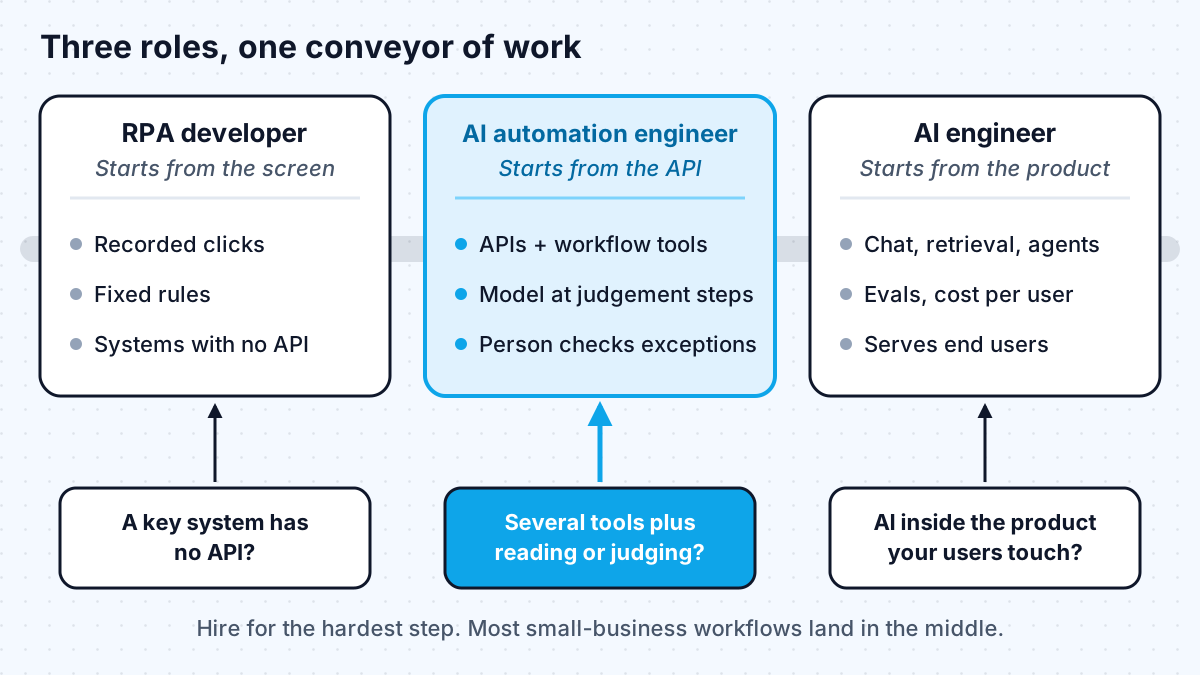
The roles are converging at the edges. UiPath's own agentic automation launch in April 2025 described bringing "proven RPA, AI models, and human expertise into cohesive workflows". So a modern RPA developer may well use models, and an AI automation engineer may use a robot for the one system with no API. The difference that remains is the default: RPA starts from the screen, AI automation starts from the API.
Which one should you hire for your workflow?
Hire for the hardest step in the process, not for the most fashionable label. Three questions settle it in most cases.
- Does every system involved have an API? If a key system has no API and no export, you need someone who can drive the screen, which is RPA territory. If they all have APIs, you rarely need RPA at all.
- Does any step need reading or judgement? Classifying emails, pulling fields from PDFs, drafting replies, or deciding which queue a ticket belongs in all need a model. Pure data movement between tools does not, and a plain workflow builder will do.
- Is the AI for your team or for your customers? If the output is an internal process, an AI automation engineer is the fit. If the output is a feature your users touch inside your product, you want an AI engineer, because the job then includes product design, latency, evals and cost per user. I walk through that path in adding AI to an existing app.
Many small businesses land on the middle option. If you are not sure where to start, my guide to AI automation for small business covers the first steps.
What should an AI automation engineer always build in?
Whoever you hire, a few safeguards separate a reliable automation from a demo. OWASP lists excessive agency as a top risk for LLM applications and recommends limiting the tools an agent can call "to only the minimum necessary", limiting their permissions the same way, and using "human-in-the-loop control to require a human to approve high-impact actions before they are taken."
In practice, on client work I expect:
- validation in code of every value a model produces before it touches a real system,
- a review queue for low-confidence or high-value cases,
- logs of each run, so a wrong result can be traced to its input,
- credentials and workflows owned by the client's accounts, not the builder's,
- a short runbook explaining what each workflow does and how to switch it off.
If a candidate cannot explain how they handle the case where the model is wrong, keep looking. That answer tells you more than any job title.
Work with me
I design and build AI automations that connect the tools a business already uses, with models only where they earn their place and a person in the loop for anything risky. See workflow automation and AI agent development, or browse my work and book a scoping call.
Frequently asked
What is the difference between an AI automation engineer and an RPA developer?
An RPA developer automates rule-based tasks by having software robots repeat on-screen human actions, which suits systems without APIs. An AI automation engineer connects systems through APIs and workflow tools and uses a model for steps that need reading or judgement. The first starts from the screen; the second starts from the API.
Is an AI automation engineer the same as an AI engineer?
No. An AI engineer builds AI features into a product for its end users, such as chat, retrieval or agents. An AI automation engineer automates internal business processes across existing tools. The skills overlap, but the deliverable and the customer are different.
Is RPA being replaced by AI agents?
Not entirely. RPA is still the practical option when a system has no API and the steps are fixed. What is changing is that RPA platforms now add AI models and agents, and AI automation increasingly handles the messy, judgement-heavy steps that rules alone could not.
What skills should an AI automation engineer have?
They should be comfortable with APIs and webhooks, at least one workflow tool such as n8n, Zapier or Make, enough code to write a small service when a visual builder runs out, and prompt design with structured outputs. Just as important are error handling, logging and a habit of keeping a person in the loop for risky actions.
Do I need an AI automation engineer or just a Zapier account?
If the workflow only moves data between tools on simple rules, a Zapier, Make or n8n account and some patience may be enough. Bring in an engineer when steps need judgement, when errors would be costly, or when the workflow touches several systems and needs logging, review queues and ownership set up properly.
Sources
Related services
Building something like this?
Naman Gundaniya takes on full-stack and AI projects fixed quote after a free 30-minute scoping call, replies within 24 hours.
Get in touch