 By Naman Gundaniya
Gemini 4 Argon for Builders: Pricing, Limits, Fit
Gemini 4 Argon is Google's frontier reasoning model, called as gemini-4-argon on the Gemini API and Google Cloud. It has a 1,048,576-token window shared by input and output, can write up to that much with long decoding, and costs $2 input and $10 output per million tokens until 30 November 2026, then $4 and $20. It suits long agentic and document-heavy jobs.
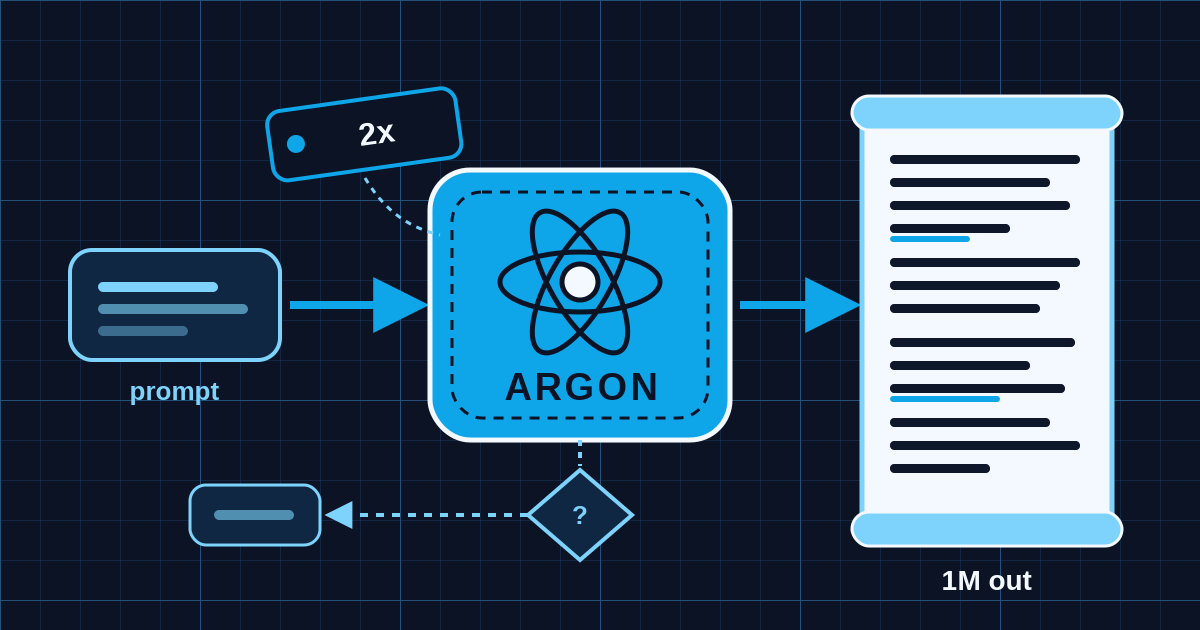
Google announced Argon on 30 September 2026 and opened it to paid API customers in October. As of late November 2026, the introductory price ends in a week, so anyone running cost estimates now needs both numbers. This post collects the facts that matter for a build decision from Google's own pages, then compares Argon with the Claude and GPT models I would weigh it against.
What is Gemini 4 Argon, and where can you call it?
Gemini 4 Argon is a Gemini 4 frontier model that Google describes as "built to sustain deep reasoning across complex, long-horizon workflows", aimed at software engineering, legal and finance work, and cyber defence, in the launch post from Google DeepMind dated 30 September 2026. At launch it went first to vetted cyber defenders through Google's Fairwind Program, with a wider release promised for paid API customers.
That wider release came in October. The Google Cloud launch post says developers can call Argon "via API in Gemini platform under model ID gemini-4-argon", and in Google AI Studio and Antigravity. The Gemini Enterprise Agent Platform release notes list gemini-4-argon as generally available from 13 October 2026, alongside a gemini-4-argon-cyber-permissive variant that is limited to Fairwind Program members. Vertex AI services now sit inside that Agent Platform, so this is the page to watch if your Google Cloud project used Vertex before.
What Argon accepts and returns, from the model page in the Gemini API docs:
- Inputs: text, images, video, audio and PDF. Output: text only.
- Supported: function calling, structured outputs, code execution, computer use, file search, URL context, Google Search and Maps grounding, and thinking at low, medium and high levels.
- Not supported: the Live API, image generation and audio generation.
What are the real limits on Gemini 4 Argon's output?
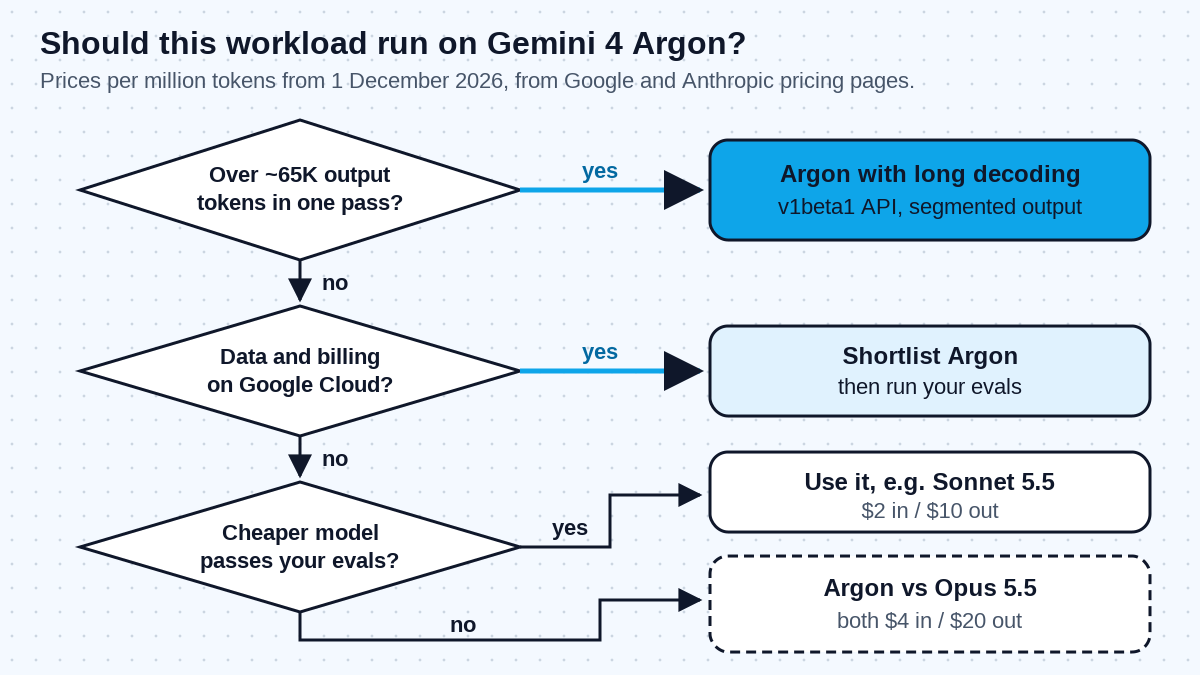
Gemini 4 Argon's 1,048,576-token limit is one budget shared by input and output, not 1M tokens of output on top of a full prompt. The model page gives a default maximum of 65,536 output tokens per synchronous call, rising to 1,048,576 only with long decoding.
The release notes add the detail that decides your code path. Long decodes extend output "up to 1,048,576 tokens (minus input tokens)" past a per-segment limit of 65,536 tokens when streaming or 32,768 when not. On the GenerateContent API, long decoding works only in the v1beta1 API, not v1. Long decodes on the Interactions API became generally available on 5 November 2026.
In practice that means three things for a build:
- A normal request still caps out at about 65K tokens of output. Plan for that unless you deliberately use long decoding.
- Long decoding is a continuation loop. Your code has to handle segments, and it has to survive a failure halfway through a very long write.
- A 900K-token prompt leaves roughly 150K tokens for output. The two compete for the same window.
The long-output ability is worth having for jobs such as rewriting a large codebase module or producing a full report from a document set in one pass. For chat, support agents and most tool-calling loops, 65K is already far more than you need.
How much does Gemini 4 Argon cost before and after 30 November 2026?
Gemini 4 Argon's standard price doubles on 1 December 2026. The Gemini API pricing page lists these paid-tier rates per million tokens, with no free tier for this model:
| Tier | Input, to 30 Nov 2026 | Output, to 30 Nov 2026 | Input, from 1 Dec 2026 | Output, from 1 Dec 2026 |
|---|---|---|---|---|
| Standard | $2.00 | $10.00 | $4.00 | $20.00 |
| Batch or Flex | $1.00 | $5.00 | $2.00 | $10.00 |
| Priority | $3.60 | $18.00 | $7.20 | $36.00 |
| Cached input (standard) | $0.10 | n/a | $0.20 | n/a |
Two pricing details matter for agents. First, output prices include thinking tokens, so a high thinking level raises your bill even when the visible answer is short. Second, caching is implicit only: the pricing page says explicit caching is not supported for Argon, so you cannot pin a large shared prefix the way you can with some other providers. Unlike Gemini 3.1 Pro, Argon has no higher rate for long prompts.
A worked example, using Google's standard rates. Take an agent that handles 10,000 tasks a month, each sending 20,000 input tokens and getting 2,000 output tokens back:
| Scenario | To 30 Nov 2026 | From 1 Dec 2026 |
|---|---|---|
| No cache hits: 200M input, 20M output | $600 | $1,200 |
| 15,000 of each prompt's tokens hit the cache | $315 | $630 |
The cached rows assume the implicit cache actually hits, which you cannot force. Measure your real hit rate in the usage data before you rely on it. My post on prompt caching explains why a stable prompt prefix is what gets you there.
When should you pick Gemini 4 Argon over Claude or GPT?
Pick Gemini 4 Argon when you need very long output in one job, when your data and billing already live in Google Cloud, or when its video and long-document skills match your inputs. List prices alone will not decide it, because from 1 December Argon costs the same per token as models it competes with.
These are list prices per million tokens from each vendor's pricing page as of late November 2026: Google, Anthropic and OpenAI (OpenAI rates are for prompts up to 272K tokens).
| Model | Input / output from 1 Dec 2026 | Where it fits best |
|---|---|---|
| Gemini 4 Argon | $4 / $20 | Very long outputs, video and long documents, Google Cloud shops |
| Claude Sonnet 5.5 | $2 / $10 | Everyday coding and agents where cost matters |
| Claude Opus 5.5 | $4 / $20 | Hard open-ended work needing sustained judgement |
| Claude Fable 5.2 | $8 / $40 | The hardest long-running agent jobs |
| gpt-6.2-sol | $2 / $10 | Teams already on the OpenAI stack |
| gpt-6.2-astra | $8 / $40 | OpenAI's top tier for difficult tasks |
A warning on comparing these rows. Tokenizers differ between vendors, so the same text costs a different number of tokens on each, and a model that needs fewer steps to finish a task can be cheaper even at a higher rate. Google's benchmark claims for Argon, such as 77.9% on DeepSWE v1.1 in the launch post, are vendor-reported. The only comparison I trust for a client is the same task set, run on each candidate, with cost per finished task measured. For a wider view of the two other APIs, see Claude API vs OpenAI API.
On client projects I treat the model as a swappable part. I keep prompts, tools and evals provider-neutral where I can, so moving one workflow to Argon is a config change plus an eval run, not a rewrite.
What should you check before moving a workload to Gemini 4 Argon?
Check five things before moving a workload to Gemini 4 Argon: the price you will pay after 30 November, your API version, your cache hit rate, data terms, and your fallback.
- Budget at the December price. Any estimate built on $2 and $10 is out of date in a week.
- Pick the API version on purpose. Long decoding needs
v1beta1on GenerateContent. If you need the 1M output path, decide whether a beta API is acceptable for production. - Measure caching. With implicit caching only, keep the shared part of every prompt identical and first, then check the cached-token counts.
- Read the data terms for your tier. The pricing page notes that the invite-only Contributor tier may use prompts to improve Google's products. Make sure you are not on it by accident with client data.
- Keep a second model wired in. Rate limits and outages happen to every provider, as covered in my post on Bedrock vs Azure AI Foundry vs Vertex AI.
Work with me
I build AI features and agents for teams abroad from India, and I pick models by running the client's own tasks through evals rather than by headline benchmarks. See AI integration and AI agent development if you want a second opinion on whether Argon belongs in your stack.
Frequently asked
What is the model ID for Gemini 4 Argon?
The model ID is gemini-4-argon on both the Gemini API and Google Cloud. Google also lists gemini-4-argon-cyber-permissive, a version without cyber guardrails that is available only to organisations accepted into its Fairwind Program.
Is there a free tier for Gemini 4 Argon?
No. Google's Gemini API pricing page says Argon is not available on the free tier, so you need a paid tier to call it. There is an invite-only Contributor tier at lower prices, but prompts sent on it may be used to improve Google's products.
Will Gemini 4 Argon's price go up again after December?
Google has published only two price points: the introductory rate to 30 November 2026 and the standard rate from 1 December 2026. Nothing on the pricing page announces a further change, but vendor prices do move, so recheck before you sign a fixed-price deal that bundles model costs.
Can Gemini 4 Argon really write a million tokens in one response?
Only with long decoding, and only up to the shared limit of 1,048,576 tokens minus your input. A normal call stops at 65,536 output tokens by default, and long decoding streams the result in segments that your code has to stitch together.
Sources
- launch post from Google DeepMind (blog.google)
- Google Cloud launch post (cloud.google.com)
- Gemini Enterprise Agent Platform release notes (docs.cloud.google.com)
- model page in the Gemini API docs (aistudio.google.com)
- Gemini API pricing page (aistudio.google.com)
- Anthropic (platform.claude.com)
- OpenAI (developers.openai.com)
Related services
Building something like this?
Naman Gundaniya takes on full-stack and AI projects: fixed quote after a free 30-minute scoping call, replies within 24 hours.
Get in touch