 By Naman Gundaniya
AI-First vs Traditional Development: What Changes
AI-first software development moves the bottleneck. In a traditional lifecycle, writing code is the slow, expensive step. When coding agents generate most of the code, that step becomes cheap and fast, while specifying, reviewing and verifying the code do not get cheaper at the same rate. Teams that win adjust their process around review, tests and clear specs.
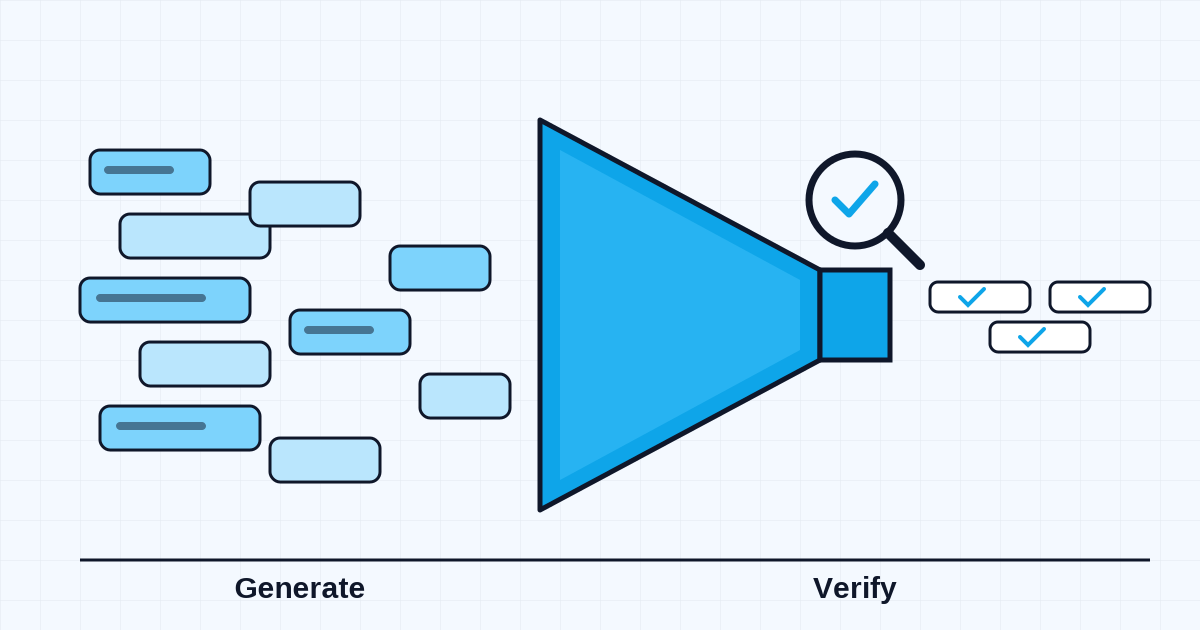
I build client software both ways, and the honest summary is that AI-first changes where the effort goes more than how much effort there is. The evidence on speed is mixed, the evidence on adoption is not, and the practical lesson is about process. This post compares the two lifecycles stage by stage, then looks at what the research actually supports.
How does AI-first development differ from traditional development?
AI-first development differs from traditional development in who writes the first draft of the code: in an AI-first team, a coding agent produces most first drafts from a written spec, and engineers spend their time on the spec, the review and the checks. In a traditional team, engineers write the code themselves and reviewers read a smaller amount of it.
The table compares the six stages I work through on every project.
| Stage | Traditional | AI-first | Where effort moves |
|---|---|---|---|
| Spec | Ticket plus conversation; gaps filled while coding | Written spec the agent can follow, with acceptance criteria | Up: vague specs produce confident wrong code |
| Build | Engineer writes code; hours to days | Agent drafts code; minutes to hours | Down sharply |
| Review | Reviewer reads a human-sized diff | Reviewer reads larger, more frequent diffs | Up: the new bottleneck |
| Test | Tests written alongside or after code | Tests written first and used by the agent as its check | Up front, then automated |
| Release | Pipeline gates and manual checks | Same gates, more often, with more changes per release | Same work, higher volume |
| Maintain | Authors remember why code exists | Decisions must be written down, because no human wrote the code | Up: documentation matters more |
The pattern is that one stage gets much cheaper and the stages around it get more important. That is the whole story of AI-first development in one sentence, and the rest of this post is detail.
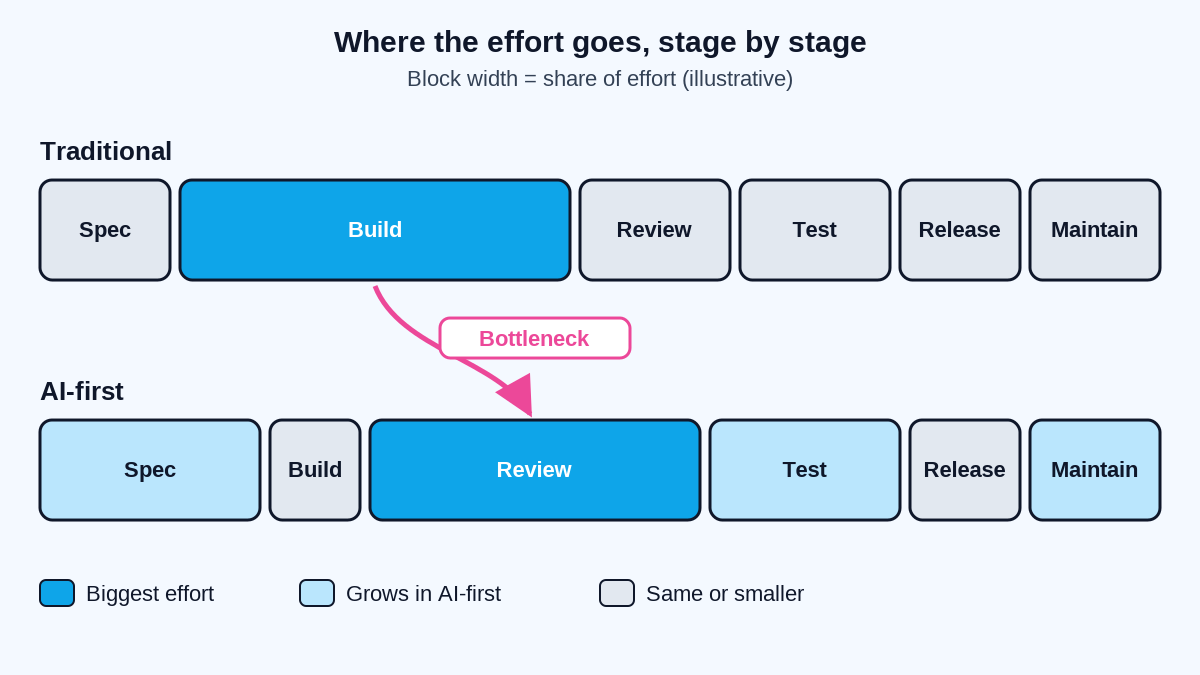
Why does review become the bottleneck?
Review becomes the bottleneck because generation scales with compute while review scales with human attention. A coding agent can produce in an hour more code than a reviewer can read carefully in a day, so unless the team changes how it reviews, changes queue up or get waved through.
Two effects make this worse:
- Volume. More pull requests, and larger ones, arrive per engineer. Each still needs someone to understand it before it ships.
- Plausibility. Agent code usually looks right. It compiles, follows the house style and reads cleanly, so the bugs that remain are subtle: a wrong assumption, a missed edge case, a test that checks the wrong thing. My post on the almost right problem covers this failure mode in detail.
The fix is not to read less. It is to make reading cheaper: smaller changes, a spec to review against, tests that run before a human looks, and reviewers who check intent and risk rather than formatting. I describe the routine I use in how I review AI-written code.
What does the research say about AI-first speed?
The research says adoption is near universal, the effect on delivery depends on the organisation, and controlled measurements of speed are still unreliable. Three sources are worth reading in full rather than through headlines.
DORA 2025. Google's announcement of the 2025 DORA report says it drew on survey responses from nearly 5,000 technology professionals and that 90% of respondents report using AI at work. It found a positive relationship between AI adoption and software delivery throughput, unlike the year before, but AI adoption still had a negative relationship with delivery stability. The report's own framing, on the DORA site, is that AI's primary role is as an amplifier, magnifying an organisation's existing strengths and weaknesses. The same announcement notes that 30% of respondents report little or no trust in AI-generated code.
METR's February 2026 update. METR's early-2025 randomised trial found experienced developers took 19% longer with AI tools. In its February 2026 update, METR reported a late-2025 estimate for returning developers of an 18% speedup, with a confidence interval from 38% faster to 9% slower, and for newly recruited developers a 4% speedup, with an interval from 15% faster to 9% slower. METR then said the data gives an unreliable signal: 30% to 50% of surveyed developers said they skipped submitting some tasks because they did not want to do them without AI, so the tasks with the biggest gains were likely missing. METR calls its estimate likely a lower bound and a bad proxy for the real effect.
What it costs. Speed claims aside, the tooling has a measurable price. Anthropic's Claude Code cost documentation states that across enterprise deployments the average is around $13 per developer per active day and $150 to $250 per developer per month, with 90% of users below $30 per active day.
Read together, these say: nearly everyone uses AI, the payoff depends on the system around it, and nobody has a clean number for the speedup yet. I go deeper on the METR and DORA findings in does AI make developers faster.
What has to change in an AI-first team?
An AI-first team has to change its inputs and its checks, not just its tools. On client projects, these are the changes I make before handing work to agents:
- Write the spec first. A short document with the goal, constraints, interfaces and acceptance criteria. Agents follow written instructions well and guess badly. See spec-driven development for the format I use.
- Make tests the definition of done. Write or agree the tests before the code, and let the agent run them in its loop. A failing test is a cheap, automatic review.
- Keep changes small. One concern per pull request, so a reviewer can hold the whole change in mind.
- Review for intent and risk. Does the change do what the spec says, and what could it break? Leave style to linters.
- Record decisions. A short note on why an approach was chosen, in the repository, because the author was a model and will not remember.
- Measure what matters. Track lead time, change failure rate and review queue length, not lines of code generated.
None of these is new. They are good engineering practice that a traditional team could skip when the person who wrote the code was also the person who understood it. AI-first removes that safety net.
When is the traditional approach still better?
The traditional approach is still better when the work is hard to specify, hard to verify or cheap to write by hand. In practice that means:
- Exploratory or novel design, where working out what to build is the job and a spec would be a guess.
- Code with no reliable check, such as subtle concurrency, security-critical paths or numerical work, where a plausible bug is expensive and tests are hard to write.
- Tiny changes, where writing the spec takes longer than writing the code.
- Teams without review capacity, where adding generation without adding review only grows the queue.
Most real projects mix both. I use agents for well-specified features, migrations and tests, and write the risky core myself or pair closely with the agent on it.
The split can also change over a project's life. Early on, when the architecture is still moving, I write more by hand and use agents for scaffolding and tests. Once interfaces settle and the test suite is solid, more of the work becomes well specified and safe to hand to agents, and the review routine carries the weight. Deciding this per task, rather than declaring a whole team AI-first or not, is what keeps quality steady.
Work with me
I build products AI-first where it fits, with written specs, tests and review built in, and hand over code a team can maintain. See full-stack development and AI agent development, or browse my work and book a scoping call.
Frequently asked
Is AI-first development faster than traditional development?
It can be, but the best controlled evidence is inconclusive. METR's February 2026 update reported estimates that leaned towards a speedup, with confidence intervals that include no effect, and said selection effects made the signal unreliable. DORA 2025 found a positive link with throughput but a negative one with stability.
Does AI-first development need fewer engineers?
Not automatically. Writing code takes fewer hours, but specifying, reviewing and verifying take more, and those need experienced people. Cutting reviewers while adding agents risks shipping more changes with more defects, which fits DORA's finding that AI adoption still has a negative relationship with delivery stability.
How much does an AI coding agent cost per developer?
Anthropic's Claude Code documentation reports an average of around $13 per developer per active day and $150 to $250 per developer per month across enterprise deployments, with 90% of users under $30 per active day. Your figure depends on model choice, codebase size and how many agents run in parallel.
What is the first step to becoming an AI-first team?
Start with specs and tests on one well-understood feature, and let an agent build against them. Measure review time and defects before and after, then widen the scope only if both hold up.
Sources
Related services
Building something like this?
Naman Gundaniya takes on full-stack and AI projects: fixed quote after a free 30-minute scoping call, replies within 24 hours.
Get in touch