 By Naman Gundaniya
Hiring an AI Developer Abroad From the UK: IR35, IP, GDPR
For a UK business, hiring an AI developer abroad comes down to three checks. IR35 generally does not reach a non-UK-resident contractor who works wholly outside the UK, but UK visits and intermediaries change that. Copyright in the code stays with the developer unless it is assigned in writing. And letting someone abroad access personal data is a restricted transfer under UK GDPR.
I am one of these developers: I work from India for clients in the UK and elsewhere. So I have a stake in this answer, and I would rather you got it right than skipped it. The good news is that none of the three checks is hard if you deal with them before the first commit.
This is general information, not legal or tax advice. Confirm your own position with an accountant or solicitor, especially if your setup involves agencies or UK visits.
Does IR35 apply to an overseas AI developer?
Usually not, if the developer is not UK resident and does all the work outside the UK, but there are edge cases. Sprintlaw explains that where a non-UK-resident contractor performs all their services outside the UK, there "may be no UK income tax liability for that work", which can take the engagement out of scope of the off-payroll rules.
The cases that change the answer:
- Regular UK visits. Work done in the UK may be taxable here. Sprintlaw's example of a monthly week on site creates likely UK tax exposure.
- The contractor becomes UK resident during the engagement.
- A personal service company or agency in the chain. IR35 is about intermediaries. A developer engaged directly as a sole trader sits outside IR35 itself, though employment status questions can still arise.
- Your size. Small UK companies are generally exempt from the off-payroll rules, and the contractor's intermediary makes the decision instead. For medium and large clients, HMRC's manual puts the duty to issue a status determination statement, "with reasons", on the client.
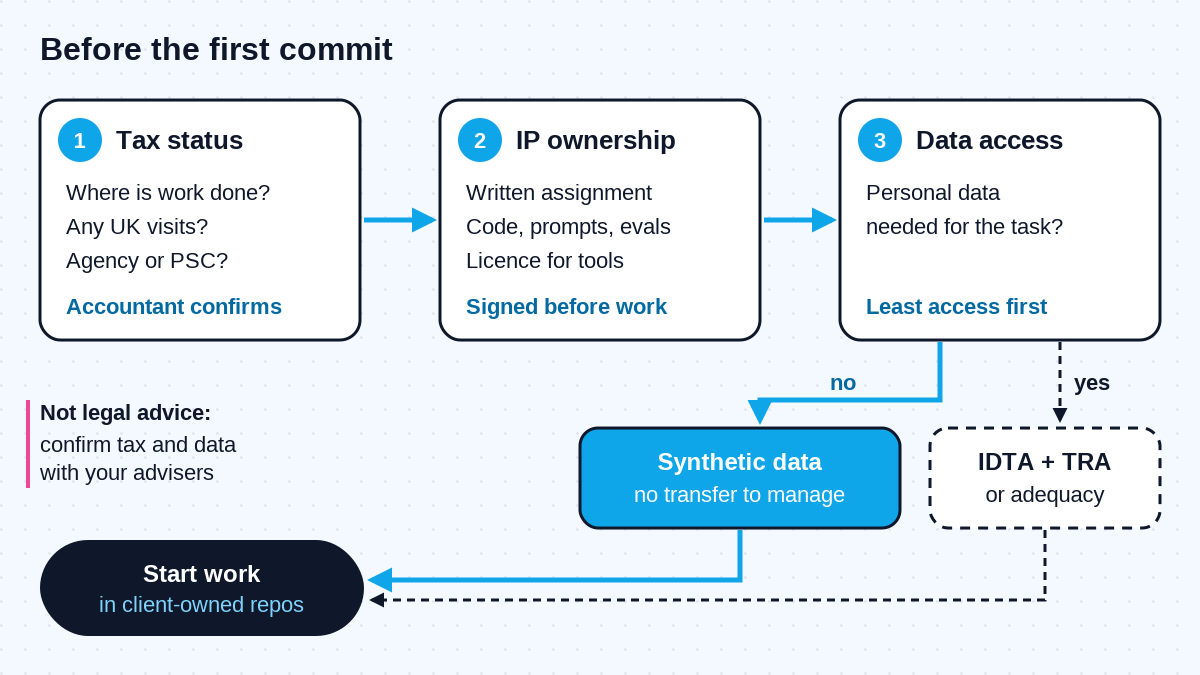
The practical step is to write down where the work is done, how often the developer will visit, and who sits between you, then let your accountant confirm the position. Recheck if any of those facts change.
Who owns the code an overseas developer writes?
The developer does, unless there is a written assignment to your company. Sprintlaw's guide to custom code ownership states that external developers "will usually own the copyright in code they create unless there is a written assignment", and that an assignment generally has to be "in writing and signed by or on behalf of the assignor". It also warns that a brief, proposal or invoice saying "work for hire" may not be enough, and that admin access to the repository does not prove ownership.
For AI projects, the deliverables go beyond application code. I list them explicitly in the contract:
- source code, infrastructure-as-code and deployment scripts,
- prompts, system instructions and agent configurations,
- evaluation sets, test fixtures and labelled examples,
- workflow exports from tools such as n8n or Zapier,
- documentation and architecture diagrams.
Most developers also bring their own reusable tools and snippets. Those usually stay theirs, with a licence to you. Sprintlaw suggests a "perpetual, worldwide, royalty-free licence" for any background IP that ends up in your product. My post on who owns your automations when the freelancer leaves covers the accounts and keys side of this.
Is giving an overseas developer data access a restricted transfer?
Yes, if UK GDPR applies to the data and the developer is a separate legal entity outside the UK. The ICO's international transfers guide treats making personal information accessible to an organisation abroad as a transfer, not only sending it, and uses an example of an overseas customer-services firm in India accessing a UK company's systems. Its three-step test asks whether UK GDPR applies, whether you are initiating the transfer to an organisation outside the UK, and whether the receiver is a separate legal entity. Three yeses mean a restricted transfer.
You then need a transfer tool. The ICO lists UK adequacy regulations first; where none cover the destination, the usual route is an appropriate safeguard such as the International Data Transfer Agreement (IDTA) or the International Data Transfer Addendum, backed by a transfer risk assessment.
The cheaper fix is often to avoid the transfer. On client projects I ask for staging environments with synthetic or anonymised data, and only touch production personal data when a task genuinely needs it. That keeps most of the work outside the transfer question entirely, and it is good security practice anyway. When the AI feature itself sends data to a model provider, the same thinking applies; see my notes on GDPR-safe LLM integration.
What should the contract cover?
A short contract that covers these points does more than a long one that misses them. Sprintlaw's IR35 article lists a contractor agreement, IP assignment, confidentiality terms and a data processing agreement where personal data is involved. This is how I would map each item:
| Clause | Why it matters | What to ask for |
|---|---|---|
| Work location and travel | Drives the IR35 and tax position | Where work is done, expected UK visits, a duty to tell you if that changes |
| IP assignment | Copyright stays with the author otherwise | Written, signed assignment of named deliverables, plus a background IP licence |
| Moral rights | Can limit how you modify the work | A waiver or agreement not to assert, where the law allows |
| Confidentiality | Protects prompts, data and roadmap | Mutual NDA terms that survive the contract |
| Data processing | UK GDPR processor duties | A data processing agreement and the transfer tool, if personal data is accessed |
| Handover | Avoids lock-in | Company-owned repositories, accounts and keys, documented handover |
How do you set up the work to reduce risk?
Most of the risk disappears if the business owns the environment from day one. My standard setup on client work:
- The client creates the repository, cloud account and AI provider account, and invites me.
- API keys live in the client's secret manager, never in my personal accounts.
- Staging uses synthetic data; production access is granted per task and removed after.
- Every change goes through pull requests the client can see.
- Prompts, evaluations and workflows live in the repository, not in a personal dashboard.
None of this is about distrust. It means the business can keep running the system if the developer disappears, which is the right test for any supplier. If you are still choosing someone, my list of questions to ask before hiring an AI developer and the guide to hiring an AI consultant in India cover the vetting side.
Work with me
I work with UK teams from India on AI features and full-stack builds, in client-owned repositories and accounts, with the IP assignment agreed in writing before work starts. The details for UK clients are on my AI developer for UK teams page. See full-stack development and AI integration, or browse my work and book a scoping call.
Frequently asked
Does IR35 apply if I hire a developer based in India?
Generally not if the developer is not UK resident, works wholly outside the UK and is engaged without a UK intermediary, because there may be no UK income tax liability for that work. Regular UK visits, a change of residence or an agency chain can change that, so confirm with your accountant.
Do I own the code if I paid for it?
Not automatically. Under UK law the author usually keeps copyright unless it is assigned in writing and signed. An invoice or a "work for hire" line in a proposal may not be enough. Get a written assignment that names the deliverables, including prompts and evaluation sets.
Is remote access by an overseas developer a data transfer?
The ICO treats making personal information accessible to a separate organisation outside the UK as a restricted transfer. You need a transfer tool such as adequacy regulations or the IDTA, or you can avoid the issue by working with synthetic or anonymised data.
What is the IDTA?
The International Data Transfer Agreement is the UK's standard contract for restricted transfers of personal data. The ICO lists it, alongside the International Data Transfer Addendum and UK binding corporate rules, as an appropriate safeguard where no adequacy regulations cover the destination.
Sources
Related services
Building something like this?
Naman Gundaniya takes on full-stack and AI projects: fixed quote after a free 30-minute scoping call, replies within 24 hours.
Get in touch