 By Naman Gundaniya
Australia's ADM Privacy Rule: What AI Builders Must Change
From 10 December 2026, Australian APP entities that use a computer program to make, or substantially help make, decisions that could significantly affect people must say so in their privacy policy: the kinds of personal information used and the kinds of decisions. For builders, that means an inventory of every automated decision path, logs that show what each one uses, and plain-language policy text.
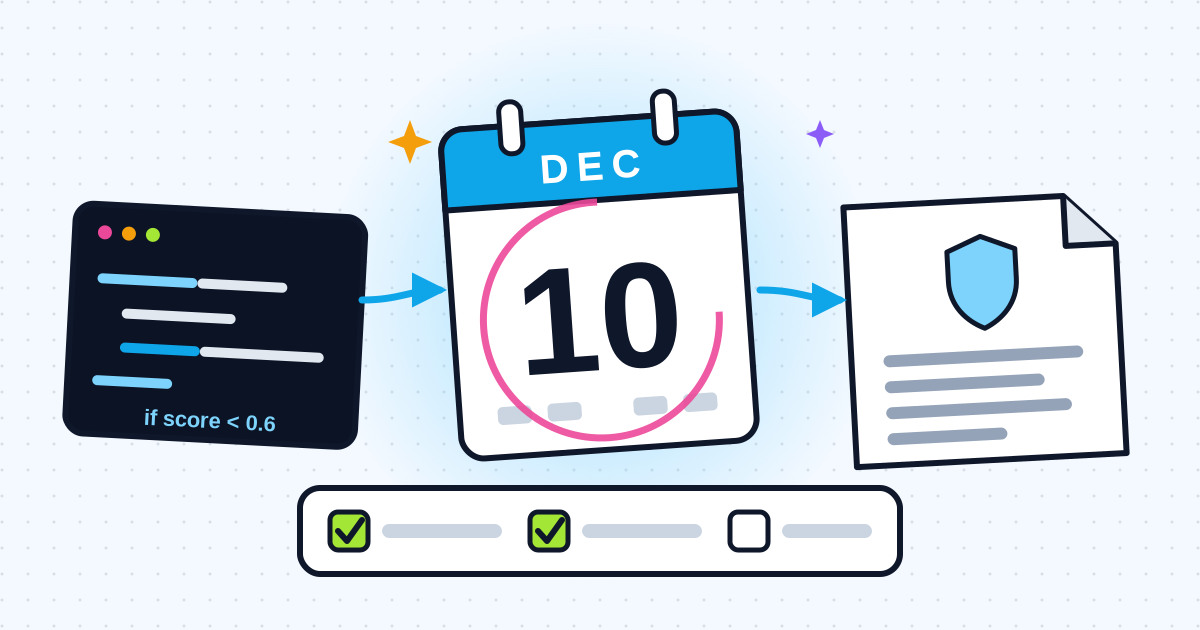
The new rule sits in APPs 1.7 to 1.9 of the Privacy Act, added by the Privacy and Other Legislation Amendment Act 2024. Law firms have covered what the text says. This post covers what I would change in the code and product before the date, because the privacy policy can only describe what the team can actually see.
This is general information, not legal advice. Where your product sits close to a line, get a privacy lawyer to read your inventory.
What does the 10 December 2026 rule require?
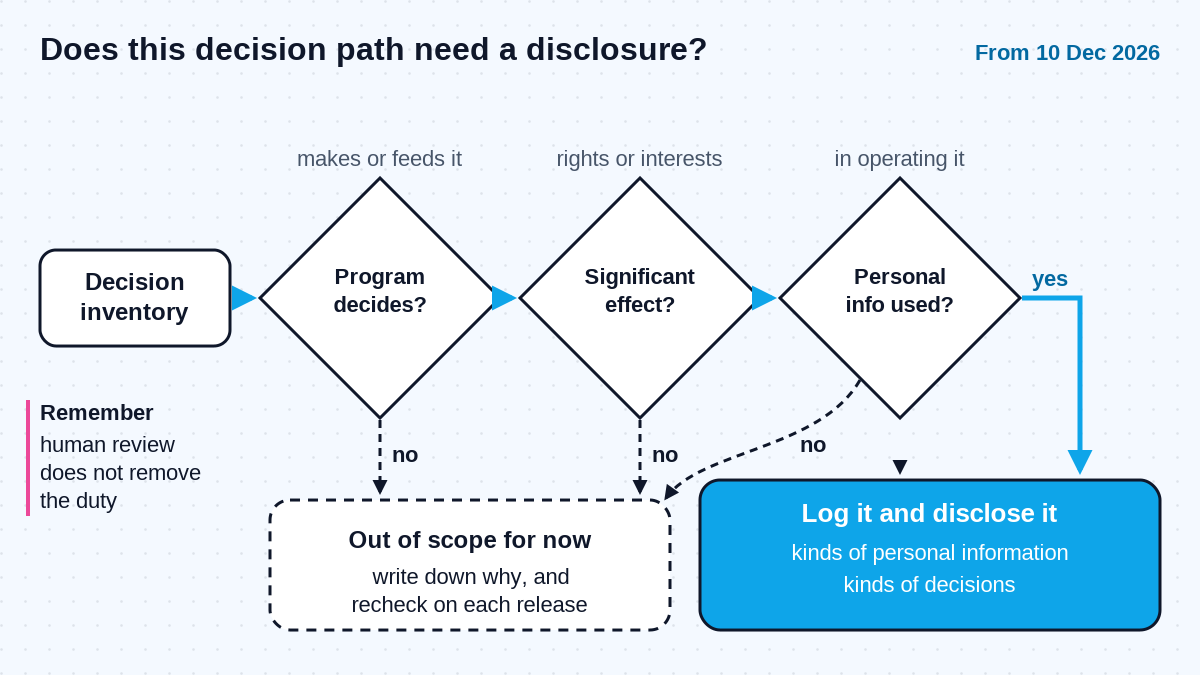
The rule requires a privacy-policy disclosure when three conditions are all met. As Allens summarises the OAIC's final guidance, released on 30 September 2026:
- you have arranged for a computer program to make a decision, or to do a thing "substantially and directly related" to making it,
- the decision could reasonably be expected to significantly affect an individual's rights or interests, and
- personal information about that individual is used to operate the program.
When all three apply, the policy must describe the kinds of personal information used, the kinds of decisions made solely by the program, and the kinds of decisions where the program does a substantially related step. It is a transparency duty only. Allens notes the guidance creates no right to contest a decision and no duty to notify people individually.
Three points from the guidance matter most to builders:
- "Computer program" is broad. It covers rule-based tools, machine learning, spreadsheets and generative AI, and simple long-standing tools can be captured.
- A human in the loop does not take you out of scope. If a program's output is a material input to the decision, it is likely captured regardless of human oversight. HWL Ebsworth makes the same point: the software "need not exercise independent judgment or autonomy".
- Using a vendor does not move the duty. The obligation sits with the business that uses the tool, so you may need information from suppliers about decisions their product makes inside yours.
Which AI features are likely to be in scope?
Features that decide access to something that matters, or that change prices or terms for a person, are the likely candidates. Corrs lists the kinds of significant effects the regulator has pointed to: refusing a benefit, decisions affecting contractual rights, access to significant services such as healthcare, credit, banking, education, telecommunications or utilities, and differential pricing aimed at individuals. Corrs also notes that significance "is not binary, but a spectrum influenced by context".
| Feature | Example | Likely position |
|---|---|---|
| Eligibility or approval scoring | A model ranks loan or rental applications | Likely in scope |
| Screening job applicants | An LLM shortlists CVs for a recruiter | Likely in scope, even with a human reviewer |
| Personalised pricing | Rules set a premium or discount per customer | Likely in scope |
| Account suspension | A fraud score freezes an account | Likely in scope |
| Support triage | A classifier routes tickets to a queue | Probably not, unless routing denies service |
| Drafting replies | An assistant drafts text a person edits | Usually not a decision about the individual |
The table is a starting point, not a ruling. The same feature can move columns depending on what happens next: a support classifier that sends some customers to a "no refund" path is doing something different from one that picks a queue.
Step 1: build a decision inventory from the code, not from memory
A decision inventory is a list of every code path where software makes or materially shapes an outcome for a person, with the data it uses. On client projects I build it from the repository and the running system, because a list written from memory misses the old rules engine and the vendor feature someone switched on last year.
What I look for:
- calls to model APIs, scoring services and rules engines, and what is done with the result,
- conditionals that branch on a score, flag or classification (approve, decline, hold, price tier),
- scheduled jobs that change account status in bulk,
- third-party tools with built-in automation: CRM lead scoring, fraud screening, applicant tracking,
- spreadsheets and scripts that feed decisions outside the main app.
For each entry, record the decision type, the personal information fields that reach the program, who acts on the output, and whether a person can change the result. HWL Ebsworth also flags shadow IT: staff using AI tools the business has not approved. An AI usage policy is the cheapest way to surface those.
Step 2: log enough to describe each decision honestly
If you cannot say which fields went into a decision, you cannot describe the "kinds of personal information" in your policy with confidence. For each in-scope path I add a small structured log record: decision type, model or rule version, the names (not values) of input fields, the outcome, and whether a person reviewed or changed it.
This does three jobs at once. It lets the privacy-policy text be accurate, it gives you evidence if the regulator or a customer asks, and it is the same tracing you need to debug the feature anyway. My guide to observability for LLM apps covers how to set it up without logging sensitive values in plain text.
If your human reviewers are meant to be a real check, measure it: how often do they change the outcome? A reviewer who never overrides is a signal worth discussing, even though, under this rule, review does not remove the disclosure duty. The patterns in designing human-in-the-loop approvals help make review meaningful rather than ceremonial.
Step 3: write privacy-policy text people can understand
The policy text should name categories, not algorithms. Allens reports that the guidance does not require technical detail and allows decisions to be grouped, but separate processes with different outcomes or purposes should be identified separately, and sensitive information such as health or biometric data should be called out clearly. Corrs warns that generic statements about "using technology to improve services" will not do.
A structure I find works, one block per decision type:
- What we decide: "Whether to approve an application for [product]."
- How software is involved: "A computer program scores the application; a staff member makes the final decision using that score."
- Personal information used: "Your income, employment status and repayment history with us."
- Who to contact: a link to your privacy contact for questions.
Keep the inventory and the policy in step. I add a check to the release process: a new decision path, or a new input field on an existing one, triggers a review of the policy text.
What happens if the privacy policy is not updated in time?
A privacy policy that does not meet APP 1 can draw regulator action. HWL Ebsworth reports that the OAIC can issue infringement notices for non-compliant privacy policies of up to 200 penalty units, "currently $66,000", per contravention, and that the OAIC has already run a compliance sweep of privacy policies in selected industries in 2026. Penalty figures change with the penalty unit value, so check the current amount with your adviser.
The practical risk for most product teams is less about the fine and more about being unable to answer a simple question from a customer, a partner's due-diligence team or the regulator: "where does software decide things about me?" The inventory answers it.
Work with me
I help teams map where their software makes decisions, add the logging that makes those decisions explainable, and build review steps that work. See AI integration and AI agent development, or browse my work and book a scoping call. I work remotely from India, with overlap across much of the Australian working day.
Frequently asked
When does the Australian automated decision-making rule start?
The transparency obligation in APPs 1.7 to 1.9 starts on 10 December 2026. From that date, an APP entity's privacy policy must describe the kinds of personal information used in, and the kinds of decisions made or substantially assisted by, computer programs whose decisions could significantly affect individuals.
Does a human reviewer take my AI feature out of scope?
Generally not. According to Allens' summary of the OAIC guidance, where a program's output is a material input to the decision, it is likely captured regardless of human oversight. Review is still worth designing well, but it does not remove the disclosure.
Do I need to explain how my model works?
No technical detail is required. The policy must describe the kinds of personal information used and the kinds of decisions, in plain language, with sensitive information called out clearly. Generic wording about "using technology" is not enough.
We use a vendor's AI tool. Is the disclosure their job?
No. The obligation sits with the business that arranged for the program to be used, not with vendors in the supply chain. Ask your suppliers what automated decisions their product makes and what data it uses, and put that in your contracts.
Sources
Related services
Building something like this?
Naman Gundaniya takes on full-stack and AI projects: fixed quote after a free 30-minute scoping call, replies within 24 hours.
Get in touch